
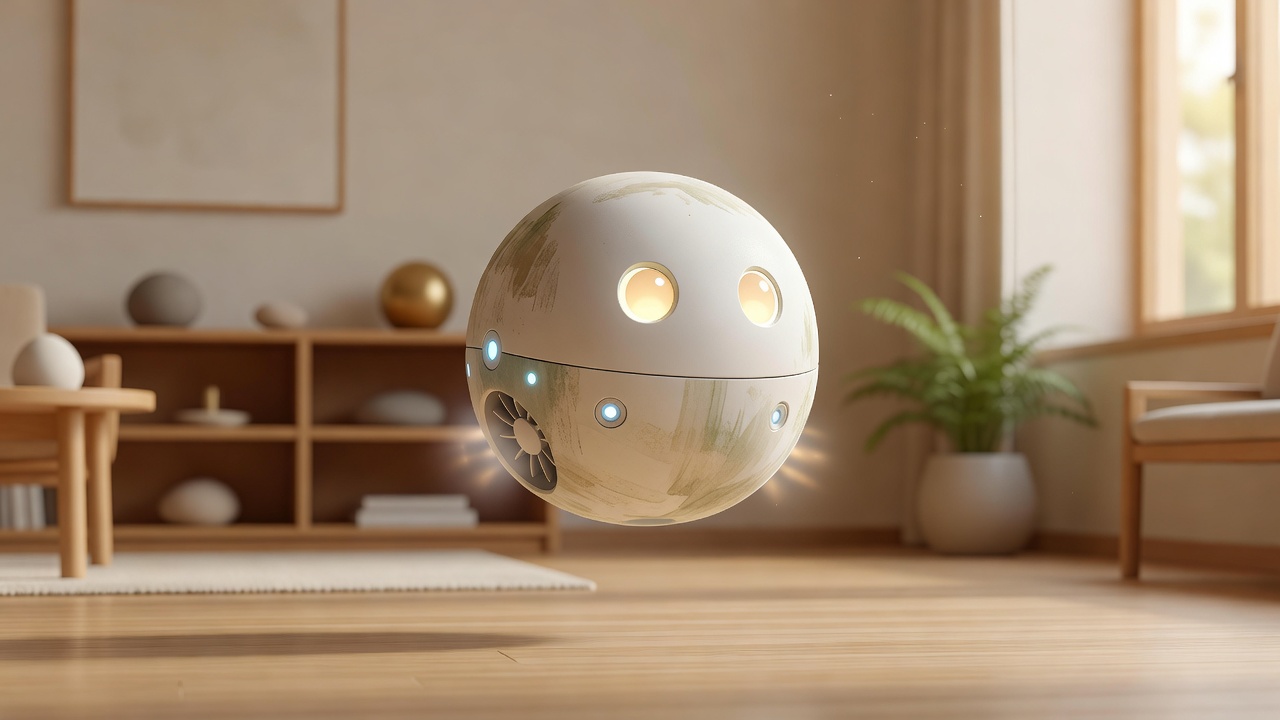
The floating spherical robot known as Lev, developed by a team at the University of Tokyo, immediately calls to mind the gentle, hand-drawn worlds of Studio Ghibli animations. With its soft white exterior, large expressive eyes, and ability to drift silently through the air, Lev seems less like a piece of engineering and more like a character that wandered out of a film such as *Castle in the Sky* or *Spirited Away*. That resemblance exists by design. The researchers behind the project deliberately drew from the visual language of Japanese animation to create a machine that feels approachable, emotionally engaging, and safe enough for people to welcome into their personal spaces.
At the heart of Lev sits a simple but effective propulsion system built around four small ducted fans arranged inside its spherical shell. These fans allow the robot to hover, move in any horizontal direction, and maintain stability even when faced with minor air currents. The entire structure measures roughly the size of a large beach ball, light enough to float on a cushion of air yet sturdy enough to survive the occasional bump against furniture or walls. Rather than racing toward maximum speed or heavy payload capacity, the creators focused on gentle movement and quiet operation, values that align closely with the peaceful atmosphere found in many Ghibli stories.
The visual design plays an equally important role in how people respond to Lev. The robot features two large circular screens that serve as animated eyes, capable of shifting between curious, happy, sleepy, or concerned expressions. These digital eyes follow people around the room, blink naturally, and react to voice commands or physical touch. A soft LED ring beneath the eyes adds subtle color changes that communicate additional emotional states without relying on spoken language. By borrowing aesthetic cues from beloved animated characters, the team reduced the mechanical coldness often associated with robotics and replaced it with something closer to companionship.
This approach reflects a growing interest in emotional design within human-robot interaction research. People tend to form quicker bonds with machines that look and behave in ways that trigger familiar social responses. The University of Tokyo group, led by assistant professor Yuto Kuroda, studied decades of animation techniques to understand how directors like Hayao Miyazaki create instant empathy for non-human characters. They discovered that rounded shapes, slow deliberate movements, and slightly exaggerated facial expressions consistently produce positive reactions across age groups. Lev puts those observations into physical form.
Beyond its appearance, Lev incorporates several sensors that allow it to understand its environment and the people within it. A small array of cameras and microphones lets the robot recognize basic gestures, detect when someone is speaking to it, and avoid collisions with objects or pets. An internal processor runs lightweight machine learning models trained to interpret emotional cues from tone of voice and body posture. When a user sounds stressed, Lev might float closer, dim its lights, and display a calm expression. If children are playing too roughly nearby, the robot can gently position itself between them and fragile items while maintaining a friendly demeanor.
The project draws explicit inspiration from Studio Ghibli’s approach to technology within its stories. In films such as *My Neighbor Totoro* or *Howl’s Moving Castle*, machines rarely appear threatening. Instead, they often serve as whimsical helpers or mysterious allies that coexist with nature and human emotion. The University of Tokyo team referenced these narratives while developing Lev, aiming to create a robot that feels like it belongs in that same universe. They even consulted with animation experts to ensure the robot’s movements matched the timing and weight found in traditional hand-drawn sequences. The result is a machine that appears to breathe, hesitate, and respond with personality rather than mechanical precision.
Practical applications for such a robot extend beyond simple entertainment. Researchers envision Lev assisting elderly individuals who live alone by providing both practical help and emotional support. The robot could remind users to take medication, alert family members if it detects a fall, or simply offer companionship during quiet evenings. Because Lev floats rather than rolls across the floor, it can navigate cluttered homes more easily than wheeled robots and reach shelves or tabletops without difficulty. Its non-threatening appearance may encourage people who feel uncomfortable around traditional technology to interact with it more freely.
In educational settings, Lev shows promise as an engaging teaching aid. Children often respond enthusiastically to the robot’s animated eyes and gentle movements, making it an effective tool for lessons about science, emotional intelligence, or even basic programming. Teachers have tested early versions in classrooms where students take turns giving Lev instructions or drawing new facial expressions for it to display. The robot’s ability to remember individual students and greet them by name further strengthens its role as a consistent classroom presence.
The development process required solving several technical challenges related to buoyancy and control. Early prototypes proved too heavy to maintain stable flight for more than a few minutes. The team eventually settled on a carbon-fiber frame wrapped in a lightweight foam shell that provides both protection and the necessary aerodynamic properties. Battery life remains a limitation, with current models operating for roughly 45 minutes before needing to return to a charging dock. Future iterations will likely incorporate more efficient motors and possibly wireless charging stations placed throughout a home.
Sound design received careful attention as well. The ducted fans produce a low, almost melodic hum rather than the harsh whine common in many drones. This audio profile was tuned to feel soothing rather than intrusive, another detail borrowed from the ambient soundscapes of Ghibli films. When Lev moves across a room, the noise blends into the background much like wind or distant water, allowing natural conversation to continue uninterrupted.
Public reaction to Lev has been largely positive, with many viewers commenting on its almost magical quality. Videos showing the robot floating alongside children or responding to gentle pets have spread widely across social media platforms. Some observers have noted that Lev triggers the same protective instincts people feel toward small animals or young children. This response aligns with the research team’s goals of creating technology that encourages care rather than domination.
The project also raises interesting questions about the future relationship between humans and intelligent machines. By making Lev adorable and non-threatening, the researchers challenge the common science-fiction trope of robots as cold, metallic beings destined to replace or compete with people. Instead, Lev suggests a model where technology augments human experience through emotional connection. This direction feels particularly relevant in Japan, where an aging population and cultural appreciation for anthropomorphic characters have created fertile ground for socially assistive robots.
Looking ahead, the University of Tokyo team plans to expand Lev’s capabilities while preserving its core character. Upcoming versions may include modular attachments for carrying small objects, more sophisticated language understanding, and the ability to project simple holographic images. The researchers emphasize that any new features must serve the robot’s fundamental purpose as a gentle companion rather than transforming it into a multipurpose gadget.
Collaboration with Studio Ghibli itself remains an intriguing possibility, though no official partnership has been announced. The animation studio has historically maintained strict control over its intellectual property, yet the clear visual connections between Lev and Ghibli’s aesthetic suggest at least informal influence. Some concept art for the robot even features background elements reminiscent of the lush, detailed environments found in Miyazaki’s films.
The story of Lev illustrates how inspiration from art can guide technological development in unexpected directions. Rather than focusing solely on speed, efficiency, or raw computing power, the creators asked what a robot should feel like to be around. Their answer, drawn from decades of animated storytelling, resulted in a machine that seems to carry its own small spark of life. As Lev continues to evolve, it may help redefine expectations about what robots can be, not just as tools but as gentle presences that enrich daily life.
The floating sphere serves as a reminder that successful technology often balances capability with humanity. Its expressive eyes, quiet movement, and thoughtful design demonstrate that machines need not intimidate or overwhelm to be useful. By embracing the visual grammar of Studio Ghibli, the University of Tokyo researchers created something that feels less like an invention and more like a friend who happens to run on electricity and code. In a world increasingly filled with screens and algorithms, Lev offers a different vision of technological progress, one that drifts softly into our lives and invites us to drift along with it.


 WebProNews is an iEntry Publication