
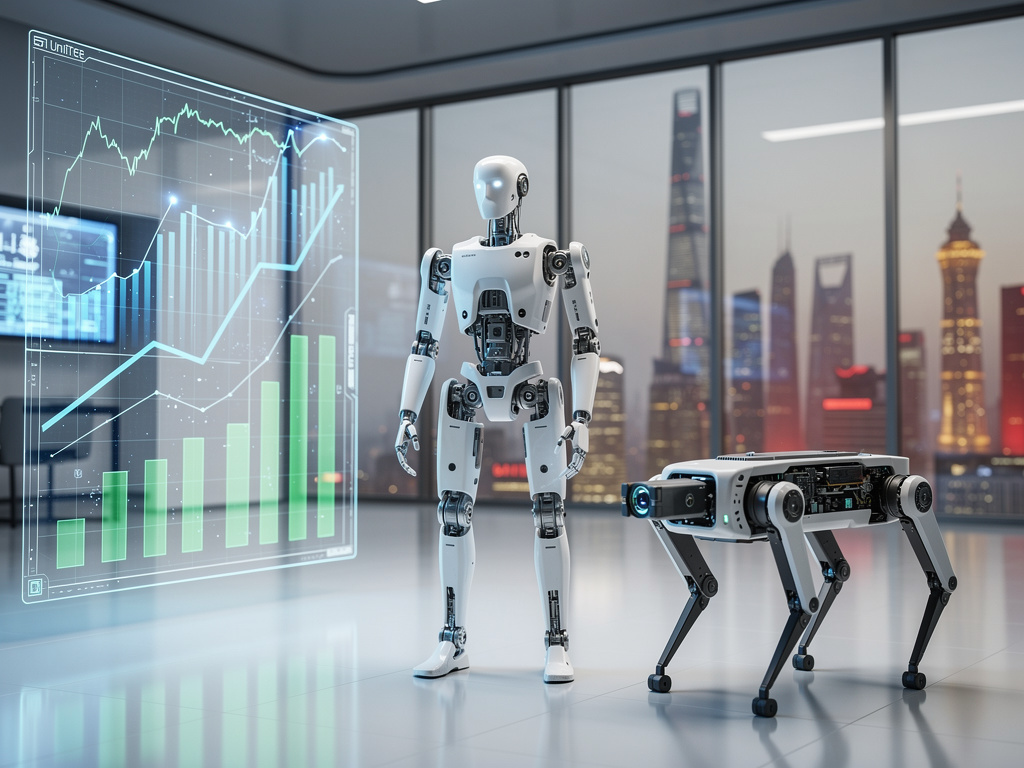
A Chinese robotics company best known for viral videos of its machines doing backflips and pouring beer now wants to raise serious money on the public markets. Unitree Robotics, the Hangzhou-based maker of humanoid and quadruped robots, is seeking to raise approximately 4.4 billion yuan — roughly $610 million — through an initial public offering on the Shanghai Stock Exchange’s STAR Market, according to The Information. If successful, it would mark one of the most significant robotics listings in China this year and a major validation of Beijing’s aggressive push into humanoid technology.
The timing isn’t accidental.
China’s government has made humanoid robots a strategic priority, embedding them into its industrial policy alongside semiconductors and artificial intelligence. The country’s Ministry of Industry and Information Technology issued guidelines in late 2023 calling for mass production of humanoid robots by 2025 — a target that seemed wildly ambitious at the time but now looks less so as companies like Unitree accelerate commercialization. Provincial governments have followed with their own subsidies and incentive programs, creating a funding environment where robotics startups can attract capital at valuations that would raise eyebrows in Silicon Valley.
Unitree, founded in 2016 by Wang Xingxing, a former student at Shanghai University, started with quadruped robots — dog-like machines that could run, jump, and navigate rough terrain. The company’s Go1 robot dog, priced at around $2,700, became something of a sensation when it launched, dramatically undercutting competitors like Boston Dynamics, whose Spot robot sells for $74,500. That aggressive pricing strategy became Unitree’s calling card: make robots cheap enough that researchers, developers, and even consumers could actually buy them.
But the company’s ambitions have grown well beyond four-legged machines. Unitree’s G1 humanoid robot, unveiled in 2024, stands about 4.3 feet tall and is priced starting at $16,000 — a fraction of what competitors charge. The H1, a larger humanoid platform, has demonstrated impressive agility in videos that have racked up millions of views on social media. These machines can walk, run, handle objects, and perform tasks that, even two years ago, seemed confined to research labs.
The proposed IPO on the STAR Market is strategic. Shanghai’s STAR board was designed specifically for technology and innovation companies, modeled loosely on Nasdaq, with more relaxed profitability requirements than China’s main boards. It’s become the preferred listing venue for Chinese companies in AI, semiconductors, and advanced manufacturing. For Unitree, the choice signals both an intent to position itself as a core technology company and a recognition that the STAR Market’s investor base is more receptive to high-growth, pre-profit or low-profit tech firms.
Details on Unitree’s financials remain sparse. The company has not disclosed revenue figures publicly, and its prospectus filings aren’t yet available for review. What is known: Unitree completed a Series C funding round earlier, reportedly at a valuation exceeding $1 billion, with backing from investors including Shunwei Capital and Source Code Capital. The $610 million IPO target suggests the company is seeking a substantially higher public market valuation, likely in the range of several billion dollars.
The broader context matters enormously here. China’s humanoid robot sector has exploded over the past 18 months. Companies like UBTECH Robotics, which listed in Hong Kong in December 2023, Fourier Intelligence, Galbot, and Agibot are all racing to develop commercially viable humanoid platforms. UBTECH’s stock has been volatile since listing but has attracted significant retail investor interest, reflecting the speculative fervor around the sector. Meanwhile, state-backed entities are pouring money into humanoid research — the city of Beijing alone has established a dedicated humanoid robot innovation center with government funding.
And it’s not just a Chinese story. Globally, the humanoid robot market has attracted extraordinary attention from investors and industrial giants alike. Tesla’s Optimus program continues to advance, with Elon Musk claiming the robots could begin performing factory tasks internally this year. Figure AI raised $675 million in early 2024 at a $2.6 billion valuation, with backing from Jeff Bezos, Microsoft, and Nvidia. Agility Robotics, backed by Amazon, has been testing its Digit robot in warehouse environments. The race is global, well-funded, and intensifying by the quarter.
What distinguishes Unitree in this crowded field is its pricing philosophy. Where Western humanoid companies tend to target enterprise customers with robots costing six figures or more, Unitree has consistently pushed for consumer-accessible price points. The G1 at $16,000 isn’t cheap by consumer electronics standards, but it’s remarkably inexpensive for a bipedal humanoid robot with real manipulation capabilities. This approach mirrors China’s broader manufacturing advantage — the ability to produce sophisticated hardware at scale and at costs that Western competitors struggle to match.
That said, there are real questions about whether these low prices can sustain a profitable business. Humanoid robots are extraordinarily complex machines requiring advanced actuators, sensors, compute hardware, and software stacks. Margins on hardware are typically thin, and the software and services layers that could generate recurring revenue are still nascent across the industry. Unitree’s path to profitability — or even to sustainable unit economics — remains unproven.
The STAR Market listing also comes at a moment of shifting sentiment in Chinese capital markets. After a prolonged downturn, Chinese equities have shown signs of recovery in 2025, aided by government stimulus measures and a partial thaw in U.S.-China trade tensions. IPO activity on the STAR Market, which had slowed significantly in 2023 and early 2024 as regulators tightened listing approvals, has begun to pick up again. Regulators appear more willing to greenlight offerings from companies in sectors aligned with national strategic priorities — and humanoid robotics sits squarely in that category.
For investors considering Unitree’s IPO, the key question is straightforward: how big is the addressable market, and how quickly will it materialize? Consulting firm Goldman Sachs has projected the global humanoid robot market could reach $38 billion by 2035, while more bullish estimates from Chinese brokerages put the figure significantly higher. But projections for nascent technology markets are notoriously unreliable. The actual commercial deployment of humanoid robots — in factories, warehouses, healthcare facilities, and homes — is still in its earliest stages. Most humanoid robots in operation today are prototypes, demonstration units, or pilot deployments.
Unitree does have one advantage that’s hard to replicate: speed. The company has moved from concept to commercial product faster than nearly any competitor in the humanoid space. Its quadruped robots are already generating revenue and being used by researchers and developers worldwide. The humanoid line, while newer, has progressed rapidly from lab demonstrations to purchasable products. In a sector where most companies are still burning through venture capital with little to show in terms of shipped units, Unitree’s track record of actually getting products into customers’ hands is notable.
There’s also the question of geopolitics. Chinese robotics companies face increasing scrutiny from Western governments concerned about technology transfer, data security, and the military applications of advanced robots. The U.S. has already imposed restrictions on Chinese access to advanced AI chips, and there’s growing discussion in Washington about whether humanoid robots should fall under similar export control frameworks. For Unitree, which has sold robots to customers globally, any tightening of trade restrictions could limit its international market opportunity.
So what happens next? Unitree will need to file its prospectus with the China Securities Regulatory Commission and the Shanghai Stock Exchange, undergo a review process that typically takes several months, and then price and launch the offering. If all goes smoothly, the IPO could happen in the second half of 2025. But Chinese IPO timelines are notoriously unpredictable, subject to regulatory windows, market conditions, and political considerations that can delay or derail even well-prepared offerings.
The company’s listing would also serve as a bellwether for the broader Chinese humanoid robot sector. A successful, well-received IPO could open the floodgates for other companies — Agibot, Galbot, and others — to pursue their own public listings. A disappointing debut, on the other hand, could cool investor enthusiasm for a sector that has attracted enormous speculative interest but limited commercial proof points.
One thing is clear: the money flowing into humanoid robotics — in China and globally — shows no sign of slowing. Unitree’s IPO bid is both a product of that momentum and a test of its durability. The company has built real products, attracted real customers, and now seeks real public market capital. Whether the market rewards that ambition at the valuation Unitree is seeking will say a great deal about where the robotics industry is headed — and how much faith investors are willing to place in machines that walk like humans but don’t yet think like them.


 WebProNews is an iEntry Publication