
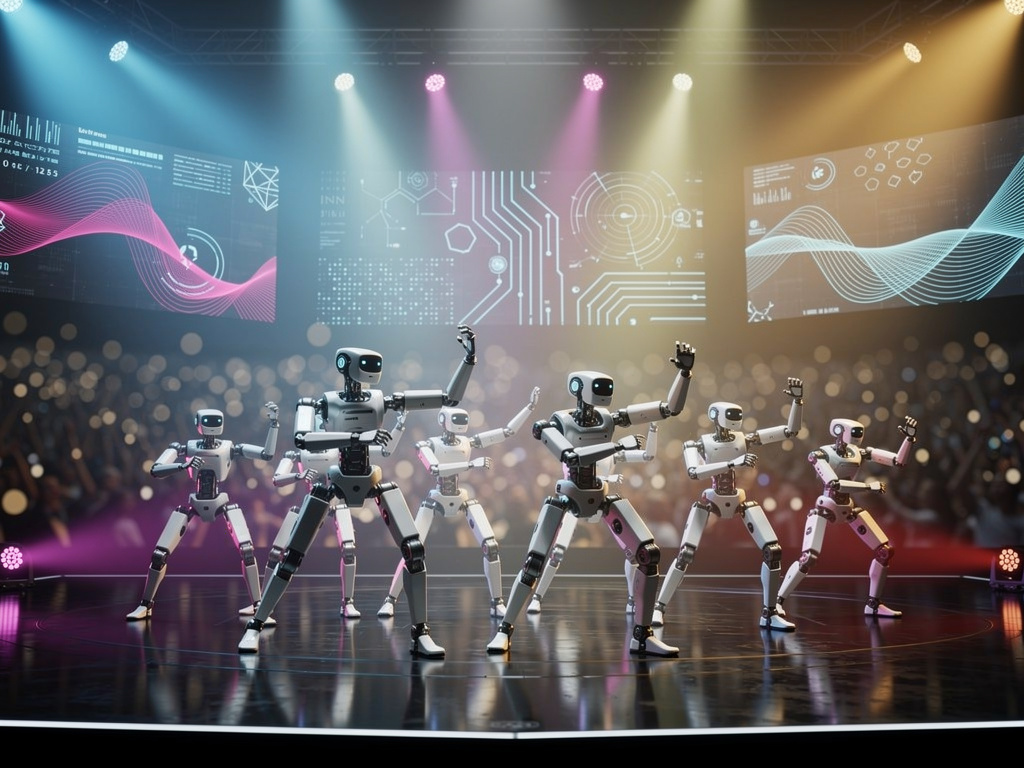
Robotic Choreography: Machines Sync Up to Revolutionize Concert Stages
In a dazzling display of technological prowess, a fleet of humanoid robots recently took center stage—or rather, the backup spots—during a high-energy concert in China. The event, featuring singer Wang Leehom, showcased Unitree’s G1 robots executing precise dance moves, including synchronized front flips, alongside human performers. This performance, held at the Chengdu Dong’an Lake Sports Park Multifunctional Gymnasium, drew an 18,000-strong audience and highlighted a burgeoning trend where machines are not just tools but active participants in live entertainment.
The robots, clad in baggy pants and sparkling overshirts, blended seamlessly with their human counterparts, their movements programmed to mimic complex choreography. This wasn’t a mere gimmick; it represented a leap in robotic coordination and agility, underscoring China’s rapid advancements in humanoid robotics. As reported in Futurism, the G1’s debut has sparked widespread online buzz, with videos circulating that capture the robots’ uncanny ability to keep rhythm and perform acrobatics in unison.
Beyond the spectacle, this integration raises questions about the future of performance arts. Industry experts note that such developments could reshape how concerts are produced, potentially reducing costs associated with human dancers while introducing new creative possibilities. However, it also prompts concerns about job displacement in an already competitive field.
Technological Foundations Behind the Moves
At the heart of these robotic dancers is sophisticated engineering from Unitree, a Chinese company known for its agile quadruped and bipedal robots. The G1 model, in particular, boasts advanced joint articulation and balance systems that allow for fluid, human-like motions. Drawing from research in robotics and AI, these machines use algorithms to synchronize with music beats and adapt to stage dynamics in real time.
A study published in Frontiers in Computer Science explores the challenges of making robots dance expressively, emphasizing the need for responsive AI that captures aesthetic qualities like rhythm and emotion. The paper surveys methods for enhancing robot-human interaction in performances, suggesting that future systems could improvise based on live cues, much like the G1’s programmed routines.
Moreover, insights from social media platforms reveal growing excitement and debate. Posts on X, formerly Twitter, highlight similar innovations, such as AI frameworks that enable robots to copy elite dance movements, pointing to collaborations between researchers at Carnegie Mellon University and NVIDIA. These discussions underscore a shift toward more autonomous robotic performers.
Historical Context and Evolution
The use of robots in entertainment isn’t entirely new. Early examples date back to animatronic figures in theme parks, but recent years have seen a surge in sophisticated applications. For instance, Boston Dynamics’ Spot robots have appeared in viral dance videos, demonstrating early potential for rhythmic coordination.
In the music industry, artists like Hatsune Miku have popularized virtual performers, but physical robots add a tangible dimension. The Wang Leehom concert builds on this, as detailed in coverage from DNYUZ, which notes the G1’s internet fame from activities like shooting hoops, now extended to stage antics.
This evolution ties into broader AI advancements. A paper from PMC, accessible via PMC, discusses how cues to human-like qualities in dancing robots influence audience engagement, shaping aesthetic preferences in art consumption.
Implications for the Entertainment Sector
For concert promoters and artists, robotic backup dancers offer reliability and scalability. Unlike humans, robots don’t tire, forget steps, or demand salaries, potentially lowering production expenses for large tours. Wang Leehom’s “Best Place Tour” exemplifies this, blending technology with live music to create memorable experiences, as boasted on the singer’s website.
However, insiders worry about the human element. Choreographers and dancers fear that machines could commoditize their craft, reducing opportunities for creative expression. Posts on X reflect this sentiment, with users joking about dancers losing jobs while others praise the innovation for enhancing shows.
Economically, the service robotics market is booming. According to a report from GlobeNewswire, the sector is projected to exceed $168 billion by 2033, driven by applications in entertainment and hospitality. This growth suggests robots will become fixtures in venues worldwide.
Challenges in Robotic Performance Design
Developing dancing robots involves overcoming significant hurdles, including hardware limitations and software complexity. The G1’s ability to perform front flips requires precise gyroscopic sensors and machine learning models trained on vast datasets of human motion.
Research from sources like Yahoo News Singapore describes the concert’s coordination as an “impressive feat,” highlighting years of progress in Chinese robotics. Yet, ensuring robots respond to unpredictable elements, such as crowd energy or stage mishaps, remains a work in progress.
Additionally, aesthetic integration is key. A post on X about “DisCo,” a framework for generating human dance via AI, illustrates efforts to disentangle control in real-world scenarios, allowing for more natural interactions between robots and performers.
Global Perspectives and Competitive Dynamics
China’s lead in this arena is evident, with companies like Unitree pushing boundaries. Coverage in Petra the Spectator frames these dancing robots as symbols of technological dominance, blending culture and innovation to captivate global audiences.
In contrast, Western firms are catching up. NVIDIA’s AI tools, mentioned in X posts, enable robots to mimic athletic dances, potentially leading to cross-cultural collaborations. The entertainment industry must navigate these dynamics, balancing innovation with ethical considerations.
Market analyses, such as one from OpenPR on Robot as a Service, predict explosive growth, with implications for how performances are monetized and experienced.
Future Trajectories in Performative Robotics
Looking ahead, experts envision robots not just as backups but as lead acts. Imagine AI-generated concerts where machines compose and perform, as speculated in older X posts about AI dominating music by 2030.
Advancements in micro-robotics, like the salt-grain-sized dancing bot reported in Popular Science, hint at even smaller-scale innovations that could revolutionize stage effects.
For industry insiders, the key is adaptation. Training programs might evolve to include robot programming alongside traditional dance, fostering hybrid talents.
Ethical and Societal Considerations
Amid the excitement, ethical debates simmer. Will robotic performers dilute the authenticity of live shows? Audience reactions, gleaned from X sentiments, range from awe to apprehension, with some calling for regulations to protect human jobs.
In hospitality, similar robots are proliferating, as per a DataM Intelligence report on OpenPR, suggesting a broader societal shift toward automation.
Ultimately, the fusion of robotics and entertainment could democratize access to high-quality performances, but it demands careful stewardship to preserve cultural values.
Innovative Applications Beyond Concerts
The technology powering these dancers extends to other fields. In factories, coordinated robot arms perform “ballets” of assembly, as depicted in X videos, improving efficiency.
In education, robots could teach dance, making arts more accessible. Research on expressive robotics, like that in the Frontiers study, supports this potential.
Moreover, AI’s role in music generation, as forecasted in X discussions, could lead to entirely synthetic bands, challenging traditional notions of artistry.
Economic Ripples and Investment Trends
Investors are taking note. The AI robots market, projected to reach $38 billion by 2031 according to another OpenPR analysis, attracts funding for entertainment applications.
For the music industry, this means new revenue streams, such as robot rentals for events, akin to Robot as a Service models.
Challenges include high initial costs and the need for specialized programming, but declining prices could accelerate adoption.
Cultural Impact and Audience Reception
Culturally, robotic dancers bridge technology and tradition. Wang Leehom’s performance, echoed in Yahoo coverage, marks a milestone in this integration.
Audience feedback on X praises the novelty, with videos amassing views, indicating strong appeal among tech-savvy demographics.
As robots become more emotive, they might evoke deeper connections, transforming how we perceive performance art.
Strategic Recommendations for Industry Players
For artists and producers, embracing this tech involves partnerships with robotics firms. Experimenting with hybrid shows could set trends.
Policymakers should consider labor protections, ensuring automation enhances rather than replaces human creativity.
In the end, robotic choreography promises to enrich the entertainment realm, provided it’s pursued thoughtfully.


 WebProNews is an iEntry Publication