
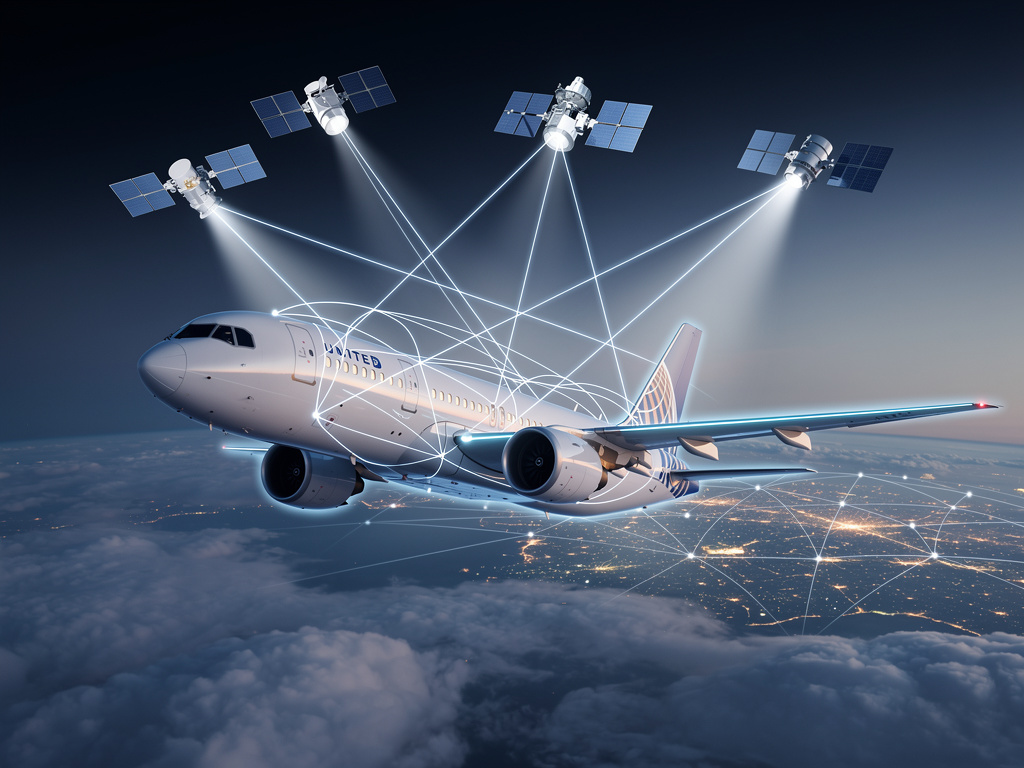
United Airlines is taking an unusual step this Sunday, devoting millions of dollars in Super Bowl advertising real estate not to promote its own brand, but to showcase a technology partner: SpaceX’s Starlink satellite internet service. The 30-second commercial represents a strategic inflection point in the aviation industry, where reliable in-flight connectivity has evolved from luxury amenity to essential competitive differentiator—and where United believes it has secured a meaningful advantage over rivals still struggling with legacy systems.
The airline’s aggressive marketing push comes as it completes one of the fastest technology rollouts in commercial aviation history. According to Travel Market Report, United has equipped more than 300 aircraft across its two-cabin regional fleet with Starlink in less than a year, carrying 7 million passengers across 129,000 flights and powering 3.7 million devices in just ten months. The results have been dramatic: Wi-Fi customer satisfaction scores on Starlink-equipped planes nearly doubled during that period, a metric that United executives believe justifies both the capital investment and the Super Bowl advertising expenditure.
The commercial itself, as reported by Tesla North, emphasizes practical use cases that resonate with business travelers and digital nomads—passengers gaming, streaming, and working seamlessly at 35,000 feet. By featuring handheld gaming specifically, United is making a subtle but important technical claim: that Starlink’s low-latency performance exceeds what traditional satellite or air-to-ground systems can deliver. For an industry that has long disappointed customers with connections barely capable of loading email, the message represents a paradigm shift in what airlines believe they can promise.
From Afterthought to Competitive Moat: Why Connectivity Suddenly Matters
The strategic calculus behind United’s Super Bowl investment reflects a fundamental reassessment of what drives airline loyalty in 2025. For decades, carriers competed primarily on routes, schedules, and price, with in-flight amenities occupying a distant secondary tier. But as remote work has normalized and business travelers have gained flexibility in choosing when and how they fly, the ability to remain productive at altitude has become a primary selection criterion for the industry’s highest-value customers.
Industry observers on social media have noted the shift with remarkable candor. One frequent flyer commenting on the announcement via X stated he “swapped to United after 6 years with AA 100% for this reason,” while another directed criticism at Delta, noting that “the internet experience has gone downhill ever since they made it free. Not to mention, no WiFi coverage over the pacific. Terrible for business travelers.” These aren’t isolated complaints—they represent a growing chorus of road warriors making carrier decisions based primarily on connectivity quality rather than traditional loyalty program benefits or route networks.
The competitive implications extend beyond individual traveler preferences. According to posts on X, United is not limiting its Starlink marketing to the Super Bowl spot alone. The airline is reportedly spending several additional millions targeting MileagePlus members and credit card holders specifically, positioning Starlink as “one of the biggest customer value added assets” in its portfolio. This sustained, multi-channel campaign suggests United views its Starlink partnership not as a temporary differentiator but as a durable competitive moat—at least until rivals complete their own satellite connectivity transitions.
The Technical Reality Behind the Marketing Claims
United’s assertion that it offers “the fastest, most reliable high-speed Wi-Fi in the sky” rests on Starlink’s fundamental architectural advantages over competing systems. Traditional in-flight internet relies either on air-to-ground cellular towers (which provide no coverage over oceans and suffer from handoff issues) or geostationary satellites positioned 22,000 miles above Earth (which introduce latency measured in hundreds of milliseconds). Starlink’s low-Earth orbit constellation, by contrast, operates at altitudes between 340 and 550 kilometers, dramatically reducing signal travel time and enabling latency comparable to terrestrial broadband.
The practical impact of these technical differences manifests in use cases that were previously impossible at cruising altitude. Passengers on Starlink-equipped United flights can participate in video conferences, stream high-definition content without buffering, and engage in real-time gaming—activities that remain frustratingly unreliable on competitors’ systems. As one X user observed, “Airlines finally solving the one thing business travelers actually care about: WiFi that doesn’t require blood sacrifices and three reboots to load a Slack message.”
United’s rollout velocity itself deserves scrutiny. Equipping 300 regional aircraft in under a year represents a logistics and engineering achievement that few airlines could replicate. The carrier has announced plans to extend Starlink to more than 500 mainline aircraft by the end of 2026, which would bring the total number of equipped planes across its fleet to over 800—representing a substantial majority of its operational aircraft. Today, more than 25% of United’s daily departures already offer Starlink connectivity, a penetration rate that gives the airline a significant first-mover advantage in marketing and customer perception.
Competitive Pressure Mounts as Rivals Lag Behind
The enthusiasm surrounding United’s Starlink deployment has intensified pressure on competing carriers, particularly those that committed to alternative connectivity solutions or delayed satellite upgrades. Delta Air Lines, which offers complimentary Wi-Fi across its domestic fleet, has faced mounting criticism from business travelers who report degraded performance since the service became free—a predictable outcome when usage increases without corresponding capacity expansion. The carrier’s lack of coverage over Pacific routes remains a particular pain point for travelers on lucrative transpacific business routes where productivity during flight time commands premium value.
American Airlines faces similar scrutiny, with passengers on social media lamenting the carrier’s decision not to partner with SpaceX. One X user bluntly stated that “@AmericanAir screwed up not going with @SpaceX @Starlink,” reflecting a growing perception that the carrier has fallen behind in a technology race it may not have initially recognized as strategically critical. Both Delta and American have existing partnerships with other connectivity providers—relationships that may prove difficult to unwind even as Starlink’s performance advantages become increasingly apparent to traveling customers.
International carriers face their own calculus. Ryanair, Europe’s largest low-cost carrier, has publicly questioned whether the performance benefits of satellite internet justify the installation costs and aerodynamic drag penalties. However, X users have pushed back on this reasoning, suggesting that Ryanair should “talk to @united on the extra drag coefficient the starlink terminals actually produce instead of guessing it wouldn’t be worth it.” The exchange highlights a broader industry debate about whether premium connectivity will remain a differentiator for full-service carriers or eventually become table stakes across all airline segments, including ultra-low-cost operators.
The Economics of Satellite Connectivity: Investment vs. Return
United’s willingness to dedicate Super Bowl advertising dollars to a partner’s technology rather than its own brand raises questions about the underlying economics of the Starlink relationship. While neither United nor SpaceX has disclosed the financial terms of their partnership, industry analysts estimate that equipping an aircraft with Starlink hardware costs between $100,000 and $250,000 per plane, with additional ongoing service fees. For United’s planned 800-aircraft deployment, the total capital investment could exceed $200 million—a substantial commitment that requires clear return-on-investment justification.
The business case appears to rest on multiple revenue and cost-avoidance pillars. First, superior connectivity enables United to command premium pricing from business travelers and potentially justify higher fares on competitive routes. Second, improved customer satisfaction scores translate to increased loyalty program engagement and reduced customer acquisition costs. Third, reliable internet enables ancillary revenue opportunities, from paid premium bandwidth tiers to partnerships with streaming services and gaming platforms. Finally, by positioning itself as the connectivity leader, United may attract corporate travel contracts specifically because of its technological edge—a B2B benefit that doesn’t appear in consumer-facing metrics but drives substantial revenue.
Critics have questioned whether advertising a “default service that people receive when trapped in flying objects” represents responsible capital allocation, as one X user sarcastically noted. However, this perspective underestimates the strategic value of establishing category leadership before competitors can respond. Super Bowl advertising reaches decision-makers at corporations that negotiate airline contracts worth millions annually, and it reinforces United’s positioning among frequent flyers who influence those corporate decisions. The commercial serves dual purposes: building consumer awareness while signaling to business travel managers that United has solved a problem that competitors have not.
Starlink’s Expanding Aviation Footprint and SpaceX’s Strategic Play
United’s deployment represents Starlink’s most visible aviation partnership, but SpaceX has been methodically building a portfolio of airline customers across multiple continents. Hawaiian Airlines announced its Starlink partnership in 2022 and began service in 2023, while JSX, a semi-private carrier, equipped its fleet even earlier. Qatar Airways, Air France, and several other international carriers have announced plans or pilot programs. Each partnership provides SpaceX with operational data, engineering refinements, and proof points that accelerate adoption across the industry.
For SpaceX, aviation represents a strategic market that extends beyond direct service revenue. Airlines provide high-visibility use cases that demonstrate Starlink’s capabilities to other enterprise customers—cruise lines, maritime shipping, remote industrial operations, and government agencies all face similar connectivity challenges that Starlink’s low-Earth orbit architecture addresses. Every United passenger who successfully streams video or completes a video call at 35,000 feet becomes an informal evangelist for Starlink’s terrestrial and maritime applications. The halo effect of aviation success extends SpaceX’s competitive positioning across multiple market segments.
The aviation market also provides SpaceX with leverage in spectrum allocation and regulatory discussions. As Starlink becomes integral to airline operations—and as passengers come to expect reliable connectivity as a basic service—regulators face increased pressure to allocate spectrum and approve operational parameters that support aviation use cases. United’s Super Bowl commercial, in this context, serves SpaceX’s interests as much as the airline’s, building public awareness and expectation that may influence regulatory outcomes favorable to expanded satellite operations.
What Comes Next: Industry-Wide Transformation or Temporary Advantage?
The central strategic question facing United and its competitors is whether Starlink connectivity represents a durable competitive advantage or merely a temporary lead in an inevitable industry-wide transition. If every major carrier eventually deploys comparable satellite internet—whether through Starlink or competing systems like Amazon’s Project Kuiper or Eutelsat’s OneWeb—then United’s first-mover advantage dissipates, and connectivity becomes an undifferentiated commodity. In this scenario, United’s Super Bowl investment and rapid rollout buy the carrier perhaps 18 to 36 months of differentiation before the competitive playing field levels.
However, several factors suggest United’s advantage may prove more durable than this pessimistic scenario implies. First, Starlink currently maintains a substantial lead in satellite deployment, operational experience, and aviation-specific engineering over potential competitors. Second, airlines that committed to alternative connectivity providers face contractual obligations and sunk costs that complicate rapid transitions, even as Starlink’s performance advantages become apparent. Third, United’s operational experience with Starlink—accumulated across 129,000 flights and millions of passengers—provides institutional knowledge about optimization, troubleshooting, and customer communication that competitors will need years to replicate.
The broader transformation extends beyond individual carriers to reshape passenger expectations and airline economics. As one X commenter observed, Starlink is “making ‘working remotely from 35,000 feet’ actually viable,” which fundamentally alters the value proposition of business travel. If executives can remain fully productive during flight time, the effective cost of business travel decreases, potentially stimulating demand on routes where travel time previously represented pure productivity loss. Airlines that enable this productivity—through superior connectivity—capture a disproportionate share of this expanded demand, creating a virtuous cycle that reinforces their competitive position.
The Super Bowl Gambit: Marketing Strategy or Market Signal?
United’s decision to feature Starlink in Super Bowl advertising represents an unconventional marketing strategy that blurs traditional boundaries between brand promotion and partner endorsement. Airlines typically use premium advertising real estate to showcase destinations, comfort, or service quality—attributes that differentiate their brand from competitors. By instead highlighting a technology partner’s capabilities, United is making a calculated bet that connectivity has become so central to customer decision-making that associating its brand with the category leader delivers more value than traditional brand messaging.
The strategy carries risks. If Starlink experiences high-profile service disruptions or technical failures in the weeks following the Super Bowl, United’s brand becomes collaterally damaged by its partner’s performance issues. The airline has effectively tied its reputation to SpaceX’s operational execution—a dependency that introduces vulnerability even as it provides competitive advantage. Moreover, as competitors inevitably deploy their own satellite solutions, United’s messaging may require evolution from “we have Starlink” to more nuanced claims about implementation quality, coverage, or performance—subtleties that prove harder to communicate in 30-second spots.
Yet the Super Bowl commercial also serves as a market signal to competitors, investors, and corporate travel managers that United views connectivity as a strategic priority worthy of its most expensive marketing investment. The ad declares that the era of apologizing for poor in-flight internet has ended, and that airlines will be evaluated—and differentiated—based on their connectivity performance. For an industry that has long under-invested in passenger-facing technology, this represents a meaningful shift in capital allocation priorities and competitive dynamics. Whether other carriers match United’s commitment or cede the connectivity advantage remains the defining question for airline competition in the coming years.


 WebProNews is an iEntry Publication