
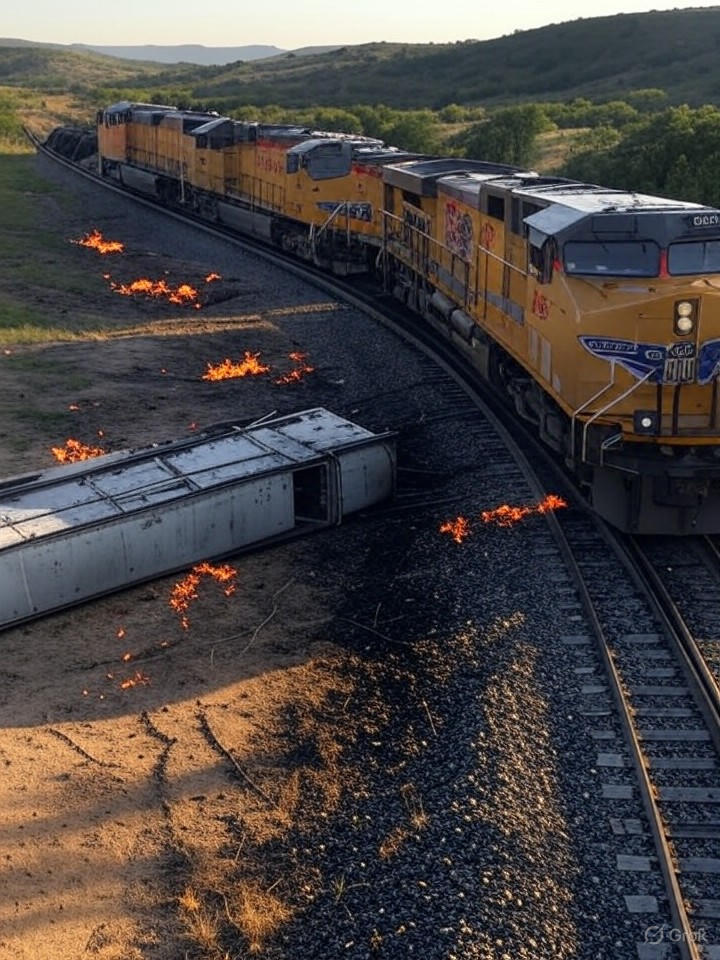
In the quiet rural expanse of Palo Pinto County, Texas, a Union Pacific Railroad train derailed on Tuesday afternoon, sending 35 cars off the tracks in a dramatic incident that has raised fresh concerns about rail safety and hazardous material transport. The derailment occurred around 2 p.m. local time, roughly two miles east of Gordon, a small town with a population of about 460, located approximately 65 miles southwest of Fort Worth. According to Union Pacific spokeswoman Robynn Tysver, no injuries were reported among railroad personnel, and all individuals were accounted for, averting what could have been a more catastrophic event.
Emergency responders quickly mobilized, treating the site as a hazardous materials situation due to the potential contents of the derailed cars. While initial assessments indicated no leaks from the cars, the Palo Pinto County Emergency Services District 1 emphasized in a social media post that the situation remained under close monitoring. News footage captured the chaotic scene: mangled rail cars piled atop one another, with sparks igniting small grass fires nearby, which firefighters worked to contain. This incident echoes broader industry challenges, as rail operators grapple with aging infrastructure and increasing scrutiny following high-profile accidents.
The Immediate Response and Containment Efforts
Union Pacific, one of North America’s largest freight railroads, confirmed the derailment in a statement, noting that crews were on-site to assess damage and begin cleanup. The company did not immediately disclose the exact cargo, but sources familiar with the operation suggested the train may have been carrying potentially hazardous materials, prompting the hazmat alert. As reported by Reuters, emergency officials reiterated that no leaks were detected, providing a measure of relief in a region where environmental risks could amplify quickly.
The absence of evacuations was a key factor in maintaining public calm, with local authorities assuring residents that the site was stable, though not fully controlled. This cautious approach aligns with protocols refined after events like the 2023 East Palestine, Ohio, derailment, which involved toxic chemicals and led to widespread evacuations. Industry insiders point out that Union Pacific’s rapid response—coordinating with local fire departments and hazmat teams—demonstrates improvements in emergency preparedness, yet questions linger about preventive measures.
Broader Implications for Rail Safety Standards
Drawing from recent coverage, the incident has spotlighted ongoing debates over railroad safety regulations. A Newsweek article highlighted how such derailments keep public and regulatory attention fixed on safety standards, especially amid a surge in freight volumes. Union Pacific, which operates over 32,000 miles of track, has invested heavily in technology like positive train control systems to mitigate risks, but critics argue that track maintenance in rural areas like Palo Pinto County often falls short.
Federal agencies, including the National Transportation Safety Board (NTSB), are likely to investigate the cause, which remains unclear. Preliminary reports suggest no foul play, but factors such as track conditions, mechanical failure, or human error could be at play. In a post on X by user Karli Bonne’ (@KarluskaP), shared widely with over 4,000 views, details mirrored official accounts, emphasizing the grass fires and lack of injuries, reflecting real-time public sentiment and the role of social media in disseminating crisis information.
Industry Context and Economic Ramifications
For rail industry executives, this derailment underscores the economic stakes: disruptions can halt supply chains, affecting commodities transport across the Southwest. Union Pacific’s network is vital for moving goods from Texas ports to inland hubs, and any prolonged downtime could ripple through sectors like agriculture and manufacturing. According to U.S. News & World Report, the rural location minimized immediate human impact, but cleanup costs and potential environmental assessments could run into millions.
Comparisons to past incidents reveal patterns; for instance, a WFAA report noted similarities to other Texas derailments, where hazardous cargo heightened response complexity. Insiders speculate that if hazardous materials were indeed involved—possibly chemicals or fuels—the incident could prompt renewed calls for stricter federal oversight, including mandatory cargo disclosures during emergencies.
Looking Ahead: Prevention and Policy Shifts
As cleanup progresses, Union Pacific has pledged full cooperation with investigators, a stance echoed in statements to outlets like Investing.com. The company’s track record shows a decline in derailments over the past decade, thanks to predictive analytics and infrastructure upgrades, yet events like this highlight vulnerabilities in less-trafficked rural lines.
For policymakers, the Gordon derailment may accelerate discussions on rail modernization bills pending in Congress, potentially mandating enhanced monitoring for hazmat trains. Local communities, meanwhile, are left reflecting on their proximity to such risks, with emergency districts praising the “lots of reasons to be thankful” for the contained outcome, as per WFAA. Ultimately, this incident serves as a stark reminder that while rail transport remains efficient, the margin for error in handling potential hazards demands unwavering vigilance from operators and regulators alike.


 WebProNews is an iEntry Publication