
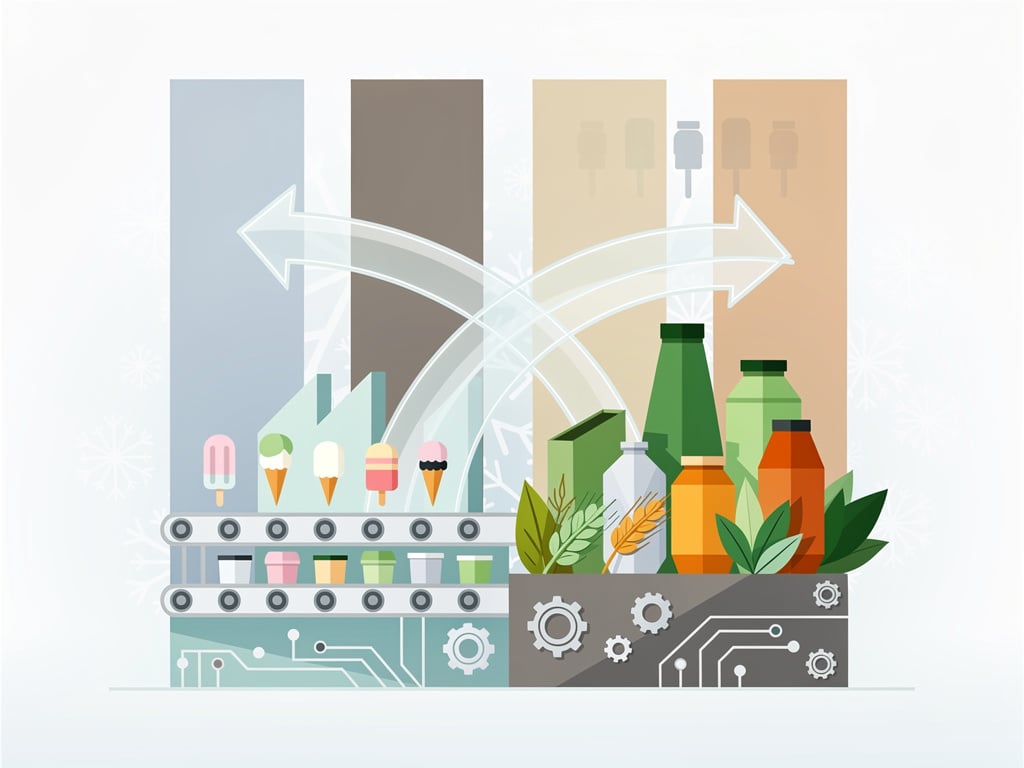
Unilever is preparing to consolidate its food businesses into one combined unit — a move that sounds like routine corporate housekeeping but is anything but. The London-headquartered consumer goods giant, whose portfolio stretches from Hellmann’s mayonnaise to Magnum ice cream, is weighing the merger of its ice cream division with its broader nutrition business, according to Yahoo Finance. If executed, the restructuring would mark one of the most significant organizational changes at Unilever in years, and it signals a broader rethinking of what the company wants to be when it grows up.
The timing matters. Unilever has spent the better part of the last two years under intense pressure from investors who believe the sprawling conglomerate has too many brands, too little focus, and margins that don’t match its ambitions. CEO Hein Schumacher, who took the reins in July 2023, has already begun pruning. He launched a sweeping productivity program, announced plans to cut around 7,500 jobs, and signaled that underperforming brands would be sold or restructured. Combining the food units would be the latest — and perhaps most consequential — step in that campaign.
Here’s what’s at stake. Unilever currently operates through five business groups: Beauty & Wellbeing, Personal Care, Home Care, Nutrition, and Ice Cream. The ice cream division, which includes brands like Ben & Jerry’s, Magnum, and Wall’s, has long been something of an outlier. It requires cold-chain logistics — specialized freezer trucks, temperature-controlled warehouses — that the rest of Unilever’s product lines simply don’t need. That operational mismatch has made it a perennial candidate for separation.
But outright divestiture isn’t the only option on the table. Rather than sell or spin off ice cream entirely, Unilever is now considering folding it into its Nutrition business, which houses brands like Knorr, Hellmann’s, and the company’s food service operations. The logic: a merged food unit could capture efficiencies in distribution, procurement, and marketing that neither division achieves on its own. And it would simplify Unilever’s organizational chart, reducing the number of business groups from five to four.
Skeptics aren’t hard to find.
The cold-chain problem doesn’t vanish just because you redraw org charts. Ice cream’s supply chain is fundamentally different from ambient food products, and merging the two units on paper doesn’t merge them in practice. Industry analysts have pointed out that previous attempts by consumer goods companies to extract synergies from dissimilar product lines have produced mixed results at best. Procter & Gamble’s long experiment with Pringles — a food brand inside a household products company — ended with a sale to Kellogg’s in 2012, an acknowledgment that the fit was never quite right.
Unilever’s leadership appears to believe the calculus is different here. For one, the company already operates both businesses and understands their cost structures intimately. For another, the combined unit would have the scale to negotiate more aggressively with retailers, particularly in markets where Unilever’s food brands and ice cream products share shelf space or promotional calendars. The merged division would also present a simpler story to investors: Unilever as a focused operator with four pillars instead of five, each with clearer growth mandates.
The broader context is a consumer goods industry in flux. Inflation has reshaped buying patterns. Private-label products have gained ground in Europe and North America. And companies like Nestlé and Danone are also restructuring, trimming portfolios and doubling down on categories where they see durable pricing power. Unilever can’t afford to stand still.
Schumacher has been blunt about this. In a March 2024 investor presentation, he described the company’s historical approach as “spreading resources too thin across too many brands.” He committed to focusing investment on roughly 30 “power brands” that account for the bulk of Unilever’s revenue and profit. Everything else is up for review.
That philosophy explains why the food merger is on the table now. Ice cream, despite its logistical quirks, is a high-margin business with strong brand recognition. Walking away from it entirely would mean surrendering billions in annual revenue and some of the most recognizable names in the freezer aisle. Merging it into a larger food unit lets Unilever keep the revenue while potentially reducing overhead — a classic have-your-cake-and-eat-it strategy, if the execution holds.
Execution is the hard part. Always is.
Unilever’s track record on major restructurings is uneven. The company’s 2020 decision to unify its dual-listed structure under a single London headquarters was smooth enough, but its attempt to acquire GlaxoSmithKline’s consumer health unit in 2022 was widely criticized as overpriced and strategically muddled. The bid collapsed, and it contributed to the boardroom pressure that ultimately led to the CEO transition. Schumacher inherited a company that needed to prove it could execute, not just announce.
So the food merger will be watched closely — not just for what it achieves operationally, but for what it signals about Schumacher’s management style. Is he a consolidator who tightens the machine and squeezes out costs? Or is he building toward something larger, using the restructuring as a platform for acquisitions or market expansion in high-growth food categories?
The answer is probably both. Unilever’s nutrition brands are strongest in savory foods and condiments, categories that have shown resilient demand even as consumers trade down in other areas. Ice cream, meanwhile, is a treat category — more discretionary, more weather-dependent, but also more emotionally resonant with consumers. A combined unit could market across those occasions more effectively, bundling meal solutions with dessert options for food service customers or creating cross-promotional campaigns in retail.
There’s a talent dimension too. Running five business groups means five sets of leadership teams, five strategic planning cycles, five P&L reviews. Consolidation frees up management bandwidth. It also forces hard choices about who leads the combined entity and which division’s culture dominates. Those decisions, made in conference rooms far from public view, often determine whether a merger delivers on its promise or becomes a source of internal friction for years.
Wall Street’s initial read has been cautiously positive. Unilever shares have performed reasonably well since Schumacher took over, buoyed by his cost-cutting announcements and the perception that the company is finally getting serious about focus. But the stock still trades at a discount to peers like Procter & Gamble and Reckitt Benckiser on a price-to-earnings basis, reflecting lingering doubts about growth. A clean, well-communicated food merger could help narrow that gap. A messy one could widen it.
The competitive implications extend beyond Unilever’s own walls. Nestlé, the world’s largest food company, has been reshaping its own portfolio under CEO Mark Schneider, selling off underperforming water brands and investing in health science and premium nutrition. If Unilever creates a more focused, better-resourced food unit, it becomes a more formidable competitor in categories where the two companies overlap — particularly in out-of-home food service, a fast-growing channel that both are targeting aggressively.
And then there’s the activist investor question. Nelson Peltz’s Trian Fund Management acquired a stake in Unilever in 2022 and pushed hard for operational improvements. Peltz joined the board in 2022, and his presence has been a constant reminder that patience for underperformance is thin. A food business consolidation aligns neatly with the kind of streamlining that activist investors typically champion: fewer divisions, clearer accountability, lower costs.
But activists also want growth. Cost cuts can only take you so far before you start starving the brands that generate your revenue. Unilever will need to show that the merged food unit isn’t just cheaper to run — it needs to demonstrate that the combination unlocks new revenue opportunities, whether through innovation, geographic expansion, or better execution in existing markets.
The emerging-market angle deserves attention. Unilever generates a significant share of its revenue from developing economies in Asia, Africa, and Latin America, where ice cream and packaged foods are growing faster than in mature Western markets. A unified food business could deploy resources more nimbly in these regions, scaling brands that work locally while maintaining the global infrastructure that keeps costs in check. It’s the kind of operational advantage that shows up in margins over time, even if it doesn’t generate headlines.
None of this is guaranteed to work. Corporate restructurings are littered with good intentions and disappointing results. But Unilever is making the bet that simplicity — fewer units, clearer mandates, stronger brands — is the path forward. The food merger, if it happens, will be the most visible test of that thesis.
For an industry that has spent the last decade watching consumer goods giants struggle with complexity, Unilever’s next move will be instructive. Not because it’s unprecedented, but because it’s the kind of decision that separates companies that talk about transformation from those that actually pull it off. The details will matter enormously. So will the speed. And so, ultimately, will the results — measured not in press releases, but in market share, margins, and the confidence of investors who have been waiting a long time for Unilever to simplify its story and deliver.


 WebProNews is an iEntry Publication