
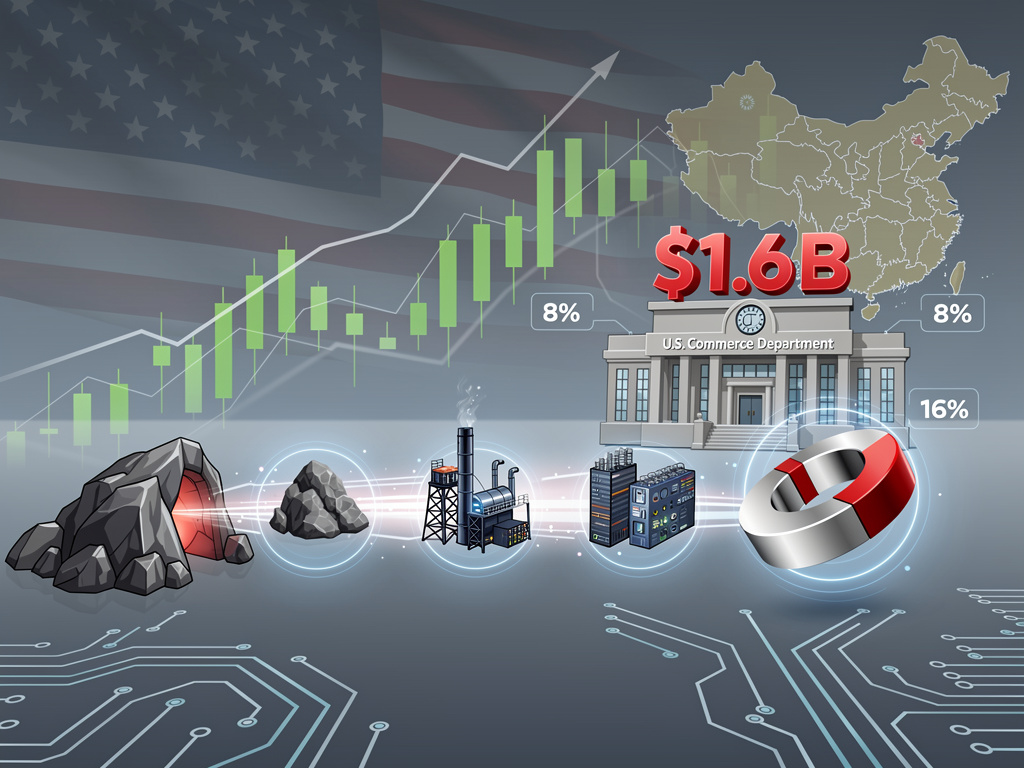
Shares of USA Rare Earth Inc. rocketed as much as 29% Monday before settling with an 8% gain to $26.72, propelled by news that the U.S. Department of Commerce issued a letter of intent for a $1.6 billion funding package that includes an equity stake in the critical minerals startup. The deal, which hands the government 16.1 million shares and 17.6 million warrants for an ownership slice of 8% to 16%, marks the Trump administration’s boldest move yet to wrest control of rare earth supply chains from China.
USA Rare Earth, ticker USAR on Nasdaq, is racing to develop a full mine-to-magnet operation with a manufacturing plant in Stillwater, Oklahoma, set for commissioning in the first quarter of 2026, and commercial mining at the Round Top deposit in Sierra Blanca, Texas, slated for late 2028. The company’s $4.1 billion project needs massive capital, and this infusion—comprising a $1.3 billion loan and $277 million in federal funding disbursed through 2028 based on milestones—pairs with a $1.5 billion private investment in public equity (PIPE) deal anchored by Inflection Point, issuing 69.8 million shares at $21.50 each. Still, executives peg another $600 million gap, likely via equity from strategic and institutional backers, per CNBC.
CEO Barbara Humpton hailed the pact as “a watershed moment in our work to secure and grow a resilient and independent rare earth value chain based in this country,” adding, “We have long said that meeting the urgent call to reassure the rare earth and critical minerals industry will require a multiplayer solution, and this establishes our company as one of the leaders.” Chief Financial Officer Rob Steele echoed confidence, stating, “We believe we can raise the remaining capital from attractive sources, and you should assume that’s equity capital but that can come from strategic investments as well as institutional investors.”
Strategic Push Against Beijing’s Grip
Rare earth elements, vital for defense systems, electric vehicles, semiconductors, robotics, and AI infrastructure, remain overwhelmingly dominated by China, which controls nearly 70% of global production and 90% of magnet manufacturing. Last year, Beijing clamped down on exports amid trade tensions, exposing U.S. vulnerabilities. Commerce Secretary Howard Lutnick declared, “USA Rare Earth’s heavy critical minerals project is essential to restoring U.S. critical mineral independence. This investment ensures our supply chains are resilient and no longer reliant on foreign nations,” according to Fortune.
This Commerce-led initiative via the CHIPS program diverges from the Defense Department’s summer 2025 deal with MP Materials, which included an equity stake, price floor, and offtake agreement. Unlike MP, USA Rare Earth’s pact lacks pricing guarantees, reflecting its focus on rarer heavy earths less prone to Chinese dumping. The administration has since snapped up stakes in Lithium Americas for a Nevada project, Trilogy Metals for Alaska exploration, and eyed others like NioCorp and U.S. Antimony, as noted by analyst Neal Dingmann of William Blair in Reuters.
The government’s growing portfolio extends beyond minerals to Intel, Westinghouse, and U.S. Steel, sparking debate. Critics warn of market distortion, but proponents argue taxpayer stakes yield upside if firms thrive, per The New York Times. Demand surges: the International Energy Agency forecasts up to 60% growth in needs for graphite, cobalt, and nickel by 2040.
Stock Volatility and Market Ripples
USAR’s rally extended a scorching run—up 125% year-to-date to a $3.7 billion market cap—though pre-revenue status and 2028 mine startup flag risks. Premarket spikes hit 62%, with peers like MP Materials and Lithium Americas also lifting on sector tailwinds. X chatter buzzed: Shanu Mathew noted, “Gov’t increasingly involved,” while Ted Zhang highlighted unprecedented public-private blends for national security.
Conditions abound for finalization: $500 million non-federal raise (achieved), semiconductor MOUs, feedstock deals through 2027, and power plans. Funding ties to milestones, de-risking for private capital amid China’s overhang. Yahoo Finance reported the PIPE as a fast capital bridge, typically at discounts.
Investors eye spillovers. Korea Zinc’s $7.4 billion Tennessee refinery eyes a 40% Defense stake post-$4.7 billion loans. Hecla Mining surged 24% on rare earth exposure. Dingmann anticipates “more government rare earth funding to come,” potentially fast-tracking permits akin to 1970s oil stockpiles.
Government’s Equity Playbook Evolves
Washington’s direct ownership—unprecedented in scale—signals sovereign priority. The New York Times detailed Lutnick’s push, while Yahoo Finance tied it to AI, defense, and energy races. Round Top’s heavy earths promise stable supply by 2027, slashing capital costs via a federal floor.
For industry insiders, this cements a multiplayer model: government anchors, private amplifies. Steele’s optimism underscores viability, but execution hinges on milestones amid permitting hurdles and commodity swings. As X user DigitalGoldRush put it, “This is U.S.–China decoupling in action.”
The pact accelerates Stillwater’s Q1 2026 launch, targeting defense and high-tech buyers. With $3.5 billion secured, USA Rare Earth positions as a linchpin in America’s mineral resurgence, per Seeking Alpha and Investopedia.


 WebProNews is an iEntry Publication