
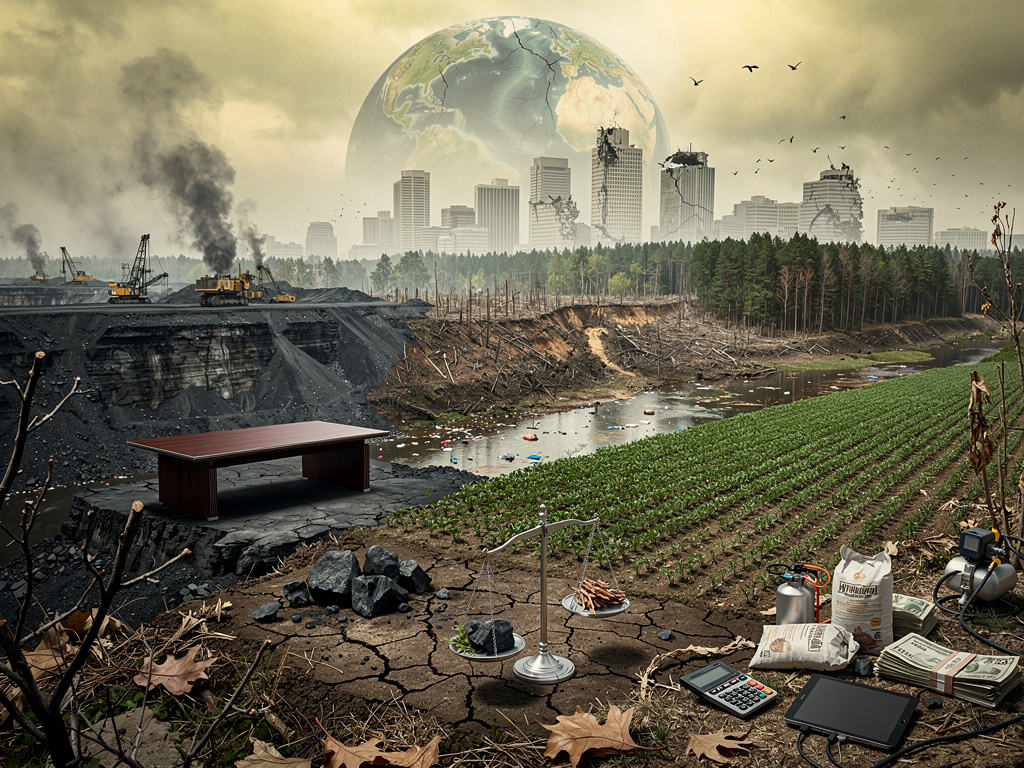
The latest United Nations Global Environment Outlook report paints a stark picture of the hidden costs embedded in humanity’s daily necessities. Released this week, the document asserts that unsustainable practices in food production and fossil fuel extraction are inflicting environmental harm valued at $5 billion every single hour. This staggering figure, drawn from comprehensive analysis by nearly 200 researchers, underscores a crisis that extends far beyond carbon emissions, encompassing biodiversity loss, water pollution, and soil degradation. The report, produced under the auspices of the UN Environment Programme, warns that without radical shifts in global governance, economics, and finance, societal collapse could become an unavoidable reality.
At the heart of this assessment is the quantification of externalities—those unaccounted-for damages that industries impose on ecosystems and future generations. Food systems, particularly intensive agriculture and livestock farming, contribute massively through deforestation, excessive fertilizer use, and methane emissions from cattle. Fossil fuels, meanwhile, drive air and water contamination, habitat destruction, and climate-altering greenhouse gases. Together, these sectors generate hourly damages equivalent to the annual GDP of a mid-sized nation, a revelation that has sent ripples through environmental policy circles and corporate boardrooms alike.
The UN’s findings build on years of accumulating evidence, but this iteration sharpens the focus on urgency. Researchers calculated these costs using advanced modeling that incorporates everything from lost ecosystem services to health impacts on human populations. For instance, the degradation of arable land from overuse in farming not only reduces future crop yields but also exacerbates food insecurity in vulnerable regions. Fossil fuel operations, particularly in extraction-heavy areas like the Permian Basin or the Amazon, compound this by polluting waterways and accelerating species extinction.
Unpacking the Hourly Toll on Ecosystems
Delving deeper, the report attributes roughly half of the $5 billion hourly damage to food production alone. Industrial agriculture’s reliance on monocultures and chemical inputs has led to widespread soil erosion and nutrient depletion, with long-term consequences for global food security. In regions like sub-Saharan Africa and Southeast Asia, where smallholder farms are being squeezed by climate variability, these practices are already manifesting in declining yields. The UN experts highlight how nitrogen runoff from fertilizers creates dead zones in oceans, killing marine life and disrupting fisheries that billions rely on for protein.
Fossil fuels, on the other hand, account for the remaining bulk through direct environmental assaults. Oil spills, coal mining runoff, and fracking-induced seismic activity degrade landscapes and contaminate groundwater supplies. The report cites examples from recent incidents, such as pipeline leaks in North America that have cost billions in cleanup while irreparably harming wetlands. These damages are not abstract; they translate into real economic burdens, including healthcare costs from pollution-related illnesses and lost tourism revenue in affected areas.
Industry insiders are particularly alarmed by the report’s call for a “global transformation” to avert collapse. This isn’t mere rhetoric— the document proposes repurposing subsidies currently funneled into fossil fuels and unsustainable agriculture. According to estimates referenced in the analysis, governments worldwide dole out hundreds of billions annually in such supports, effectively underwriting environmental destruction. Redirecting these funds toward regenerative farming and renewable energy could, the report argues, mitigate much of the hourly toll.
Policy Shifts and Economic Repercussions
The implications for policymakers are profound, especially as international climate talks like COP30 loom on the horizon. The UN report explicitly links these damages to broader systemic failures, advocating for carbon pricing mechanisms and biodiversity credits to internalize costs. In Europe, where the EU’s Green Deal is already pushing for sustainable agriculture, officials are eyeing the findings as validation for stricter regulations on meat production and fossil fuel phaseouts. Yet, resistance from agribusiness lobbies and energy giants remains fierce, with arguments centering on short-term economic disruptions.
Economically, the $5 billion hourly figure equates to over $43 trillion annually—a sum that dwarfs global defense spending and rivals the world’s combined healthcare budgets. This has prompted analysts to question the viability of current business models in these sectors. For fossil fuel companies, the report amplifies calls for stranded asset risks, where investments in oil and gas infrastructure could become worthless amid accelerating transitions to clean energy. Food conglomerates, too, face scrutiny over supply chains that prioritize yield over sustainability, potentially leading to investor pullbacks.
Drawing from recent discussions on social media platforms like X, public sentiment reflects growing frustration. Posts from environmental advocates emphasize how crop yields could plummet by 30% by 2050 due to these damages, exacerbating hunger in a world needing 50% more food. One widely shared thread highlighted the carbon footprint of beef production, noting it emits nearly 100 kg of CO2 equivalent per kilogram—far outstripping alternatives like plant-based proteins. These online conversations underscore a shift in consumer awareness, pressuring companies to adopt transparent reporting on environmental impacts.
Industry Responses and Innovation Frontiers
Major players in the fossil fuel arena, including ExxonMobil and Shell, have begun acknowledging such reports in their sustainability filings, though critics argue these are superficial. For instance, initiatives like carbon capture and storage are touted as solutions, but the UN analysis deems them insufficient without drastic production cuts. In the food sector, companies like Cargill and Tyson Foods are experimenting with precision agriculture to reduce fertilizer use, yet scaling these technologies globally remains a challenge amid supply chain complexities.
Innovation offers a glimmer of hope, with startups and research institutions pioneering alternatives. Lab-grown meat and vertical farming could slash the environmental footprint of food production by minimizing land and water use. On the energy front, advancements in hydrogen and battery storage are eroding fossil fuels’ dominance, supported by investments from funds like BlackRock that are divesting from high-damage assets. However, the report stresses that technological fixes alone won’t suffice; they must be paired with equitable policies to avoid burdening developing nations.
Referencing broader web-sourced insights, a 2021 fact sheet from the Environmental and Energy Study Institute detailed how fossil fuels contribute to air pollution linked to millions of premature deaths annually. This aligns with the UN’s hourly damage calculations, which factor in health costs. Similarly, a ScienceDaily article from 2020 discussed reimagining food systems to limit warming, warning that without changes, agricultural emissions could breach Paris Agreement targets even if energy sectors decarbonize.
Global Ramifications and Future Trajectories
The ripple effects extend to international trade, where countries exporting commodities like Brazilian beef or Indonesian palm oil face potential tariffs under emerging carbon border adjustments. This could reshape global markets, favoring nations with lower-damage production methods. For industry leaders, adapting means integrating environmental accounting into core strategies, perhaps through tools like true cost accounting that reveal the full price of operations.
Looking ahead, the UN report urges a reevaluation of growth paradigms, suggesting that endless expansion in food and fuel production is incompatible with planetary boundaries. Experts from UC Berkeley, as noted in a March 2025 publication, have issued warnings about fossil fuels driving crises that threaten wildlife and human livelihoods. Their call for urgent action echoes the GEO’s emphasis on interlinked threats, from microplastics in crops to methane leaks from drilling sites.
Social media buzz on X further amplifies these concerns, with users sharing statistics on how meat and dairy alone could bust 1.5°C warming limits. Posts cite studies showing farmed prawns and cheese as high emitters, fueling debates on dietary shifts. This grassroots pressure is influencing corporate agendas, with some firms pledging net-zero commitments in response.
Pathways to Mitigation and Resilience Building
To stem the $5 billion hourly bleed, the report advocates for multifaceted strategies, including agroecology in farming to restore soils and biodiversity. Transitioning fossil fuel-dependent economies toward renewables could create jobs while curbing damages, as evidenced by successful models in Denmark and Costa Rica. Financial institutions play a pivotal role here, with calls for divesting from high-risk sectors and funding green alternatives.
Challenges abound, particularly in enforcement. Developing countries argue that wealthier nations, historical polluters, should bear more responsibility. The UN proposes global funds to support transitions, ensuring that small farmers aren’t left behind. Industry insiders note that while costs are high, inaction’s price tag—potentially trillions in lost productivity from environmental collapse—far exceeds investment in change.
Integrating insights from The News International, which covered the report’s release, the emphasis on economic reforms like subsidy repurposing and carbon pricing resonates with ongoing debates at forums like the World Economic Forum. This holistic approach could transform how societies value natural capital, turning hourly damages into opportunities for sustainable prosperity.
Voices from the Frontlines and Emerging Alliances
Frontline communities, from Indigenous groups in the Amazon to farmers in the American Midwest, are already feeling the brunt. Their stories, shared across platforms, highlight immediate needs for adaptation funding. Alliances between environmental NGOs, tech innovators, and progressive investors are forming to push for accountability, with campaigns targeting corporate laggards.
In the fossil fuel realm, regulatory pressures are mounting, as seen in recent U.S. policies aiming to cap methane emissions. Food production reforms, inspired by successes in organic farming, could reduce damages by promoting crop diversity and reducing chemical dependencies. The UN’s vision is clear: systemic change is essential to prevent the hourly toll from escalating into irreversible harm.
As this report reverberates through boardrooms and policy halls, it serves as a clarion call. By addressing these intertwined crises head-on, humanity might yet forge a path where food and energy sustain rather than deplete the planet. The alternative, as starkly outlined, risks a future where environmental debts overwhelm all gains.


 WebProNews is an iEntry Publication