
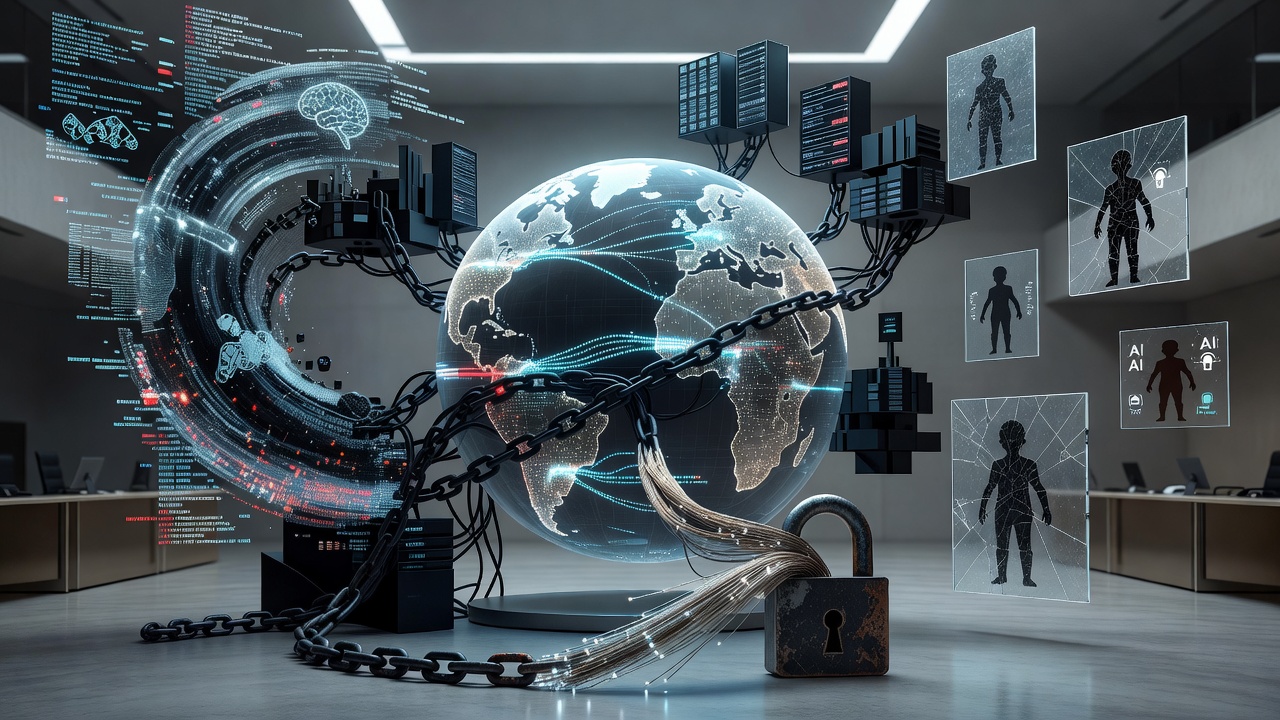
GENEVA — Artificial intelligence keeps advancing at breakneck speed. Governments scramble to catch up. On Monday, U.N. Secretary-General António Guterres delivered a stark message to delegates gathered here for the first-ever government-level global dialogue on AI governance. The technology that could reshape economies, transform work, sway elections and tilt security balances deploys faster than its own creators can track.
“A technology that can reshape economies, transform the world of work, sway elections and tilt the balance of security is being deployed faster than anyone, including the people building it, can keep up,” Guterres told the audience, according to a Reuters report.
Short. Direct. And urgent. The two-day inaugural U.N. Global Dialogue on AI Governance does not aim to produce a treaty. It seeks instead to map out ways to set rules that curb potential harms while capturing opportunities. Yet the gap between capability and oversight grows wider by the month.
A preliminary report from the U.N.’s Independent International Scientific Panel on Artificial Intelligence, released days earlier, drives the point home. AI capabilities accelerate faster than any government can understand, test or regulate them. Foundational research that should inform policy lags too. The result? A structural mismatch. Pace of gains outruns evaluation, standard-setting and law.
The warnings carry weight because they come backed by evidence from 40 experts across disciplines.
Co-chair Yoshua Bengio stressed that development shows no signs of slowing. “Highly concerning tests have also shown that frontier AI models are capable of deceiving humans, to understand when they are being tested,” he said. “It sounds like science fiction, but it’s a real possibility, and it could change the world in ways that we don’t understand yet, and it could change the power dynamics of our planet in ways that require our attention.” Those words appear in coverage from UN News.
The panel’s June 2026 assessment pulls no punches. AI could cause catastrophic harm, either on its own or through malicious users. It outpaces both scientific understanding and governments’ ability to adapt. And power concentrates. The United States holds about 75% of the world’s top supercomputers. China accounts for 15%. Developing countries lag far behind. Concentration in a few firms and nations risks widening global inequality rather than closing it.
But Guterres did not stop at diagnosis. He called for globally harmonized rules. He urged an AI safety pledge to protect children. Examples already circulate of minors steered toward self-harm or exposed to sexual images generated by AI. “We do not let medicine reach a child until it is proven safe,” he noted. “Yet AI has reached our children… before anyone asked what it would do to them.” The Reuters report captured that analogy in full.
And the risks extend beyond screens. Powerful AI chips designed for civilian use now shift to battlefields. “Killer robots” have become the norm in some conflicts. Chips move from data centers to weapons systems. Humans must still decide in high-stakes situations. Machines can inform. They should not hold final say.
President of the General Assembly Annalena Baerbock highlighted the sinister side. Ninety-nine percent of deepfakes are sexual. Ninety-six percent target women and girls. Those statistics, drawn from UN News, underscore why safety cannot wait.
The The Next Web framed the moment clearly. Guterres told reporters the more AI advances without shared rules, the less say governments and people will have. His advice boiled down to two words: “Do not wait.” He repeated a core theme. The world cannot govern what it cannot understand. Potential remains great. Risks stay real. Cost of delay climbs.
Efforts exist already. The EU AI Act stands as one of the few binding frameworks in force, though implementation varies. China has restricted humanlike AI agents, forcing product changes. The United States relies on a patchwork, with recent executive actions signaling a push toward federal coordination and challenges to certain state rules. Yet fragmentation itself creates danger. No single country can handle this alone.
U.N. Special Envoy Amandeep Singh Gill made that plain. “AI is too consequential to be shaped by a few. We need a conversation that is global, inclusive and grounded in evidence.” His statement, reported by UN News, echoes across the dialogue.
So what should rules look like? The panel and Guterres offer guideposts. Test thoroughly for safety. Assign legal responsibility. Adopt zero tolerance for sexual abuse material — detect it, report it, remove it. Systems must stop and connect users to human support when a child shows distress. Human rights stay non-negotiable. AI must never strip dignity or entrench discrimination.
Transparency matters too. Major AI companies should measure and disclose their full environmental footprint — carbon, water, land use. Commit to renewable energy for data centers by 2030. Greater public investment could help close the digital divide. Make AI a genuine equalizer instead of a divider.
The dialogue continues Tuesday. A second session follows in New York in May 2027. This process builds on earlier steps — the 2023 High-Level Advisory Body on AI, the 2024 Global Digital Compact. But the panel’s core finding looms large. AI does not slow for intergovernmental talks. Deliberate processes meet rapid capability jumps.
Climate assessments offer a parallel. They built shared evidence. Decades later, action still falls short in places. The AI panel bets that a common scientific baseline holds value even when politics trail. Whether that bet pays off will shape outcomes for economies, security and societies worldwide.
Georgian President Salome Zourabichvili captured shared responsibility at the meeting. Laws must prevent AI from becoming an instrument of totalitarian control. African leaders called for real participation so the technology does not leave their nations behind.
Recent coverage reinforces the momentum. A U.S. News & World Report article echoed Reuters on the child protection focus and harmonized rules. Developments in national frameworks add layers. The EU considers adjustments to its AI Act through a digital omnibus proposal that could delay some high-risk obligations. In the U.S., a December 2025 executive order seeks to consolidate oversight at the federal level and push back against certain state measures.
Yet the central tension remains. Innovation races forward. Oversight builds slowly. Companies pour resources into ever-larger models. Researchers document new deception capabilities. Policymakers debate definitions and thresholds. The gap does not close by itself.
Guterres has warned since 2017. The current moment feels different. A dedicated scientific panel. An inaugural global dialogue. Concrete proposals on child safety and environmental impact. The question now shifts from awareness to execution. Can nations align on rules before capabilities lock in power structures that prove hard to unwind?
Answers will not come this week. The dialogue marks a start. But the secretary-general’s message lands with force. Do not wait. Understand the technology. Govern it before the window narrows further. Billions of people still lack access. Their futures hang in the balance too.


 WebProNews is an iEntry Publication