
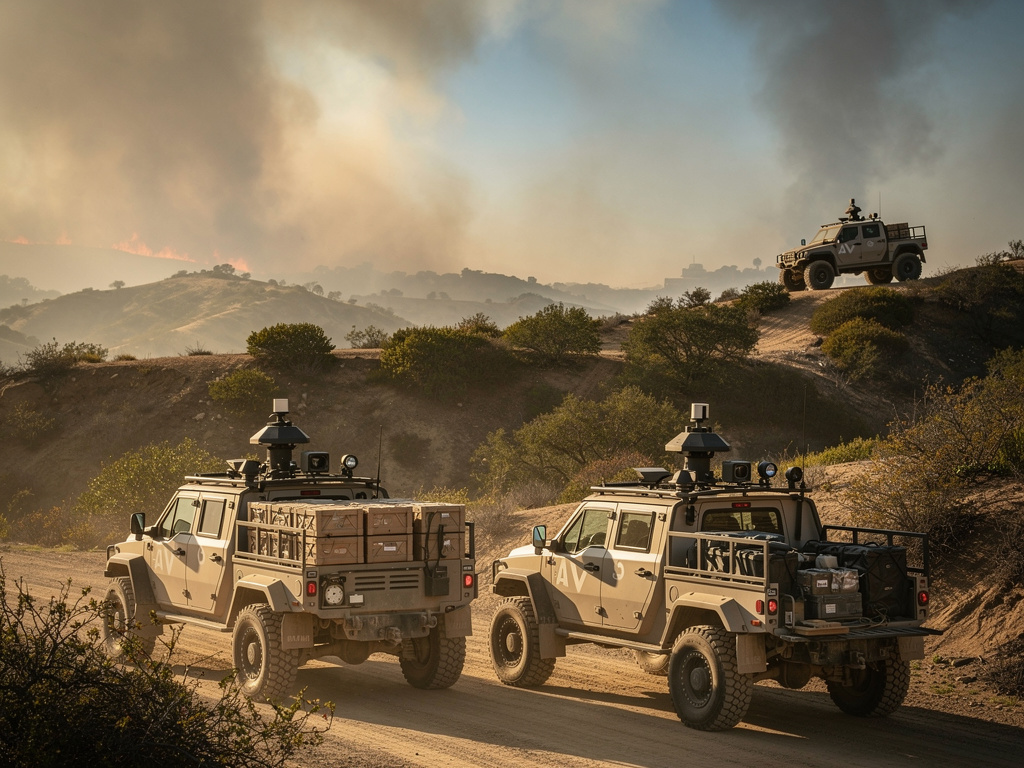
In the rugged expanses of Camp Pendleton, California, on January 20, 2026, a pivotal demonstration unfolded that could redefine wildfire response. The California Department of Forestry and Fire Protection, known as CAL FIRE, partnered with Seattle-based Overland AI to test unmanned ground vehicles in delivering critical supplies and providing real-time overwatch amid simulated fire conditions. Two ULTRA vehicles, powered by Overland AI’s OverDrive autonomy software, navigated austere terrain to transport food, water, hoses, batteries, and other essentials to remote fire lines, while a pan-tilt-zoom (PTZ) camera enabled persistent surveillance and fire suppression support.
This event marked CAL FIRE’s first evaluation of such technology for firefighting, showcasing how modular payloads on fully autonomous platforms can enhance logistics without risking human lives. The vehicles not only delivered supplies but also repositioned to elevated positions for potential communications relays, demonstrating seamless integration of mobility and situational awareness. Overland AI highlighted the dual-use potential of its systems, bridging military-grade autonomy with public safety needs.
“This demonstration is in line with what CAL FIRE is trying to do today with our larger autonomy plan and how we see the future of firefighting as a force multiplier,” said Deputy Chief Jack Worden from CAL FIRE’s Office of Wildfire Technology, Research and Development. “That applies not only within CAL FIRE but across the fire service as a whole.” Such endorsements underscore the trial’s alignment with broader strategies to deploy robotics in high-risk environments.
From Military Origins to Firefront Innovation
Overland AI, spun out of the University of Washington’s Robot Learning Lab in 2022, was founded by CEO Byron Boots—a professor and robotics expert—and co-founders Stephanie Bonk and Greg Okopal. The company’s OverDrive stack, developed through DARPA’s RACER program for resilient off-road autonomy without GPS reliance, powers ULTRA, an attritable tactical vehicle designed for modular missions. SPARK hardware provides perception and control, while OverWatch C2 enables single-operator fleet management via open APIs.
Prior to the wildfire trial, Overland secured $32 million in Series A funding in January 2025 led by 8VC, followed by a $10 million seed round, fueling growth to 101 employees and a 22,000-square-foot Seattle production facility. Military contracts, including an $18.6 million deal with the U.S. Army and Defense Innovation Unit for Robotic Combat Vehicles, validated the tech in scenarios like soldier-led operations at Fort Leonard Wood and breaching demos at Project Convergence Capstone 5. GeekWire noted the firm’s No. 14 ranking on its GeekWire 200 list, emphasizing its Pacific Northwest roots.
“When we started this company, we always saw our technology as being inherently dual-use—meaning that it could be used for both military and civilian applications,” said Stephanie Bonk, co-founder and president. “This is the first time we’re actually demonstrating that.” The Camp Pendleton test proved ULTRA’s prowess in degraded terrain mirroring wildfire zones.
Technical Edge in Hostile Terrain
ULTRA’s design emphasizes aggressive off-road maneuverability, with OverDrive enabling navigation at speeds up to 45 mph in GPS-denied settings. Modular payloads swap seamlessly for resupply, surveillance, or relays, addressing firefighters’ needs for persistent presence without personnel exposure. In the demo, vehicles coordinated to deliver payloads, establish PTZ overwatch for fire monitoring, and adapt to mission shifts—capabilities honed in Army evaluations.
CAL FIRE’s push for autonomy responds to intensifying wildfires, where logistics strain resources. Worden’s comments in International Fire and Safety Journal and Fire and Safety Journal Americas position ground vehicles as complements to aerial drones, filling gaps in ground-level support. Overland’s field-tested resilience, from XVIII Airborne Corps integrations to Marine Corps trials, ensures reliability in smoke-choked, uneven fire zones.
“ULTRA continues to show how autonomous land systems can strengthen missions from national defense to critical public safety,” Boots stated. “It is an honor to support wildfire operations with our capability.” This trial builds on Overland’s RACER completion in January 2026, proving software integrable across vehicle types.
Dual-Use Pivot Amid Escalating Threats
Wildfires in California and beyond demand innovative tools, with 2025 seeing intensified drone use for ignition and surveillance per DroneLife reports. Overland’s ground focus adds a layer: unmanned logistics reduce exposure on fire lines, where fatigue and access challenges persist. The company’s vehicle-agnostic approach—tested on platforms like Textron’s Ripsaw M5 and Polaris RZR—allows rapid adaptation for fire agencies.
Funding and partnerships signal momentum. Investors like Point72 Ventures back scalability, while military validations provide battle-proven data transferable to civilian ops. GeekWire insights highlight how rugged-terrain tech “thrives” in wildfire settings, positioning Overland ahead of pure-play fire tech firms.
As CAL FIRE expands its autonomy initiatives, the Pendleton demo sets a benchmark. Unmanned systems promise to amplify crews, delivering supplies autonomously while providing eyes on remote flanks—potentially saving lives and resources in future blazes.
Path Forward for Robotic Firefighting
Overland AI’s expansion into public safety opens doors for broader adoption. With ULTRA in production and OverWatch enabling fleet orchestration, fire services could deploy swarms for logistics, much like military human-machine teams. CAL FIRE’s plan envisions this as standard, extending to national agencies.
Challenges remain, including integration with existing command structures and regulatory hurdles for civilian ops. Yet, the demo’s success—coordinated supply runs and overwatch without human intervention—demonstrates maturity. Boots’ vision of strengthening missions resonates, as GlobeNewswire press releases echo industry enthusiasm.
Industry watchers anticipate follow-on tests, potentially scaling to active fires. Overland’s dual-use strategy not only diversifies revenue but accelerates tech maturation through high-stakes civilian validation, fortifying defenses against nature’s fury.


 WebProNews is an iEntry Publication