
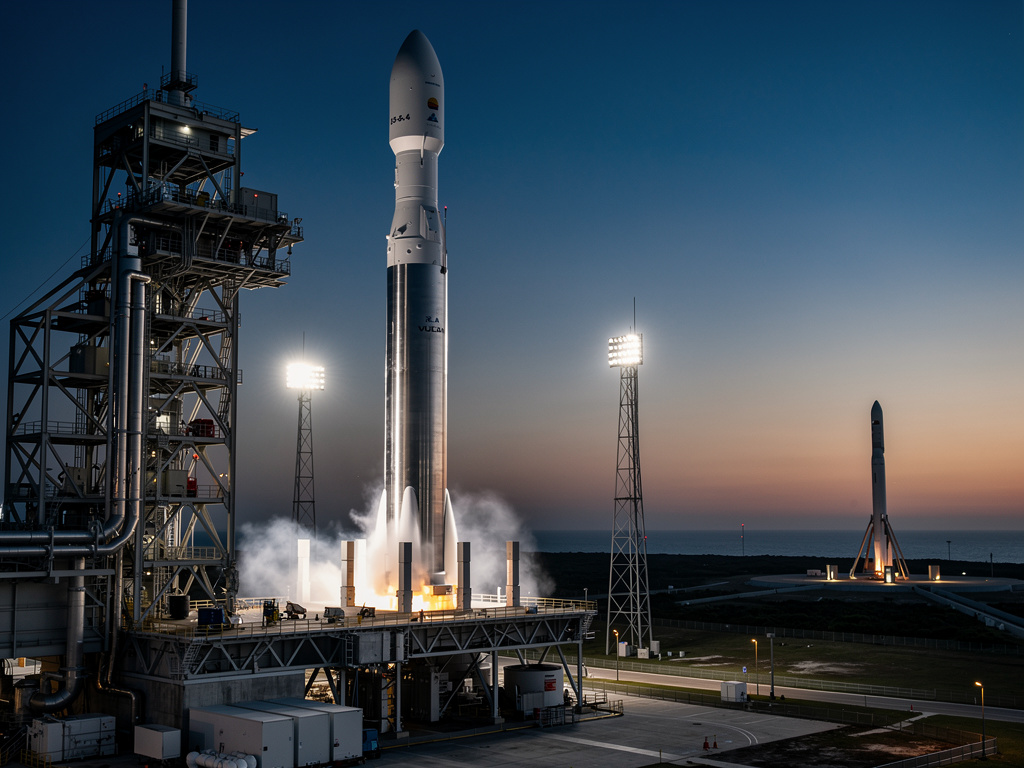
The Space Coast of Florida is gearing up for what promises to be one of the most consequential rocket launches of 2024 — the second flight of United Launch Alliance’s Vulcan Centaur rocket. Scheduled for launch from Cape Canaveral Space Force Station, the mission carries enormous stakes not just for ULA, but for the broader U.S. national security space enterprise and the commercial launch industry at large.
The Vulcan Centaur, ULA’s next-generation heavy-lift vehicle designed to eventually replace both the Atlas V and Delta IV Heavy rockets, must demonstrate its reliability on this certification flight before it can begin carrying the Pentagon’s most sensitive and expensive payloads. As Digital Trends reported, the launch is expected to light up the Space Coast with a spectacular display as the rocket’s twin BE-4 engines roar to life, sending the vehicle on its critical second journey to orbit.
A Rocket Built to Compete — and to Certify
ULA, the joint venture between Boeing and Lockheed Martin that has long served as the backbone of America’s national security launch capability, developed Vulcan Centaur as its answer to the rapidly evolving competitive pressures in the launch market. The rocket is powered by a pair of Blue Origin-built BE-4 engines burning liquid natural gas and liquid oxygen — a significant departure from the Russian-made RD-180 engines that powered the Atlas V for more than two decades. The shift to domestically produced engines was driven in part by congressional mandates following Russia’s annexation of Crimea in 2014, which made reliance on Russian propulsion technology politically untenable.
The first Vulcan Centaur flight launched successfully on January 8, 2024, carrying Astrobotic’s Peregrine lunar lander. While the rocket itself performed admirably, delivering its payload to the correct trajectory, the Peregrine lander subsequently suffered a propulsion system failure that prevented it from landing on the Moon. For ULA, however, the launch vehicle’s performance was the key metric, and by that measure, the inaugural flight was a success. The second flight, known as Cert-2, is required by the U.S. Space Force’s National Security Space Launch (NSSL) program before Vulcan can be certified to carry military and intelligence community satellites.
What’s Riding on the Cert-2 Mission
The stakes for this second certification flight extend far beyond a single launch. ULA has a substantial backlog of NSSL missions that it cannot begin to fly until Vulcan receives its certification. The U.S. Space Force awarded ULA approximately 60% of the NSSL Phase 2 launch contracts, with SpaceX receiving the remaining 40%. These contracts, worth billions of dollars, represent the financial lifeblood of ULA’s future operations. Any significant delay or failure on the Cert-2 mission would not only push back ULA’s certification timeline but could also raise questions about the company’s ability to meet its contractual obligations to the Department of Defense.
The payload for this second flight is expected to be a demonstration mission that will further test the rocket’s capabilities, including the performance of the Centaur V upper stage, which ULA has touted as one of the most capable and versatile upper stages ever built. The Centaur V features a longer burn capability and greater payload accommodation than its predecessor, enabling complex multi-manifest missions and direct insertion into a variety of orbits — capabilities that are essential for the diverse range of national security missions Vulcan is expected to fly.
Blue Origin’s BE-4 Engines Under the Spotlight
Perhaps no component of the Vulcan rocket has attracted more scrutiny than the BE-4 engines supplied by Jeff Bezos’s Blue Origin. The development of the BE-4 was plagued by years of delays, which in turn pushed back Vulcan’s debut by several years. The engines use an oxygen-rich staged combustion cycle burning liquefied natural gas, a propellant combination that offers a balance of performance and cost-effectiveness. On the first Vulcan flight, the BE-4 engines performed within their expected parameters, a milestone that was closely watched by both ULA and Blue Origin.
The second flight will provide additional data points on the engines’ reliability and consistency. In the rocket business, a single successful flight is encouraging but far from definitive. The space industry has seen numerous examples of rockets that performed well on their maiden voyages only to encounter issues on subsequent flights. For Blue Origin, which is also using the BE-4 to power its own New Glenn rocket — currently in development and expected to compete directly with SpaceX’s Falcon Heavy and eventually Starship — the engine’s performance on Vulcan serves as a critical real-world proving ground.
The Competitive Pressure from SpaceX
ULA’s urgency to certify Vulcan and begin operational flights is amplified by the relentless pace of SpaceX, which has fundamentally transformed the economics and tempo of orbital launch. SpaceX’s Falcon 9 has become the workhorse of the global launch industry, with a cadence that now exceeds 90 launches per year. The company’s Falcon Heavy, meanwhile, has already been certified for NSSL missions and has flown several high-profile national security payloads. SpaceX’s Starship, the fully reusable super-heavy launch vehicle currently in its test flight phase, represents yet another competitive threat on the horizon.
ULA CEO Tory Bruno has repeatedly emphasized that Vulcan is designed not just to compete on price but to offer the mission assurance and reliability that national security customers demand. ULA’s track record of more than 150 consecutive successful launches across its Atlas V and Delta IV fleet is a powerful selling point, but that legacy of reliability must now be transferred to the new Vulcan platform. The Cert-2 mission is the next critical step in building that track record.
Industry Observers and Analysts Weigh In
Space industry analysts have noted that the transition from legacy rockets to new vehicles is one of the most perilous periods for any launch provider. The retirement of the Atlas V and Delta IV Heavy — both of which have remaining missions to fly — creates a narrow window during which ULA must ramp up Vulcan operations while winding down its older fleet. This transition must be executed without disrupting the cadence of national security launches, a challenge that requires meticulous planning and flawless execution.
According to reporting from Digital Trends, the visual spectacle of the Vulcan launch is expected to be significant, with the rocket’s powerful engines illuminating the Florida coastline. For residents and visitors along the Space Coast, the launch offers a tangible reminder of the region’s central role in America’s space ambitions. Cape Canaveral and the adjacent Kennedy Space Center have served as the nation’s primary gateway to orbit for more than six decades, and the introduction of Vulcan adds another chapter to that storied history.
The Road Ahead for ULA and Vulcan Centaur
Beyond certification, ULA faces the challenge of scaling Vulcan production and launch operations to meet its contractual commitments. The company has invested heavily in modernizing its manufacturing facilities and streamlining its supply chain to reduce costs and increase throughput. ULA has also explored the possibility of recovering and reusing Vulcan’s BE-4 engines through a concept called SMART (Sensible Modular Autonomous Return Technology) reuse, which would involve detaching the engine section during flight and recovering it via helicopter. While this concept has not yet been implemented, it represents ULA’s longer-term strategy for reducing launch costs.
The commercial launch market is also a potential growth area for Vulcan. While ULA has historically focused primarily on government missions, the company has secured commercial contracts, including with Amazon’s Project Kuiper, which has booked a significant number of Vulcan launches to deploy its broadband satellite constellation. Amazon’s parent company and Blue Origin share a common founder in Jeff Bezos, creating an unusual but strategically significant alignment of interests across the supply chain.
A Defining Moment on the Space Coast
As the countdown clock ticks toward the Cert-2 launch, all eyes in the space industry will be trained on Cape Canaveral. A successful mission would clear the path for ULA to begin flying operational national security payloads on Vulcan, validate the BE-4 engine’s reliability with a second data point, and demonstrate that ULA remains a formidable force in the launch market despite the rise of SpaceX. A failure, on the other hand, could trigger significant delays, contractual complications, and difficult questions about the future of one of America’s most established launch providers.
For now, ULA and its engineers are focused on the task at hand: ensuring that every system, every component, and every procedure is ready for flight. The Vulcan Centaur’s second launch is more than just another rocket flight — it is a proving ground for a new era in American space access, and the outcome will reverberate across the industry for years to come.


 WebProNews is an iEntry Publication