
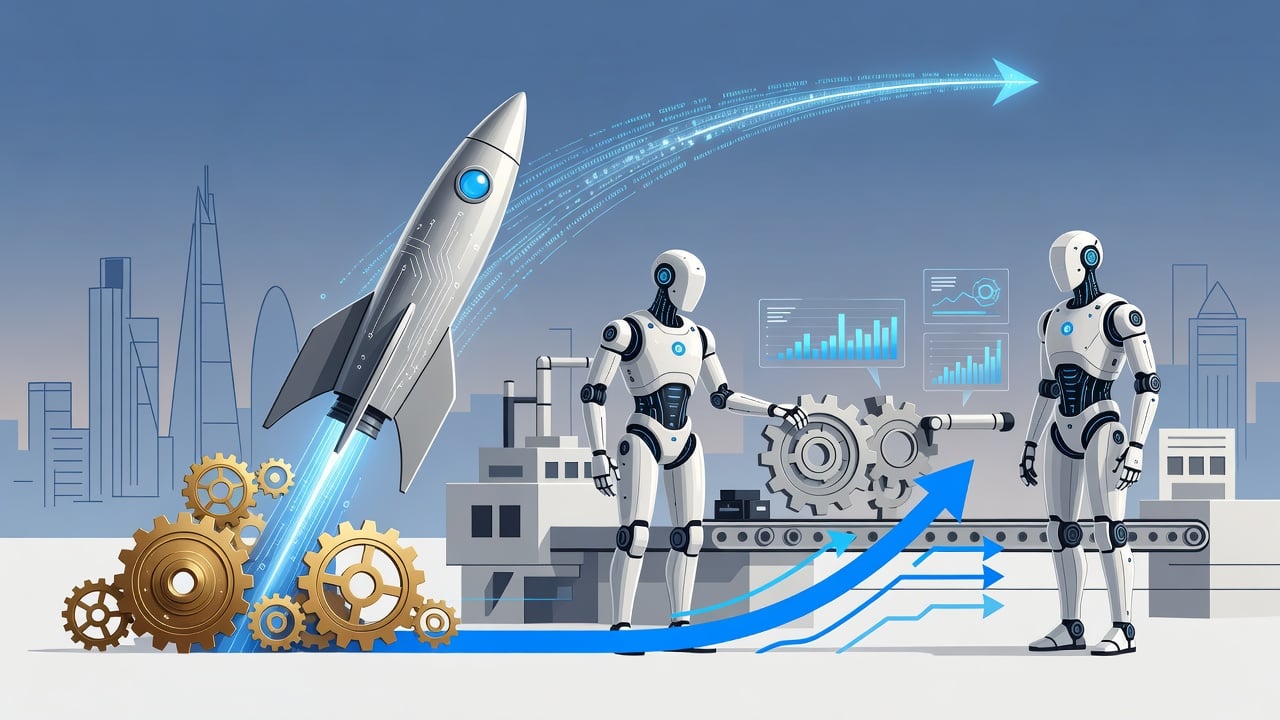
London-based robotics company Humanoid has joined the exclusive club of unicorns. The two-year-old startup reached a $1.2 billion valuation after raising the first tranche of its Series A round. Investors poured in $150 million at a $1.2 billion pre-money mark. Talks continue for another $80 million to $100 million by September.
Founder Artem Sokolov built the company in 2024. He sold his family’s Russian jewelry business the following year. That exit gave him the capital to pour $30 million of his own funds into the venture early on. His motivation traces back to childhood. He watched his grandparents endure years of repetitive labor in jewelry production. The experience shaped his drive to create machines that handle such tasks.
Humanoid develops two platforms. One rolls on wheels. The other walks on two legs. Both carry the HMND 01 Alpha designation. The wheeled version stands 220 centimeters tall. It moves at speeds up to 7.2 kilometers per hour. Payload capacity exceeds 15 kilograms. Early tests show it completing logistics work at 60 totes per hour in a live Siemens facility. Interesting Engineering covered the trial in January 2026.
Progress came fast. A robot learned to walk in two days last December. The Telegraph reported the feat. By September 2025 Humanoid had unveiled its first industrial model. Reuters described the event and noted the robots-as-a-service business model. Beta units arrive in the third quarter of 2026.
Commercial traction followed quickly. Schaeffler agreed to deploy hundreds of the machines in its factories. The deal points toward more than 1,000 units and hints at 100,000 by 2031. Forbes detailed the partnership in May 2026. Bosch will assemble the robots using Schaeffler components. Additional pilots run with major manufacturers in automotive and electronics.
The latest funding news broke yesterday. The Information first reported the $1.2 billion valuation and the $150 million raised so far. Seb Johnson highlighted on X that Humanoid becomes the UK’s first AI robotics unicorn. The company now employs a team drawn from Apple, Tesla, Google, Boston Dynamics and Nvidia. That talent pool has compressed development timelines dramatically.
Yet challenges remain. Humanoid competes in a field crowded with deep-pocketed players. Figure AI stands at a $39 billion valuation after raising more than $1.9 billion. Apptronik secured hundreds of millions for its Apollo platform. Chinese firms such as Agibot have shipped 10,000 units. Unitree aims for a multibillion-dollar public listing. Linkerbot, another Chinese unicorn, targets $6 billion for its dexterous robotic hands. Reuters covered that ambition in May.
Still, investors show no signs of cooling. Global robotics funding climbed sharply in 2025. More than $6 billion flowed into the sector in the first half alone, according to Crunchbase data. Humanoid-specific capital now exceeds $250 million. Earlier talks in February centered on a $200 million round. Forbes reported those discussions and noted Sokolov’s status as sole shareholder at the time.
The machines target real industrial pain points. Repetitive strain injuries, labor shortages and hazardous environments drive demand. Schaeffler and Siemens pilots demonstrate practical value today. A video from inside the company shows engineers training the AI brains that guide movement and decision-making. Reuters shared that footage in May 2026.
Humanoid also eyes the home. Its website once outlined ambitions to place robots in households. Yet current focus stays on factories where margins justify the high upfront costs. Robots-as-a-service lowers the barrier. Customers pay for capability rather than hardware ownership.
Europe watches closely. Analysts ask whether the region can capture a meaningful share of the humanoid market. Sifted named Humanoid among the continent’s fastest-growing robotics teams last August. The Next Web explored why Europe might quietly lead the race. Both articles appeared in 2025 when the company was still in stealth.
Success hinges on scaling production and refining autonomy. Current models rely on a mix of teleoperation, reinforcement learning and classical control. The two-day walking milestone shows how simulation and modern AI accelerate training. Engineers feed thousands of hours of synthetic data before real-world fine-tuning.
Market forecasts grow more aggressive. Morgan Stanley once projected a $5 trillion opportunity by 2050. Some founders claim the total addressable market includes every physical task performed by humans. Such numbers explain why capital continues to chase even the youngest entrants.
Humanoid now sits at the center of that frenzy. Its rapid rise from concept to pilot deployments in under two years stands out. Sokolov moved from jewelry executive to robotics chief executive in record time. The transition included a documented 19-minute film that chronicles the shift from sketches to factory floors. LA Magazine profiled that journey in June 2026.
Next steps include closing the full Series A and expanding the beta fleet. Partnerships with Bosch and Schaeffler provide manufacturing muscle. Additional letters of intent sit with automotive suppliers. If the robots perform as advertised, revenue could reach tens of millions within a few years.
The valuation reflects more than technology. It prices in the belief that safe, scalable humanoids will transform large parts of the economy. Doubters point to high costs, battery limits and the difficulty of unstructured environments. Proponents counter that each quarter brings measurable gains in dexterity, speed and reliability.
For now the machines roll and walk through carefully chosen factories. They lift, sort and transport with growing confidence. Observers who visited the sites say the robots already outperform expectations in narrow tasks. Broader autonomy remains the prize.
Humanoid’s London headquarters sits near Paddington. Additional offices operate in Cambridge, Massachusetts, and Burnaby, Canada. The company recruits aggressively for hardware, AI and safety engineers. Its KinetIQ software orchestrates fleets across wheeled and bipedal variants.
Industry insiders note the significance of a UK unicorn in a sector long dominated by American and Chinese firms. Government ministers have spoken about AI transforming human jobs for the better. One science minister told The Guardian in January that the technology will enhance skills rather than replace workers outright.
That optimism underpins the capital flow. Whether Humanoid converts its early lead into lasting advantage depends on execution over the next 18 months. Beta customers will deliver the verdict. So will the next funding round and the first true production contracts.
The robots are here. They learn quickly. And the money keeps coming.


 WebProNews is an iEntry Publication