
Early in the full-scale invasion, Ukrainian officials spoke of endurance. They described holding territory against overwhelming odds and buying time for Western aid to arrive. That language has changed. Talk now centers on regained ground, depleted Russian units and operations conducted without a single soldier crossing into harm’s way.
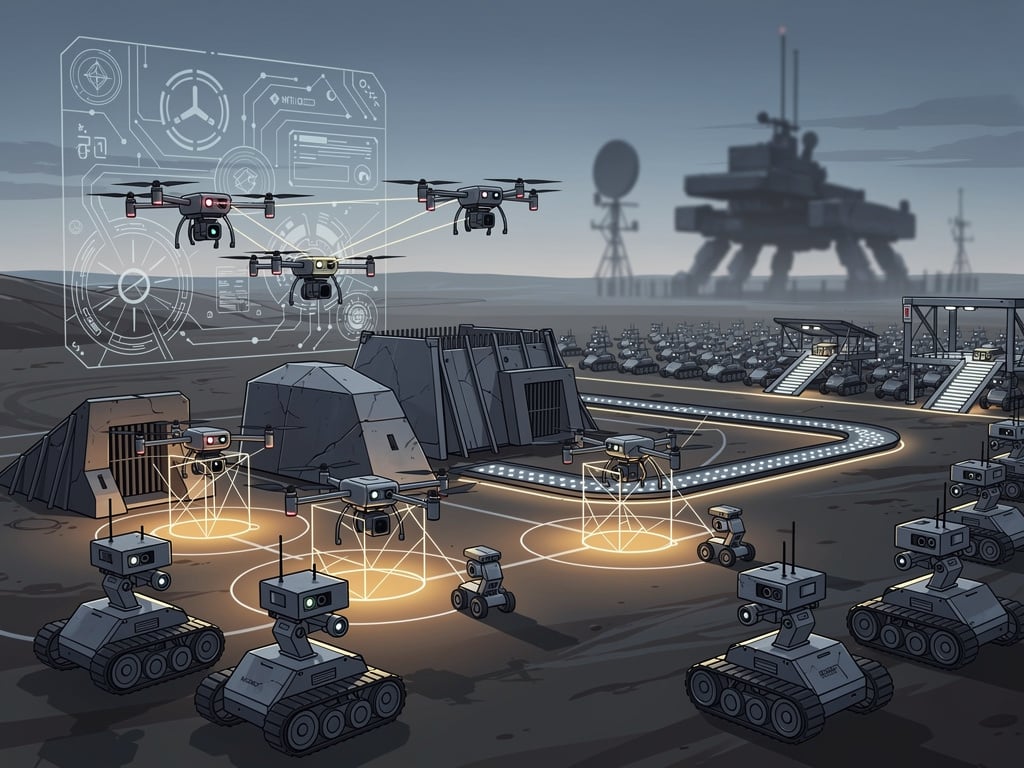
The difference traces to thousands of unmanned systems. Aerial drones scout and strike. Ground robots carry supplies, clear mines, evacuate wounded and, in some cases, lead assaults. President Volodymyr Zelensky stated in April that Ukrainian forces had captured a Russian position using exclusively unmanned platforms. He added that unmanned machines had conducted more than 22,000 missions since January. CNN reported the details.
One assault unit in the Third Assault Brigade ran the numbers. It determined that 164 robot-led missions achieved effects that would have required some 2,300 soldiers and likely produced hundreds of Ukrainian casualties. The unit estimated the machines saved about 1,000 lives. Veterans now sit in chairs reminiscent of gaming setups and direct robots that creep forward under fire. Operators watch feeds as the systems detonate charges or rake positions with mounted guns. The approach feels clinical. It is also relentless.
But the transformation runs deeper than hardware counts. Ukraine has rebuilt parts of its doctrine around these systems. Commanders experiment with combined-arms teams of aerial and ground unmanned platforms. They link sensors, artificial-intelligence guidance and human overseers in networks that operate from dispersed locations. One official described a future in which a handful of personnel in Kyiv or even abroad approve interceptions while autonomous elements handle the rest.
Davyd Aloian, deputy secretary of Ukraine’s National Security and Defence Council, explained the shift in an interview. “More than a year ago. Right now, we’re massively starting to implement this,” he said of robot-forward infantry concepts. He added that systems are being linked together so that “one day we will have only like 10 guys who are just going to be responsible for approving interception. And it will automatically go direct to the target.” Defense One detailed the comments.
The numbers keep climbing. Ukraine’s Ministry of Defense set contracts for 25,000 ground robots in early 2026, roughly double the prior year’s level. Defense Minister Mykhailo Fedorov has called for 100 percent of frontline logistics to be performed by robotic systems. More than 280 firms now work in the sector. They have produced over 550 distinct systems. The Brave1 platform has issued hundreds of grants to speed prototypes to the front.
These machines perform the most dangerous jobs. They deliver ammunition across open ground watched by enemy drones. They pull injured soldiers out of kill zones. Some hold defensive positions for weeks with only periodic maintenance. One unmanned ground vehicle reportedly maintained a position for 45 days, undergoing checks every 48 hours. “Robots do not bleed,” observed Mykola Zinkevych of Ukraine’s Third Army Corps.
Russian forces have adapted in places. They jam signals and hunt operators. Yet the asymmetry grows. Ukrainian systems operate with improving autonomy. Modules such as the TFL-1 allow a drone to continue to a selected target even after communication is cut. Its makers claim it quadruples hit probability. Such features blunt electronic-warfare advantages that once favored Moscow.
And the tactical edge compounds. Units create zones where Russian advances stall under constant unmanned surveillance and strikes. Reconnaissance drones spot movement. Loitering munitions and ground robots exploit the openings. The result is fewer Ukrainian troops exposed to artillery and first-person-view drone attacks that have defined much of the fighting.
European observers have taken notice. At a recent security conference, officials from several countries described Ukraine as the continent’s most significant military power in practical terms. Its industry has scaled rapidly. Investors from abroad eye Ukrainian-developed products. One drone executive warned partners that they lag by a decade or more in key areas and urged faster integration of artificial intelligence into both weapons and bureaucracy.
Serhii Kupriienko, chief executive of the firm Swarmer, told attendees that the speed of Ukraine’s progress should concern Europe more than any single Russian barrage. “We are behind by literally 10 years or 20 years” in certain defense technologies, he said. Yet Ukraine climbed a steep capability curve through necessity and openness to experimentation.
The human cost remains staggering on both sides. Ukraine aims to inflict 35,000 Russian casualties per month, a target it says it has met this year. British intelligence estimates place total Russian deaths near 500,000. Moscow continues to feed manpower into the fight, but the flow faces growing resistance at home. Strikes on rear areas and logistics have slowed reinforcements. Oil facilities inside Russia burn more often.
Still, no one in Kyiv claims the war is won. Dependence on Western supplies persists. Advanced air-defense systems remain in short supply. Russian forces retain mass and the ability to absorb losses. Ukrainian leaders stress that any ceasefire must leave Moscow substantially weaker than before 2022. Otherwise, rearmament could repeat the cycle seen after 2014.
What has changed is the sense of possibility. Ground robots that once seemed experimental now form routine parts of brigade operations. Factories expand output. New models emerge monthly. Training programs teach soldiers to operate these systems as naturally as rifles. The battlefield has grown emptier of humans in the most lethal sectors. Machines absorb the risk.
Recent reporting reinforces the momentum. The Christian Science Monitor examined how land drones, or UGVs as many call them, now handle reconnaissance, deliveries, evacuations and mine clearance. Manufacturers such as Ratel Robotics produce thousands of units a year in varied configurations. The innovation pipeline, supported by government platforms, pushes improvements straight to units in contact.
Analysts caution that robots will not replace infantry entirely. They augment. They reduce losses. They allow smaller forces to contest larger ones. In a war of attrition, that advantage matters. It turns stalemate into incremental gains. It lets commanders speak of pressure rather than mere resistance.
One Ukrainian engineer embedded with a robot unit put it plainly. Technology now decides outcomes in ways that training and discipline once dominated. There is no going back. Operators watch screens as silent vehicles approach tree lines. Explosions follow. Positions fall. And the conversation in Kyiv has moved on from endurance to what comes after.


 WebProNews is an iEntry Publication