
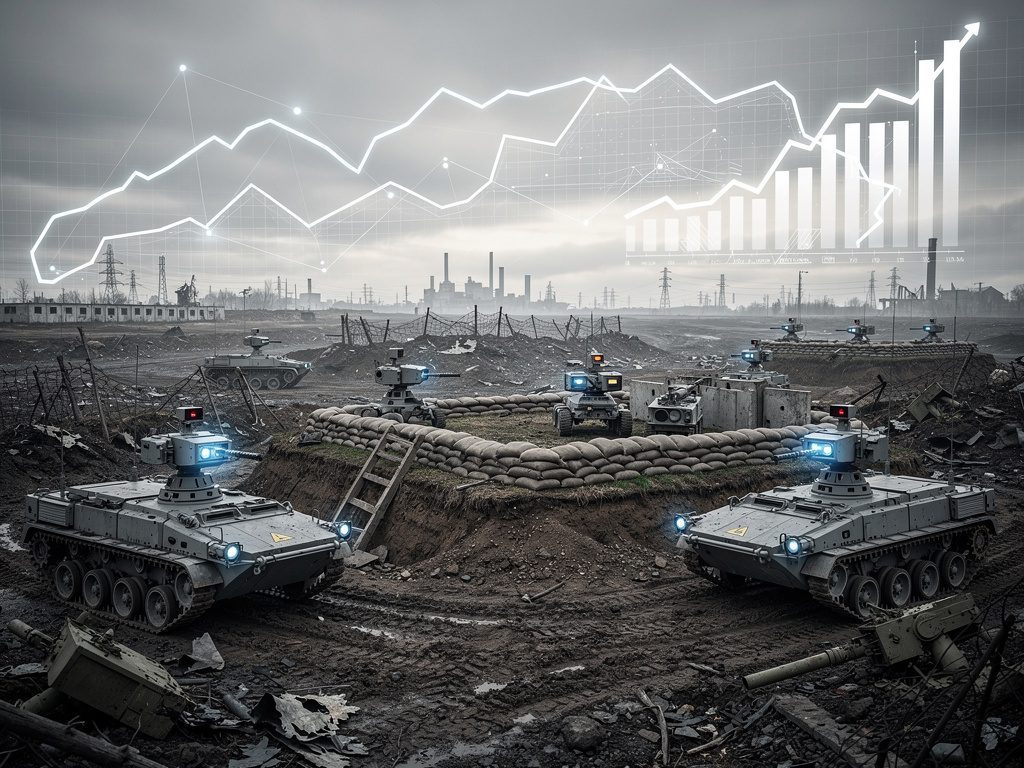
Ukraine’s military has reported a significant achievement in modern warfare, claiming that robotic systems have captured enemy-held territory for the first time in history. This development stems from operations in the ongoing conflict with Russia, where autonomous machines played a central role in seizing positions without direct human involvement on the ground. The company responsible for these robots, a firm specializing in advanced unmanned systems, has seen its valuation soar to one billion dollars following this success, highlighting the growing importance of technology in contemporary battles.
The incident occurred in the eastern regions of Ukraine, where forces have been engaged in intense fighting since Russia’s full-scale invasion began in February 2022. According to official statements from Ukraine’s defense ministry, a team of ground-based robots advanced into Russian-controlled areas, neutralizing threats and establishing control over strategic points. This marked a shift from previous uses of drones and robots, which have typically supported human troops rather than leading assaults independently. Details emerged through various reports, including one from The Next Web, which noted the operation’s success and the subsequent boost to the manufacturer’s market value.
To understand this event, consider the broader context of robotics in military applications. Over the past decade, nations worldwide have invested heavily in unmanned vehicles to reduce risks to soldiers. In Ukraine, the need for such tools became acute as the war dragged on, with both sides suffering heavy casualties. Drones, both aerial and ground-based, have become staples, used for reconnaissance, targeting, and even direct attacks. However, this reported capture represents an escalation, where machines not only engaged enemies but also held territory, a task traditionally reserved for infantry.
The robots in question are products of a Ukrainian tech company that has rapidly risen to prominence amid the conflict. Founded in the years leading up to the invasion, the firm initially focused on civilian applications like agriculture and logistics but pivoted to defense needs when war broke out. Their systems include wheeled and tracked platforms equipped with sensors, cameras, and weapons mounts. These machines can operate semi-autonomously, following pre-programmed paths or responding to remote commands, while incorporating artificial intelligence to make decisions in dynamic environments.
In the specific operation, the robots reportedly moved into a fortified enemy position under cover of darkness. They used thermal imaging to detect heat signatures, identifying Russian soldiers and equipment. Armed with machine guns or grenade launchers, the units engaged targets precisely, minimizing collateral damage. Once the area was cleared, the robots maintained a presence, relaying live feeds to Ukrainian commanders who could then decide on further actions. This approach allowed human forces to follow up safely, consolidating the gains without exposing themselves to immediate danger.
Military experts have analyzed this as a potential turning point in how wars are fought. Traditionally, seizing territory requires boots on the ground to clear obstacles, secure buildings, and prevent counterattacks. Robots change this dynamic by handling the most hazardous phases. They can navigate minefields, withstand small-arms fire, and operate in contaminated zones where chemical or biological hazards might lurk. Moreover, their deployment reduces the psychological toll on soldiers, who often face trauma from close-quarters combat.
The company’s valuation reaching one billion dollars reflects investor confidence in this technology’s future. Venture capital firms, both domestic and international, have poured funds into the enterprise, betting on its expansion beyond Ukraine. The firm’s stock, if publicly traded, or private valuations have surged based on contracts with the Ukrainian military and interest from other nations. This financial milestone underscores a trend where defense tech startups gain unicorn status—valued at over a billion dollars—through innovations proven in real-world scenarios.
Examining the technology more closely, these robots integrate several key components. At their core are robust chassis designed for rough terrain, often inspired by off-road vehicles but miniaturized for agility. Power comes from batteries or hybrid systems, allowing hours of operation without refueling. Sensors form the eyes and ears: lidar for mapping, radar for detecting movement, and AI-driven computer vision for identifying friend from foe. Communication links ensure secure data transfer, using encrypted channels to prevent jamming or hacking by adversaries.
One challenge in developing such systems is ensuring reliability in unpredictable conditions. Mud, snow, and electronic warfare can disrupt operations, so engineers have built redundancies, like multiple navigation methods including GPS, inertial systems, and visual landmarks. The AI algorithms learn from data collected in the field, improving over time to handle new threats. For instance, if a robot encounters a novel obstacle, it can adapt its path or alert operators, refining its behavior for future missions.
This achievement also raises ethical questions about autonomous weapons. Critics argue that machines making life-or-death decisions could lead to unintended escalations or violations of international law. Organizations like the International Committee of the Red Cross have called for regulations on lethal autonomous weapons systems, emphasizing the need for human oversight. In Ukraine’s case, officials insist that final engagement decisions remain with human operators, positioning the robots as tools rather than independent actors. Still, as capabilities advance, the line between assistance and autonomy blurs.
From a strategic perspective, this operation demonstrates Ukraine’s adaptability in asymmetric warfare. Facing a larger, better-equipped opponent, Ukrainian forces have turned to innovation, crowdsourcing designs and funding through platforms like United24. The robot company’s success story fits this narrative, starting from humble beginnings in Kyiv’s tech scene and scaling up amid adversity. Engineers worked in makeshift labs, sometimes under threat of airstrikes, to prototype and deploy these systems quickly.
Comparisons to other conflicts highlight the uniqueness here. In past wars, like those in Iraq or Afghanistan, unmanned aerial vehicles revolutionized surveillance and strikes, but ground robots were mostly used for bomb disposal or scouting. The Israeli military has employed remote-controlled vehicles for border patrols, yet none have claimed to seize territory outright. Ukraine’s feat could inspire similar adoptions elsewhere, from NATO allies to countries in Asia and the Middle East facing territorial disputes.
Looking ahead, the company plans to expand its product line. Future models might include swarms of smaller robots coordinating attacks, or amphibious versions for river crossings. Integration with aerial drones could create combined arms tactics, where ground units receive air support in real time. Partnerships with Western firms might bring advanced components, like more efficient batteries or quantum-resistant encryption, enhancing performance.
The economic impact extends beyond the company itself. Ukraine’s tech sector, once known for software outsourcing, is now gaining recognition in hardware and defense. This could attract foreign investment, create jobs, and foster a post-war economy centered on innovation. However, challenges remain, including supply chain disruptions from the war and the need for international export controls on sensitive technologies.
On the battlefield, this development pressures Russia to respond. Reports indicate Moscow is accelerating its own robotics programs, deploying systems like the Uran-9 combat robot, though with mixed results. The arms race in unmanned technologies could intensify, leading to more sophisticated countermeasures, such as anti-robot drones or electromagnetic pulses.
For civilians caught in the conflict, the use of robots offers mixed blessings. On one hand, they might reduce indiscriminate shelling by enabling precise operations. On the other, the psychological effect of facing machines could heighten fear and alienation. Humanitarian groups monitor these deployments to ensure compliance with laws of war, advocating for transparency in how such systems are used.
As this story unfolds, it illustrates the intersection of technology and geopolitics. The company’s billion-dollar valuation isn’t just a financial metric; it signals a broader acceptance of robots in warfare. Nations observing Ukraine’s experiences may rethink their military doctrines, incorporating unmanned systems as core elements rather than supplements.
In the months following the operation, Ukraine has continued to refine these tactics. Training programs now include robot operation, teaching soldiers to command machines effectively. Feedback from the field informs iterative improvements, making each deployment more effective than the last.
This event also spotlights the role of private enterprise in national defense. Unlike state-run arsenals, startups like this one can innovate rapidly, unburdened by bureaucracy. Their success draws talent, with engineers from around the world contributing remotely or relocating to support the effort.
Ultimately, the capture of enemy territory by robots in Ukraine serves as a case study in technological adaptation under duress. It shows how necessity drives invention, turning a besieged nation into a hub for military innovation. As the conflict persists, such advancements will likely shape not only its outcome but also the future of global security. The company’s ascent to unicorn status encapsulates this transformation, proving that in times of crisis, bold ideas can yield extraordinary results. With ongoing investments and international interest, these robotic systems may soon become standard in arsenals worldwide, redefining the boundaries of human involvement in combat.


 WebProNews is an iEntry Publication