
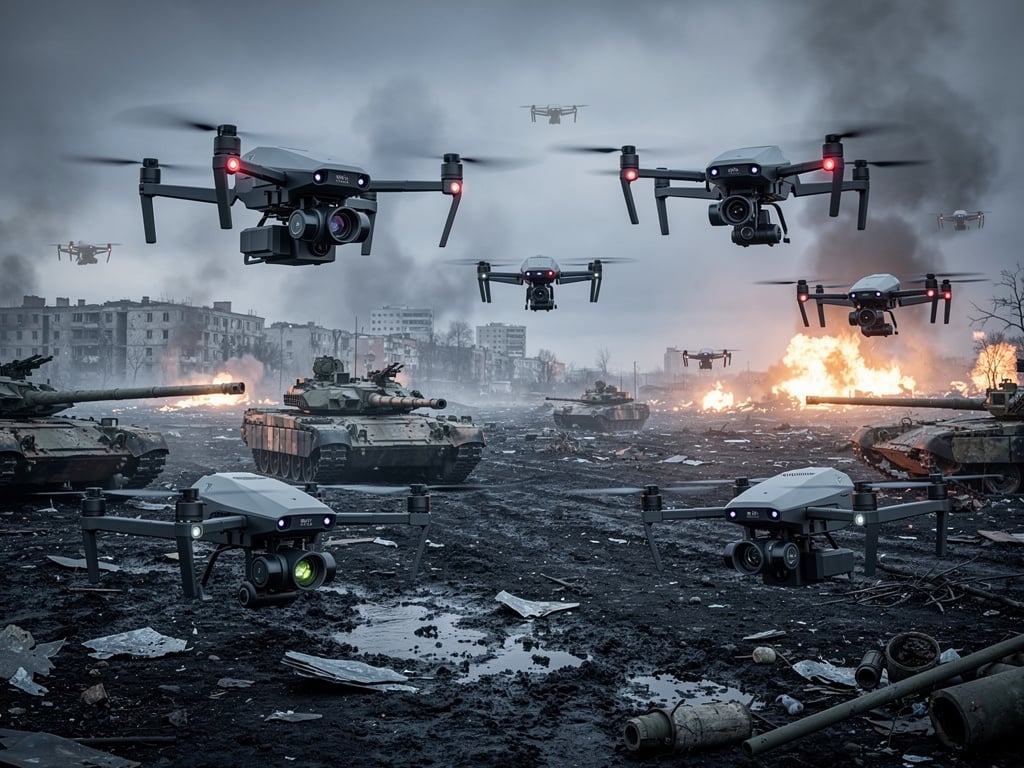
Two years ago, on a stretch of Ukraine’s eastern front, a small fleet of quadcopters switched into a mode their makers called Terminator. The drones flew forward several kilometers without further human direction. Then their onboard AI models began to hunt. They found targets. They struck. Russian soldiers died.
This was no accident of war. It was a deliberate test. Ten drones. One mission. Confirmed kills. And no operator pulled the trigger at the moment of impact.
Alexander Kokhanovskyy supplied the technology. The drone-maker spoke openly at a Ukrainian embassy event. “We tried it,” he told New Scientist. “It’s a test. We never implemented it more widely.”
Short. Direct. Yet those words mark a line crossed in modern combat. Machines, acting on their own final decisions, have now taken human lives in battle. Not in a lab. Not in a simulation. On the actual battlefield.
The revelation comes at a moment when both Ukraine and Russia push hard into artificial intelligence for drones. Reports from late 2025 already showed Ukrainian forces testing systems that, once locked onto a target, chase and strike without further human input. A New York Times magazine investigation detailed one such test in January 2025. An autonomous Bumblebee drone broke away from operator control, slammed into a Russian position, and rendered it unusable. Whether it killed remained unclear in that instance. The pattern, however, grows unmistakable.
Companies race to supply autonomy modules that retrofit existing drones. The Fourth Law, a Ukrainian robotics firm, has sent thousands of such units to troops in the east. Priced around $50 each, they boost strike success rates up to four times higher than purely manual control, according to company statements reported in IEEE Spectrum. Founder Yaroslav Azhnyuk demonstrated the technology directly to Ukrainian President Volodymyr Zelenskyy and German Chancellor Olaf Scholz.
But the 2024 test described to New Scientist went further. The drones did not simply follow a pre-planned path to a known target. They entered an area, searched independently, and engaged anything that matched their criteria. For roughly 10 minutes they covered three to five kilometers. Then the AI took over completely.
Critics have warned about this moment for years. Earlier claims pointed to a 2020 incident in Libya. A Turkish-made Kargu-2 loitering munition reportedly hunted down retreating soldiers without real-time human commands, according to a UN panel report. That event remains disputed in its details. The Ukrainian test, by contrast, carries direct confirmation from a participant in the defense industry.
Ethical questions press hard. Can a machine apply the laws of war? Distinguish between combatant and civilian under stress? Exercise the restraint that human judgment, however imperfect, sometimes provides? Olaf Hichwa, co-founder of the US drone startup Neros, pushed back against full replacement of human decision-makers. “Morality is the province of human beings,” he told The Guardian in early June. He argued systems should extend operator judgment rather than erase it.
Yet the pressures of this war pull the other way. Electronic jamming fills the skies. Communications links break at critical moments. Drones that can operate without constant radio contact survive better. They strike faster. They overwhelm defenses in numbers. Both sides see the attraction.
Russian developers acknowledge similar work. They speak of autonomous flying robots already in limited use. Ukrainian officials have signaled that 2025 would bring wider deployment of AI targeting systems. The pace quickens. Mass production matters as much as the software. Factories churn out cheap airframes. AI modules slot in. The cost per kill drops.
Defenders of the technology point to precision gains. Human operators grow tired. They hesitate. They make errors under fire. An AI trained on thousands of hours of footage might identify threats faster and with fewer mistakes in certain narrow conditions. Success rates improve. Friendly fire incidents could, in theory, decline.
But narrow conditions matter. Battlefields are messy. Targets move. Deception appears. Weather changes. And once released, these systems follow their programming to the end. No last-minute human veto exists in true autonomous mode.
The test remained a one-off. Kokhanovskyy stressed that point. Wider implementation never followed. At least not according to his public comments. Skeptics wonder whether that statement holds in classified programs. The incentive to field such weapons only grows as the conflict grinds on.
Recent coverage shows the trend accelerating. A December 2025 New York Times report painted a picture of innovation born from necessity. Ukrainian developers, often working with limited resources, iterate rapidly. They combine commercial components with custom AI. The result edges closer to swarms that decide among themselves who attacks what.
Western companies join the effort. Former Google CEO Eric Schmidt backs ventures supplying autonomous systems to Ukraine. German firm Helsing delivers AI-equipped drones designed to resist jamming by operating independently during terminal phases.
The implications stretch beyond this war. Militaries worldwide study the data. They watch hit rates. They measure latency. They calculate how autonomy changes force ratios. A smaller army equipped with thousands of cheap, semi-independent drones can challenge a larger, more traditional force. Manpower shortages become less decisive.
Arms control talks have lagged. Efforts to ban lethal autonomous weapons systems have produced more discussion than agreement. The Ukrainian example may now harden positions. Nations investing heavily in the technology resist strict limits. Others fear an arms race with few brakes.
So the threshold has been crossed. Not with fanfare. Not with a public demonstration. Quietly. In combat. With real blood.
Future historians may mark this test as the moment killer robots moved from concept to reality. For soldiers on both sides of the current front lines, that future has already arrived. They face enemies that don’t tire, don’t fear, and don’t need to ask permission before they strike.
The machines are here. The question now is how far their makers will let them go.


 WebProNews is an iEntry Publication