
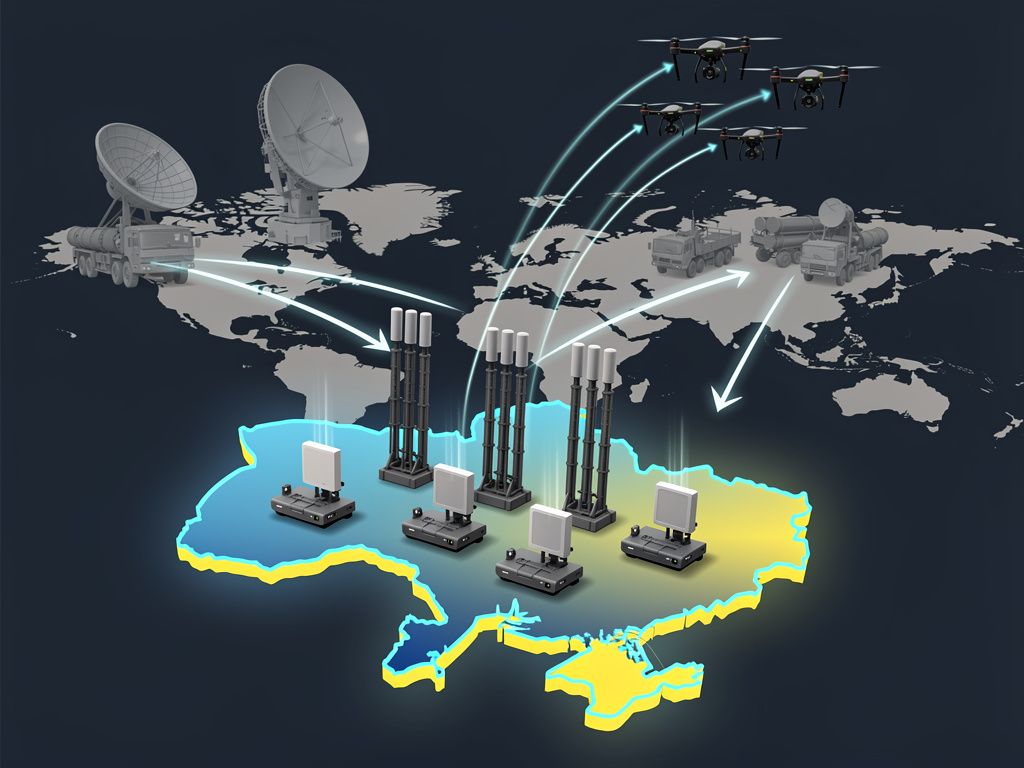
Ukraine wants to sell the world something it has built in blood and fire: the ability to shoot down drones cheaply, at scale, and soon.
That’s the core of a proposition Kyiv is now making to Western allies — not as a supplicant asking for more aid, but as a defense-industrial partner offering a product no one else can match. After three years of relentless Russian drone and missile bombardment, Ukraine has developed and deployed an array of drone interceptor systems born from actual combat, not laboratory simulations. Now its leadership says it can manufacture enough of these systems not only for its own defense but for export to allied nations facing similar threats.
According to Business Insider, Ukrainian officials have told Western counterparts that with sufficient investment, Ukraine could begin supplying interceptor drones to partner countries as early as 2026. The pitch is straightforward: Ukraine has battle-tested technology, low production costs relative to Western defense contractors, and an urgent incentive to scale up manufacturing capacity. What it needs is capital and commitment.
The timing isn’t accidental.
Across Europe, anxiety over drone threats has intensified sharply. The proliferation of cheap unmanned aerial vehicles — from Iranian-designed Shaheds used by Russia to commercially available quadcopters modified for surveillance or attack — has exposed a gap in Western air defenses that legacy systems like Patriot batteries were never designed to fill. Firing a missile that costs $2 million to $4 million at a drone that costs $20,000 is arithmetic that favors the attacker. Every military planner in NATO understands this. Few have a viable answer.
Ukraine argues it does.
The country’s defense sector has undergone a wartime transformation that few outside observers fully appreciate. Before Russia’s full-scale invasion in February 2022, Ukraine’s domestic arms industry was a modest affair, heavily reliant on Soviet-era legacy platforms and a fragmented base of small manufacturers. Today it is something else entirely. Dozens of Ukrainian companies — some startups, some spun out of volunteer units, some backed by the defense ministry — are producing first-person-view attack drones, reconnaissance platforms, electronic warfare systems, and, critically, interceptor drones designed to hunt and destroy incoming unmanned threats.
The interceptor category is where Ukraine sees its greatest export potential. These systems are designed to be cheap, fast to produce, and effective against the slow, low-flying drones that have become the signature weapon of modern asymmetric warfare. Some use kinetic kill methods — essentially ramming incoming drones. Others deploy nets or fragmentation charges. Still others use electronic means to disable targets. The diversity of approaches reflects the Darwinian pressure of the battlefield: what works survives, what doesn’t gets discarded fast.
Oleksandr Kamyshin, Ukraine’s former minister of strategic industries who oversaw much of this buildup before being named an advisor to President Volodymyr Zelensky, has been one of the most vocal proponents of the export strategy. As Business Insider reported, Kamyshin has framed the opportunity in terms that Western defense ministries and finance officials alike can understand: Ukraine’s interceptors cost a fraction of what Western equivalents would, they’re proven in combat, and scaling production creates jobs and industrial capacity inside Ukraine — reducing the long-term burden on allied budgets.
It’s a compelling argument. But it comes with complications.
For one, the Western defense procurement apparatus is not built for speed. NATO countries operate under complex acquisition rules, domestic content requirements, and bureaucratic review processes that can stretch timelines by years. Integrating Ukrainian-made interceptors into allied force structures would require testing, certification, interoperability checks, and political will — the last of which varies enormously from country to country. Poland and the Baltic states, which feel the Russian threat most acutely, may move faster. Germany and France, with their own defense-industrial interests to protect, may prove harder to convince.
There’s also the question of intellectual property and technology transfer. Some of Ukraine’s most effective drone technologies incorporate components sourced from China, commercial electronics markets, and open-source software communities. Export versions would need to address supply chain vulnerabilities and meet allied standards for security and reliability. That’s not a trivial engineering challenge, though Ukrainian manufacturers have shown remarkable adaptability in working around component shortages during the war.
And then there’s the elephant in the room: the war itself. Any investment in Ukrainian defense manufacturing carries the risk that a Russian strike could destroy a factory overnight. Ukraine has dispersed its production facilities and hardened key sites, but the threat remains real. Western investors and governments weighing commitments need to factor in this operational risk, which has no peacetime equivalent.
Despite these hurdles, momentum is building. The European Union has signaled increasing willingness to fund joint defense projects with Ukraine, particularly in areas where Ukrainian expertise exceeds what’s available domestically. In March 2025, the EU announced expanded frameworks for defense cooperation with Kyiv, including provisions for joint procurement and co-production arrangements. Several bilateral deals between Ukraine and individual European nations are reportedly in advanced stages of negotiation, though specifics remain classified.
The United States presents a more complicated picture. The Biden administration was broadly supportive of integrating Ukraine into Western defense supply chains, but the political environment in Washington has shifted. Congressional appetite for Ukraine-related spending has fractured along partisan lines, and the current debate over aid packages has created uncertainty about long-term American commitment. Ukraine’s pitch to supply interceptors to the U.S. military or its allies would need to clear not just Pentagon procurement hurdles but Capitol Hill politics — a combination that has stymied far less controversial proposals.
Still, the underlying logic is hard to argue with on purely strategic grounds. The drone threat isn’t going away. It’s accelerating. Houthi forces in Yemen have used drones and missiles to disrupt global shipping lanes. Non-state actors from the Sahel to Southeast Asia are acquiring increasingly sophisticated unmanned systems. And near-peer competitors like China are investing heavily in drone warfare capabilities that could be deployed in a Taiwan contingency or other flashpoints. The demand signal for affordable, effective counter-drone systems is global and growing.
Ukraine’s combat data gives it an edge no other country possesses. Its forces have engaged tens of thousands of incoming drones over the past three years, generating an unparalleled dataset on intercept techniques, failure modes, and system performance under real conditions. This isn’t theoretical knowledge. It’s operational intelligence refined through daily life-and-death application. Western defense firms can run simulations and conduct exercises, but none of them have stress-tested their products the way Ukraine has — involuntarily, under sustained bombardment.
Some Western defense companies see opportunity rather than competition. Partnerships between Ukrainian drone makers and established European or American firms could combine Ukraine’s battlefield innovation with Western manufacturing scale, quality control, and market access. Several such partnerships have already been announced. In late 2024, a consortium involving Ukrainian drone company Brave1 and European defense integrators began work on a co-developed interceptor platform intended for NATO markets. Details remain sparse, but the model — Ukrainian design and combat insight married to Western production standards — could prove replicable across multiple product lines.
The financial dimensions are significant. Ukraine’s defense ministry has estimated that scaling interceptor production to export-ready levels would require roughly $2 billion to $3 billion in combined investment over the next two to three years. That’s a substantial sum for a country fighting an existential war, but a rounding error in the context of global defense spending, which exceeded $2.4 trillion in 2024 according to the Stockholm International Peace Research Institute. If even a fraction of that global spending shifts toward counter-drone systems, as many analysts expect, the addressable market for Ukrainian products could be enormous.
Kyiv is also making a broader geopolitical argument. A Ukraine that functions as a defense-industrial partner — not just a recipient of Western weapons — changes the calculus around support for the country’s sovereignty. It creates mutual dependency. It gives Western governments a tangible return on their investment in Ukrainian security. And it embeds Ukraine more deeply into the Western alliance structure in ways that make abandonment politically and economically costlier. This isn’t charity. It’s business, wrapped in strategy.
Whether the West moves fast enough remains an open question. The history of allied procurement is littered with promising initiatives that died in committee or were overtaken by events. But the drone threat isn’t waiting for bureaucracies to catch up. Every month brings new incidents, new capabilities in adversary hands, new demonstrations that traditional air defenses are insufficient against swarms of cheap unmanned systems.
Ukraine is offering an answer. Not a perfect one. Not without risk. But one forged in conditions no testing range can replicate. The question for Western capitals isn’t whether they need what Ukraine is selling. It’s whether they’ll buy it before the next attack proves they should have.


 WebProNews is an iEntry Publication