
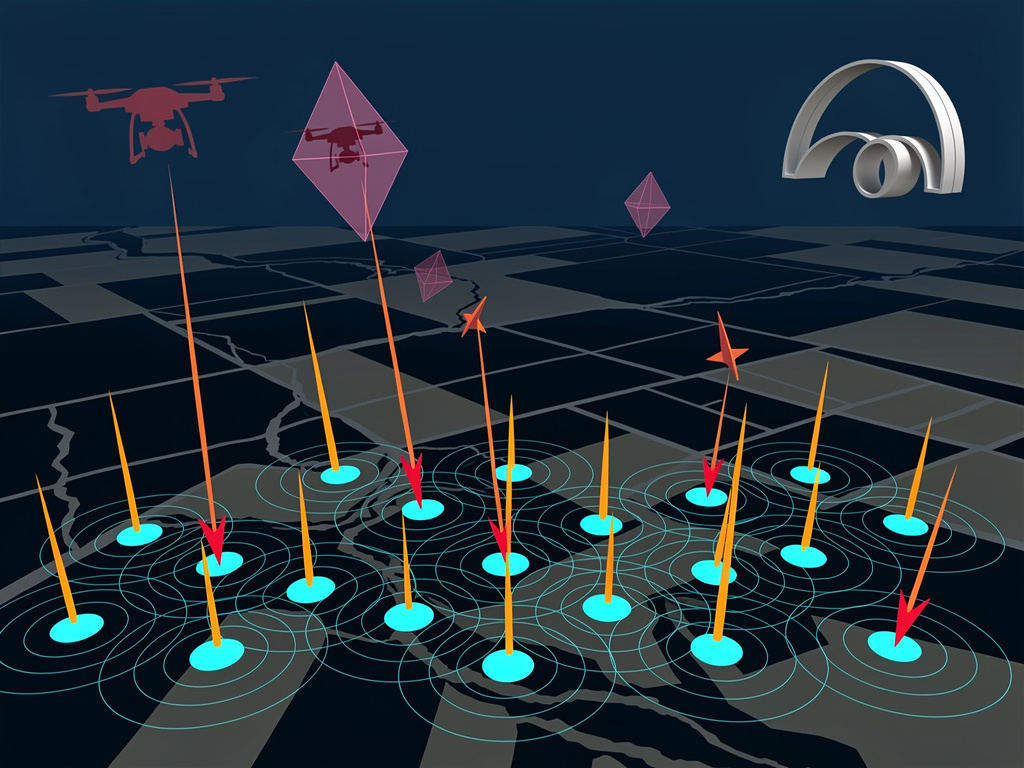
Ukraine has blanketed its territory with thousands of low-cost acoustic sensors. These simple microphone arrays listen for the telltale buzz of incoming drones. They feed data to mobile teams armed with machine guns, lasers and cheap interceptor drones. The approach works. And it has NATO commanders taking notes.
Sir John Stringer, NATO’s deputy supreme allied commander for Europe, put it plainly. The alliance must invest in a broader range of sensors, including “very cheap acoustic sensors” already deployed across Ukraine. Some of those capabilities remain novel for many Western forces. Business Insider reported his comments this month.
Traditional air defense radars excel against fast, high-flying jets and missiles. Drones fly lower. They move slower. Their small signatures often slip past systems optimized for different threats. Ukraine couldn’t afford to wait for perfect solutions. It improvised.
The result is a layered network. Acoustic sensors form the base layer. They detect engine noise at ranges sufficient to cue responses. One system, known as Sky Fortress, distributes these sensors to identify distinctive drone sounds and broadcast warnings along the front. Small Wars Journal detailed how this fits into broader decentralization of combat power.
From Squad-Level Alerts to Nationwide Coverage
At the tactical edge, soldiers carry devices such as the Tsukorok drone detector or chest-mounted GoTak systems. These tools alert squads to nearby unmanned aircraft, reveal approach direction and give precious seconds to take cover or activate countermeasures. Some units even intercept analog drone video feeds in real time with systems like Chuyka. The effect is profound. Responsibility for air defense has shifted downward. Platoon leaders and squad commanders now manage detection, jamming and kinetic response without waiting for higher headquarters.
Mobile fire teams ride in pickup trucks. They mount heavy machine guns, infrared binoculars and improvised lasers. These teams handle the bulk of day-to-day drone intercepts. Expensive missiles stay reserved for ballistic threats or massed attacks. The economics make sense. A Russian Shahed-style drone costs between $20,000 and $50,000. A Patriot PAC-3 interceptor runs roughly $3.7 million. Sustained use of the latter against the former drains inventories fast.
Tom Goffus, NATO’s assistant secretary general for operations, highlighted the scale last year. Ukraine covers its airspace below 1,000 meters with acoustic sensors for less than $54 million. “It’s crazy what they’re doing with this,” he said. The entire network costs less than two Patriot missiles.
Interceptor drones add another economical layer. Ukraine produces more than 1,000 per day. Models like the 3D-printed P1-SUN cost around $1,000 each. They reach speeds over 300 kilometers per hour. In March alone they accounted for tens of thousands of downed Russian drones, according to Ukrainian figures. BBC visited production lines and operators who described the shift from desperation to systematic defense.
One Ukrainian officer told the BBC, “we are now, unfortunately, the best in the world.” The statement carries both pride and exhaustion. Necessity drove rapid iteration. Private companies now deliver modular systems that frontline units adapt weekly. Software updates, new sensor fusions and cheaper components emerge from battlefield feedback loops faster than any peacetime procurement cycle.
But gaps remain. Ballistic missiles still require sophisticated interceptors in short supply. Acoustic sensors struggle against silent gliders or very high-altitude threats. Electronic warfare complicates the picture. Russia jams signals, spoofs GPS and hunts for emitter signatures. Ukrainian units counter with passive detection, frequency hopping and distributed jammers mounted on everyday vehicles.
Andrius Kubilius, the European Union’s defense commissioner, warned that Western radars see aircraft and missiles but miss low-flying drones. He pointed to Ukraine’s thousands of sensors as a model for a proposed European “drone wall.” Baltic states have begun purchasing similar acoustic systems, citing direct lessons from the eastern front.
The Sky Map platform ties much of this together. It fuses data from over 10,000 acoustic sensors, radars and mobile phones. Operators receive real-time cues. Interceptor drones or ground teams respond. Saudi Arabia, the United Arab Emirates, Qatar and U.S. forces at Prince Sultan Air Base have tested or adopted variants following deals signed during Ukrainian President Volodymyr Zelenskyy’s Gulf visits. Al Jazeera reported the system’s export success in May.
Cost remains the central lesson. Using a $4 million missile against a $30,000 drone is unsustainable over months or years of conflict. Ukraine demonstrated that a mix of passive sensors, cheap kinetic options and decentralized decision-making can absorb mass attacks without exhausting high-end inventories. Western officials now repeat the phrase “cost curve” in briefings. Defenses must match the economic reality of the threat.
Maj. Modris Kairišs heads Latvia’s Autonomous Systems Competence Center. He told Business Insider that NATO must rebuild detection for low altitudes. “These drones are flying very low,” he said. Quantity matters. So does diversity. Every sensor carries strengths and weaknesses. A single type creates exploitable blind spots.
Justin Bronk, senior research fellow at the Royal United Services Institute, has made similar points for years. Effective air defense demands layered sensors covering different altitudes, speeds and signatures. Linking them into a coherent picture is complex. Ukraine simplified the problem through necessity and scale.
Recent fighting in the Middle East reinforced the message. Iranian Shahed drones targeted U.S. and allied sites. Defenders sometimes exhausted expensive interceptors before the attack wave ended. Reports from the Gulf describe Ukrainian teams demonstrating Sky Map and interceptor drones to local forces. The systems achieved intercepts at fractions of traditional costs.
Lt. Gen. Sean Gainey, former commander of U.S. Army Space and Missile Defense Command, advocated integrating Ukrainian-style low-cost acoustic sensors into American networks as early as 2024. That recommendation has gained urgency. Pentagon planners study how to distribute sensors across forward bases, logistics hubs and maneuver units without creating new vulnerabilities.
The shift challenges decades of doctrine. Western forces optimized for air supremacy against peer or near-peer foes assumed dominance after initial strikes. Persistent, cheap drones erode that assumption. They force constant vigilance. They turn every movement into a potential target. Sensors litter the battlefield. Operators on both sides hunt for emissions while trying to remain silent themselves.
Ukraine’s production model adds another dimension. Factories churn out interceptors, detectors and jammers at rates that would have seemed impossible in 2022. Modular designs allow rapid upgrades. A sensor node that fails can be replaced for a few hundred dollars. Contrast that with the years required to field new radar systems or missile batteries.
Critics note limitations. Acoustic sensors can be fooled by wind, background noise or decoys. Networks require reliable communications to share data. Mobile teams remain exposed. Yet the overall system has enabled Ukraine to maintain air defense coverage despite massive Russian investment in drones and missiles. Russian forces launch hundreds of one-way attack drones weekly. Many get through. Enough are stopped to preserve combat power.
NATO’s Stringer stressed that air superiority still matters. It enables the joint force. The methods to achieve it, however, must evolve. Cheap sensors represent one piece. Cheap effectors, better integration, faster decision loops and industrial scale form the rest. Ukraine has shown the West a path. Whether alliance members move quickly enough remains an open question.
Recent analysis from Eastern Circles in January examined how drone saturation exposed weaknesses in legacy concepts. It called for layered defenses built on low-cost kinetics, passive sensors and rapid adaptation. Ukraine’s experience matches those recommendations point by point.
So the sensors keep multiplying. The networks grow denser. Interceptors get smarter and cheaper. The war grinds on. And defense ministries from Washington to Brussels study the data, run the numbers and wonder how to replicate success before the next mass attack arrives.


 WebProNews is an iEntry Publication