
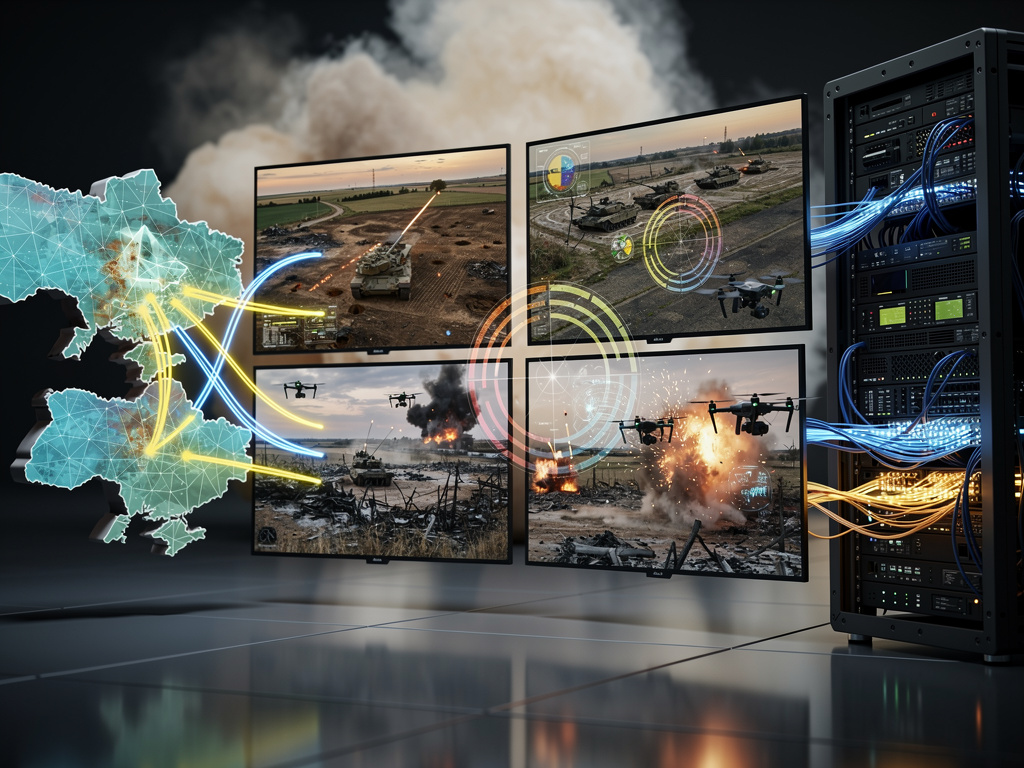
Ukraine has made a decision that could reshape how Western militaries build artificial intelligence for decades to come. The country is offering its allies access to one of the most valuable and grim datasets in modern warfare: real battlefield data drawn from more than three years of full-scale conflict with Russia. Drone footage, electronic warfare signatures, targeting information, and operational patterns — all of it now potentially available to feed machine learning models being developed by allied defense companies and governments.
The move, first reported by Engadget and sourced from a Reuters exclusive, was confirmed by Ukraine’s digital transformation ministry. The country’s Minister of Digital Transformation, Mykhailo Fedorov, has been one of the war’s most consequential figures behind the scenes, orchestrating everything from Starlink deployments to drone procurement. Now he’s positioning Ukraine’s hard-won combat experience as a strategic asset — one that can be exported.
This isn’t charity. It’s statecraft.
Ukraine understands that its battlefield data holds extraordinary value. No NATO country has fought a sustained, high-intensity conventional war against a near-peer adversary in the age of AI-enabled drones, electronic warfare jamming, and satellite-linked kill chains. The United States, United Kingdom, France, and others have spent billions developing autonomous systems and AI-driven targeting tools, but almost all of that development has relied on simulated environments, controlled exercises, and data from asymmetric conflicts against insurgents. Ukraine’s dataset is different in kind, not just degree. It captures what happens when two industrial armies collide with modern technology — when drones are jammed, when countermeasures evolve weekly, when electronic signatures shift daily.
According to Reuters, the arrangement allows partner nations and approved defense firms to use Ukrainian operational data to train AI models, particularly those involved in autonomous drone operations, target recognition, and battlefield decision-making. The specifics of data-sharing agreements will vary by partner, and Ukraine retains control over what gets shared and under what terms. Fedorov’s ministry has been building the digital infrastructure for this kind of exchange for months, working alongside Ukraine’s defense and intelligence agencies to classify, organize, and sanitize data for external use.
The timing is not accidental. Ukraine’s allies have been pressing Kyiv to formalize data-sharing arrangements as Western defense budgets increasingly pivot toward AI. The Pentagon’s Replicator initiative, which aims to field thousands of autonomous systems, needs training data that reflects real contested environments. So does the UK’s Defence AI Centre and France’s Agence de l’innovation de défense. Until now, getting that data required ad hoc arrangements, often brokered through individual defense contractors operating in Ukraine.
That informal system had limits. And risks.
Several Western drone and AI companies have been operating in Ukraine with varying degrees of official sanction, collecting data as they test and refine their systems in combat. Companies like Palantir, Anduril, and a constellation of smaller startups have had personnel or technology deployed in or near the conflict zone. But the legal and ethical frameworks around that data collection have been murky. Who owns the data? What can be done with it? Can a company train a commercial AI model on footage that includes the deaths of real soldiers? These questions have lingered without clear answers.
Ukraine’s new policy attempts to impose structure on what had been a free-for-all. By centralizing data access through government channels, Kyiv gains several advantages. It can negotiate from a position of strength, demanding reciprocal technology transfers, defense commitments, or financial compensation. It can ensure that sensitive operational details — troop positions, classified tactics, intelligence sources — are properly scrubbed before data leaves Ukrainian hands. And it can track who has what, reducing the risk of leaks or unauthorized use.
For Ukraine’s allies, the appeal is obvious. Training an AI model to identify a Russian T-72 tank in a tree line is one thing when you’re using synthetic imagery generated in a lab. It’s something else entirely when you have thousands of hours of actual drone footage showing T-72s in various states — camouflaged, moving, destroyed, partially hidden by foliage or urban structures — captured under real atmospheric conditions with real sensor noise. The same logic applies to electronic warfare data. Understanding how Russian jamming systems operate, how their patterns shift, and how Ukrainian drones have adapted provides a training corpus that simply cannot be replicated in simulation.
The implications extend well beyond the current war. AI models trained on Ukrainian battlefield data could form the backbone of autonomous systems deployed by NATO forces for years to come. That makes Ukraine not just a recipient of Western military aid but a contributor to Western military capability — a shift in the relationship that Kyiv has been seeking since the war’s earliest days. President Volodymyr Zelensky and his government have consistently argued that Ukraine is defending not just its own territory but the broader security architecture of Europe and the democratic world. Offering battlefield AI training data reinforces that argument in concrete, material terms.
There are complications. Serious ones.
First, the ethical dimension. Battlefield data inevitably contains footage of human suffering — soldiers being killed, civilians caught in strikes, the destruction of homes and infrastructure. Using that data to train AI systems raises questions that defense ethicists and international humanitarian law scholars are only beginning to grapple with. The International Committee of the Red Cross has expressed concern about the use of AI in targeting decisions and the potential for algorithmic bias when models are trained on data from a single conflict. A model that performs well in the flat terrain and electronic warfare conditions of eastern Ukraine may behave unpredictably in a different theater — say, the mountainous border regions of a potential Taiwan conflict or dense urban environments in the Middle East.
Second, there’s the question of Russian countermeasures. Moscow is acutely aware that its military operations are being studied in granular detail. Every tactic, every electronic emission, every pattern of movement captured in Ukrainian data becomes a vulnerability once it’s fed into Western AI systems. Russia will adapt, and it may already be doing so — deliberately varying its tactics to poison the dataset, introducing deceptive patterns designed to mislead machine learning algorithms. This adversarial dimension adds a layer of complexity that makes the data both invaluable and potentially treacherous.
Third, data sovereignty. Ukraine is offering access, not ownership. But once data is used to train a model, extracting it becomes effectively impossible. The knowledge is baked into the neural network’s weights. This creates a tension: Ukraine wants to maintain control and derive ongoing strategic benefit from its data, but the nature of machine learning means that once a model is trained, the original data’s leverage diminishes. Kyiv will need sophisticated legal agreements and technical safeguards to protect its interests over the long term.
The broader context here matters. Ukraine has become the world’s most active laboratory for drone warfare, electronic warfare, and AI-assisted military operations. The conflict has accelerated innovation cycles to a degree not seen since World War II. Ukrainian units are fielding new drone variants within weeks of identifying a need, iterating on designs in ways that would take Western procurement systems months or years. First-person-view kamikaze drones, autonomous ground vehicles, AI-assisted artillery targeting — all of these have been developed, tested, and refined under fire.
That speed of innovation has attracted intense interest from Western defense establishments. The U.S. Department of Defense has sent multiple delegations to study Ukrainian operations. The UK has established dedicated channels for sharing lessons learned. And defense companies large and small have been circling, eager to get their hands on the data and operational insights that only a real war can produce.
But Ukraine’s willingness to share comes with an implicit message to its allies: We’ve paid for this knowledge in blood. Don’t take it for granted.
Fedorov’s ministry has been remarkably effective at turning Ukraine’s wartime experience into diplomatic currency. The country’s Brave1 defense tech cluster, established to fast-track military innovation, has become a model that other nations are studying. Its integration of commercial technology into military operations — from consumer drones modified for combat to AI tools built by Ukrainian startups — has demonstrated what a digitally fluent military can accomplish even against a much larger adversary.
Now, by formalizing the data-sharing framework, Ukraine is taking the next step. It’s moving from ad hoc innovation partner to institutional contributor to Western defense AI. The data it holds is a strategic resource, arguably as important in the long run as any weapons system. And Kyiv knows it.
The question for Western governments is whether they’ll treat this resource with the seriousness it deserves. That means not just signing data-sharing agreements but investing in the infrastructure to process, validate, and responsibly use what Ukraine is offering. It means funding the ethical and legal frameworks needed to govern AI training on real combat data. And it means recognizing that Ukraine’s contribution to Western security extends far beyond holding a line on the map.
The war in Ukraine has already rewritten assumptions about modern combat — the dominance of drones, the vulnerability of armored formations, the centrality of electronic warfare, the speed at which the information domain shapes the physical battlefield. Now it may also rewrite how the world’s most advanced militaries build the AI systems they’ll rely on for the next generation of conflict. All because one country, fighting for its survival, decided that its data was too valuable to keep locked away.


 WebProNews is an iEntry Publication