
Robotic Shields on the Front Lines: Ukraine’s Ground Drones Defy Russian Drones in Daring Evacuations
In the relentless grind of the Ukraine-Russia conflict, where aerial drones have turned open battlefields into deadly no-go zones, a new breed of technology is emerging as a game-changer for saving lives. Ukrainian forces are increasingly relying on unmanned ground vehicles—robust, remote-controlled robots designed to navigate treacherous terrain and evacuate wounded soldiers without exposing more troops to danger. A recent incident, captured on video and shared widely, underscores both the promise and perils of this innovation: a Russian first-person-view (FPV) drone struck a Ukrainian rescue robot mid-evacuation, yet the machine’s armored shell protected the injured soldier inside from further harm.
The event unfolded in the contested regions of eastern Ukraine, where traditional medical evacuations have become nearly impossible due to the ubiquity of Russian surveillance and attack drones. According to reports from the Ukrainian military’s 1st Medical Battalion of the 1st Tank Brigade, the robot was transporting a severely wounded soldier back from the front lines when it was targeted. The drone’s impact caused significant damage to the vehicle, but the soldier emerged unscathed, highlighting the robot’s role not just as a transporter but as a literal shield against explosive threats.
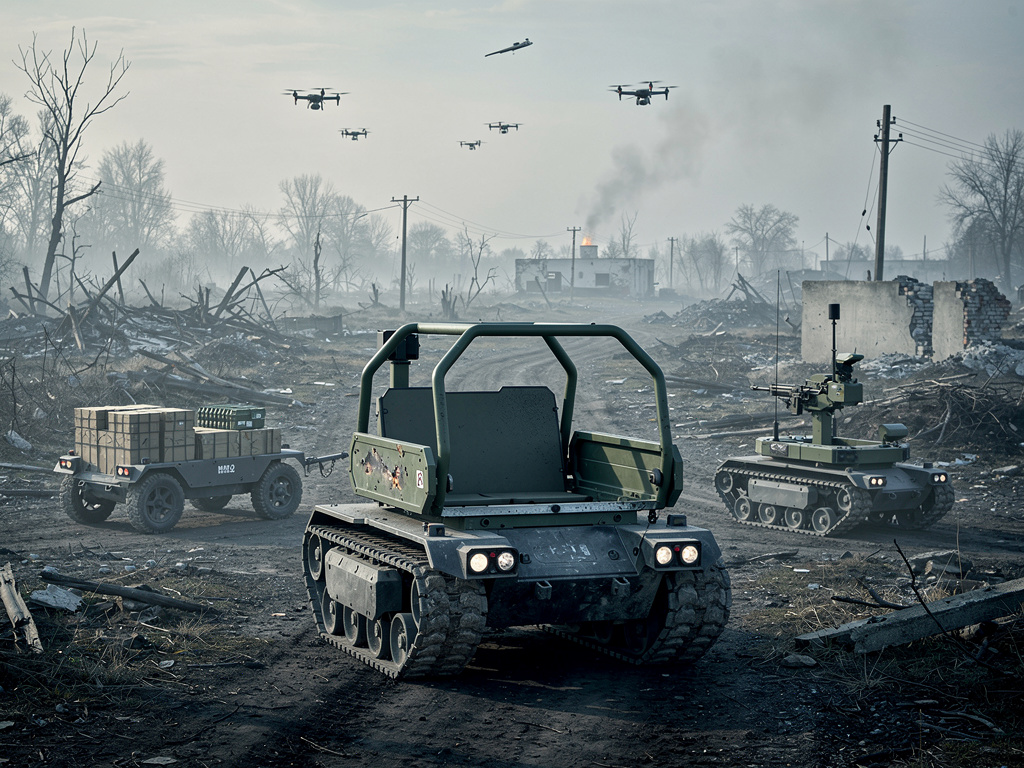
This isn’t an isolated case; it’s part of a broader shift in military tactics driven by necessity. As Russian forces press their advantages in drone warfare, Ukrainian innovators have accelerated the development and deployment of ground-based robots. These machines, often resembling armored carts or mini-tanks on wheels or tracks, are equipped with cameras, communication systems, and sometimes even weapons, allowing operators to control them from safe distances while performing critical tasks like casualty evacuation.
Evolution of Ground Robotics in Modern Warfare
The adoption of such technology marks a significant evolution in how wars are fought, particularly in environments saturated with unmanned aerial threats. Sources indicate that Ukraine has been experimenting with these robots since early in the conflict, but their use in medical evacuations has ramped up dramatically in 2025. For instance, a report from Business Insider details how the robot in question, likely a domestically produced model, withstood the drone strike during a 58-kilometer round trip, a feat that would have been suicidal for human medics.
Beyond this incident, similar stories abound. In November 2025, CBS News chronicled a daring rescue where a ground robot extracted a Ukrainian soldier trapped behind Russian lines for 33 days, navigating minefields and dodging mortar fire. The vehicle, described as an “armored off-road casket,” succeeded after seven failed human attempts, illustrating the robots’ edge in persistence and expendability.
Industry experts note that these robots are not high-end marvels but pragmatic, cost-effective solutions. A U.S. Navy special operations veteran, speaking to Business Insider in a separate piece, emphasized the value of producing many inexpensive units over a few sophisticated ones. This approach allows Ukraine to deploy swarms of robots, accepting losses as part of the strategy, much like their drone operations in the skies.
Technical Innovations Driving Battlefield Resilience
At the heart of these robots’ effectiveness is their design tailored for the harsh realities of the front. Many models feature reinforced armor capable of withstanding small-arms fire, shrapnel, and even direct hits from FPV drones, which are essentially flying improvised explosive devices. The robot in the recent strike, for example, absorbed the blast and continued functioning enough to complete the evacuation, as per battalion accounts.
Ukrainian developers, often working through initiatives like the government’s BRAVE1 platform, have iterated rapidly on these designs. Posts on X (formerly Twitter) from military enthusiasts and journalists highlight innovations such as the “ZMIY Logistic” UGV, which endured multiple attacks—including bullets, artillery shells, a mine, and an FPV drone—while evacuating a soldier from the 59th Brigade. Such resilience comes from modular construction, allowing quick repairs or replacements in the field.
Moreover, these robots integrate advanced navigation systems, including GPS-denied capabilities to counter Russian electronic warfare. Operators use real-time video feeds to maneuver through debris-strewn paths, avoiding obstacles that would halt human teams. A December 2025 article in CNN describes how these features make robots the “best way out” for injured soldiers when drones render traditional methods obsolete.
Strategic Implications for Ukrainian Forces
The strategic value extends beyond mere evacuations. Ground robots are multifaceted assets, doubling as supply carriers, reconnaissance tools, and even combat platforms. For instance, Gwara Media reported on a robot from the 3rd Separate Assault Brigade that held defensive positions against Russian assaults for 45 days, repelling breakthroughs without human intervention.
This versatility addresses Ukraine’s manpower shortages, a critical issue as the war drags into its fourth year. By minimizing risks to personnel, robots preserve fighting strength, allowing soldiers to focus on offensive operations rather than rescue missions. Recent news from Ukraine Today notes that both sides are adapting robots for new missions, with Ukraine leading in medical applications due to its innovative ecosystem of startups and volunteer engineers.
However, challenges persist. Robots can become targets themselves, as the recent drone strike demonstrates. Their visibility on thermal imaging or radar makes them vulnerable, and while cheap production mitigates losses, it doesn’t eliminate them. Ukrainian commanders, as quoted in an April 2025 Business Insider analysis, view them as a “last resort” for now, reserved for high-risk scenarios to avoid creating new vulnerabilities.
Broader Military and Ethical Considerations
Looking deeper, the rise of ground robots raises questions about the future of warfare ethics and international norms. Insiders in the defense sector point out that while these machines save lives on one side, they could escalate automation in conflicts, potentially leading to more impersonal and prolonged engagements. A post on X by journalist JP Lindsley from July 2025 praised Ukraine’s use of robots for evacuating three soldiers over 17 kilometers under fire, framing it as a “revolutionary answer” to drone dominance.
Comparatively, Russian forces are also deploying ground robots, though reports suggest their models lag in sophistication. An assessment from the Institute for the Study of War in December 2025 indicates Russia’s inability to build strategic reserves, forcing reliance on attritional tactics that robots could disrupt if Ukraine scales up production.
For Western allies, Ukraine’s experiences offer valuable lessons. The U.S. veteran interviewed earlier advocated emulating Ukraine’s low-cost model, suggesting that NATO forces could integrate similar technologies for future operations in contested environments. This cross-pollination is evident in joint projects, where Ukrainian innovations inform global military tech development.
Pushing Boundaries: From Evacuation to Autonomous Operations
As 2025 draws to a close, Ukraine continues to approve new robot variants, such as one equipped with grenade launchers for offensive roles, per a Business Insider report. This diversification hints at a future where ground robots handle a spectrum of tasks, from logistics to direct combat, reducing human exposure across the board.
Personal accounts from the front amplify the human element. A soldier rescued after a month in no-man’s-land, as detailed in CNN’s coverage, described the robot’s arrival as a “miracle on wheels,” underscoring the psychological boost these machines provide amid the war’s grim toll.
Yet, scalability remains key. With Russia claiming over 1.2 million Ukrainian casualties in recent updates from Ukrinform, the pressure to innovate is immense. Ukrainian firms like Rovertech, highlighted in X posts, are pushing boundaries with robots that withstand extreme punishment, ensuring more soldiers return home alive.
Global Ripples and Future Trajectories
The incident of the drone-struck robot has sparked discussions on X, with users like Euromaidan Press and NOELREPORTS sharing footage and analyses, reflecting widespread admiration for Ukraine’s ingenuity. These social media insights reveal a sentiment that technology is tilting the balance, even if incrementally, in a war of attrition.
Internationally, this development prompts reevaluation of military aid. Western partners are urged to supply components for robot production, as cheap, effective units could prove more decisive than expensive hardware. An Indian Defence Review piece from December 2025 portrays these robots as harbingers of an “era of droids,” where AI-assisted machines redefine frontline dynamics.
Ultimately, as Ukraine refines these robotic lifelines, they stand as testaments to resilience and adaptation. In a conflict where every life saved bolsters morale and capability, ground robots are not just tools but symbols of a nation’s determination to outthink and outlast its adversary, one armored evacuation at a time.


 WebProNews is an iEntry Publication