
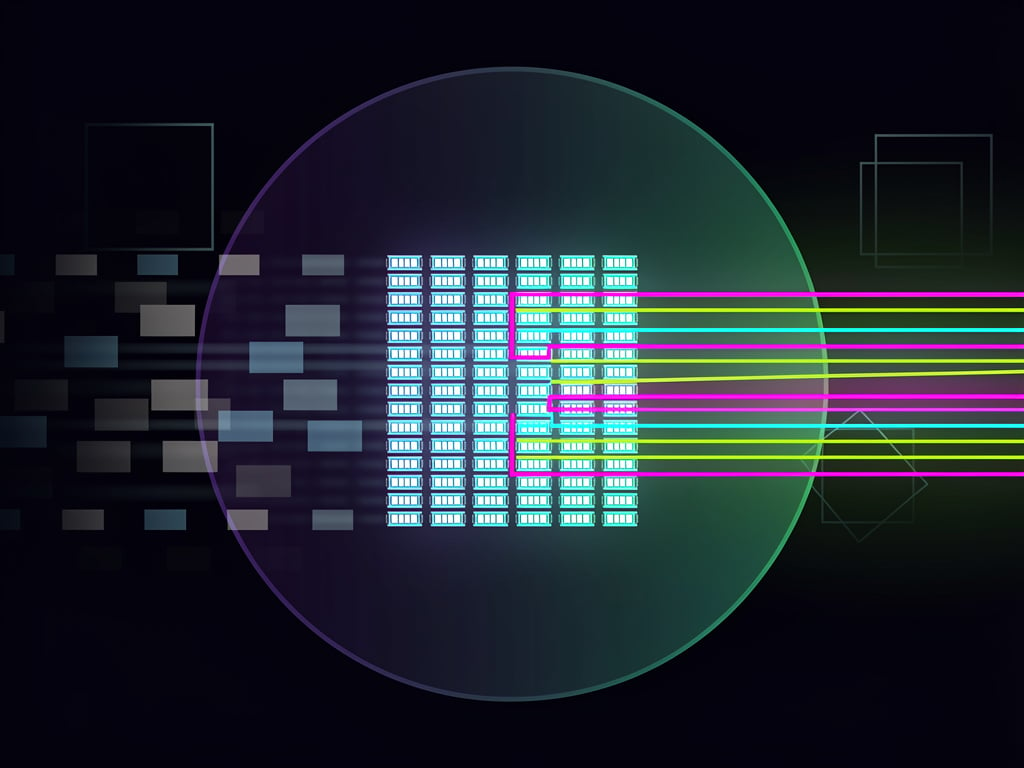
Power. Latency. Heat. The three forces that now dictate how large AI models actually run at scale. Traditional electrical switches in data center networks consume vast energy, leave GPUs waiting, and force operators to build ever more elaborate cooling systems. A small London company says it has a different answer. Light.
Oriole Networks announced Monday it will deploy what it calls the world’s first pure photonic AI network inside the UK’s ARIA Scaling Inference Lab. The system pairs the startup’s PRISM platform with AMD Instinct GPUs and AMD EPYC CPUs. No electrical packet switches sit in the core. Data moves as photons, switched in nanoseconds. The result, according to Oriole, is an 81% reduction in core network power and GPU idle time that falls from roughly 60% to less than 1%.
From Physics Experiment to Production Deployment
The shift happened fast. Oriole spun out of University College London in 2023. In three years it moved from research to its first commercial installation. The collaboration with AMD began more than a year ago. Today the hardware sits in a £50 million ($66.6 million) testbed created by the UK’s Advanced Research and Invention Agency to attack bottlenecks in large-scale inference.
James Regan, Oriole’s CEO, captured the moment. “A year ago, we were proving the physics; today, we’re proving the business.” He added that the AMD collaboration scaled the system an order of magnitude larger and that early data already shows performance gains. (SiliconANGLE, June 8, 2026)
Madhu Rangarajan, corporate vice president of AMD’s Compute and Enterprise AI business, struck a measured tone. “Oriole’s AI backend networking with nanosecond optical circuit switching represents a fundamentally different way to connect accelerators at scale. We are helping to validate how photonic fabrics can work alongside AMD compute to deliver the low-latency, high-bandwidth connectivity that AI inference workloads demand.” (HPCwire, June 8, 2026)
Suraj Bramhavar, program director at ARIA, welcomed the partnership. He called it exactly the sort of collaboration between innovative startups and industry leaders that the Scaling Inference Lab was designed to foster. (The Next Web, June 8, 2026)
PRISM works by replacing the power-hungry electrical switches that have defined data center networks for decades. Optical circuit switches take their place. Photons travel directly from chip to chip. The approach cuts not only electricity but also cooling needs and water consumption. And because the design stays agnostic to any particular accelerator, it avoids lock-in to a single vendor’s stack. Oriole plans wider industry rollout in 2027.
The numbers sound striking. Eighty-one percent less power in the core network. Tokens per second rising sharply. More users served from the same hardware. Yet these figures come from the company and its partner. Independent production-scale benchmarks do not yet exist. The ARIA deployment, while real, sits far below the size of hyperscale clusters run by the largest cloud providers. The gap between promising testbed and sustained operation at thousands of GPUs remains wide. Many hardware startups have stumbled there before.
Still, the timing matters. AI training and inference clusters keep growing. Their networks now rival compute as the dominant consumer of power and source of latency. Hyperscalers watch every watt. So do governments worried about energy grids and national competitiveness. The UK government, through ARIA, clearly sees photonic approaches as one path worth testing.
Oriole has raised roughly $35 million from investors that include Plural, the UCL Technology Fund, Clean Growth Fund, XTX Ventures and Dorilton Ventures. That capital bought three years of rapid progress. Co-founders include Professor George Zervas, whose research at UCL laid the groundwork. The company also revealed PRISM Ultra earlier this year, promising a one-hop photonic fabric capable of 50 exabits per second. Such scale, if delivered, would support clusters with up to a million nodes while staying congestion-free and resilient. (Oriole Networks)
Broader industry momentum backs the bet. NVIDIA has poured billions into photonics companies and introduced its own silicon photonics-based switches aimed at million-GPU AI factories. Tower Semiconductor partnered with Oriole in March 2026 to build nanosecond optical circuit switching on its silicon photonics platform. AMD itself invested in several optics startups and acquired Enosemi. The message is clear. Electrical interconnects have hit limits. Light looks like the next step. (CNBC, May 29, 2026)
But challenges remain. Photonic switches must prove they deliver deterministic low latency at extreme scale. Software stacks need rewriting to take full advantage of circuit rather than packet switching. Supply chains for specialized optical components are still immature. And real-world reliability over years of continuous operation has yet to be demonstrated.
Oriole’s deployment won’t solve every problem. It does, however, mark a concrete move from laboratory concept to live system running alongside production-grade AMD silicon. Success here could accelerate adoption across inference-heavy workloads where latency and efficiency matter most. Failure would reinforce skepticism that pure photonic networks belong only in research papers.
Either way, the pressure on data center operators will not ease. Models grow larger. Users multiply. Energy bills climb. The companies that tame the network bottleneck stand to capture enormous value. Oriole has placed its wager on light. AMD has joined the table. The ARIA lab will deliver the first readings. The rest of the industry will watch closely.


 WebProNews is an iEntry Publication