
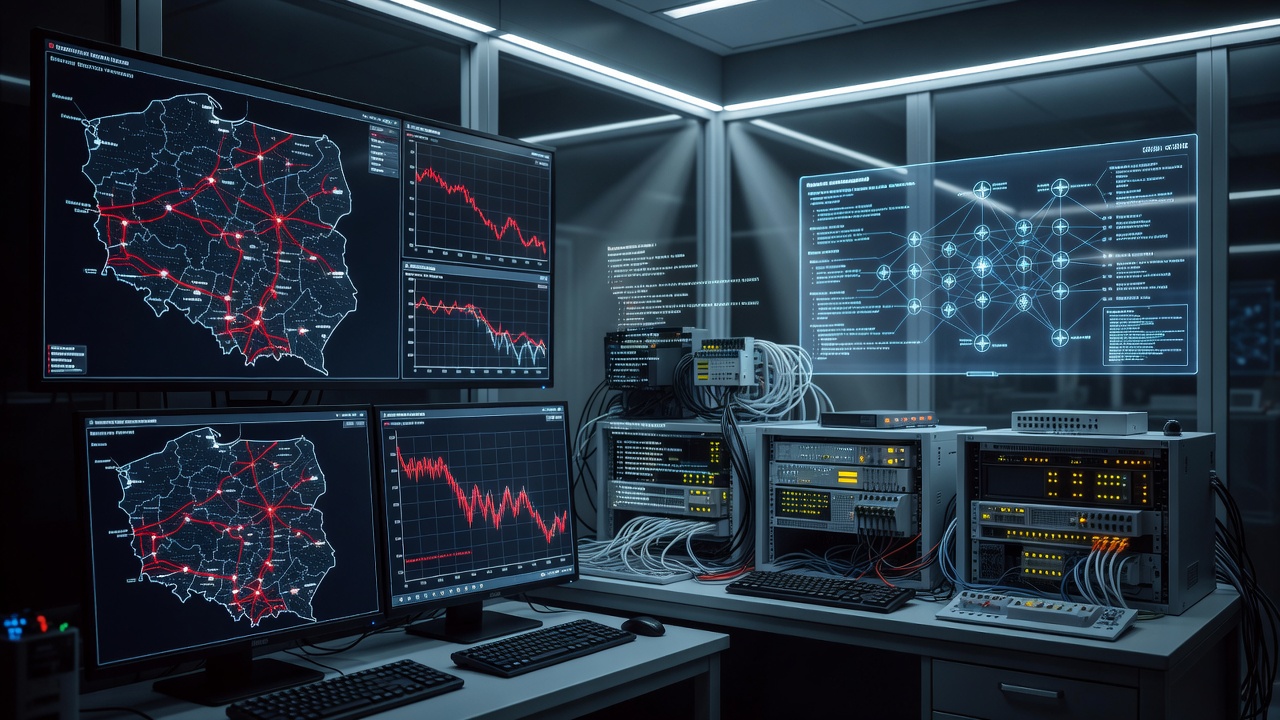
The United Kingdom and European Union governments have formally attributed a sophisticated cyberattack on Poland’s energy infrastructure to Russian state-backed actors. According to a joint statement released on 13 July 2026, officials from both sides presented technical evidence and intelligence assessments pointing directly at the Kremlin’s military intelligence service, the GRU. The incident, which targeted operational technology networks at several power generation and distribution facilities in eastern Poland, caused temporary disruptions to electricity supply and raised fresh concerns about hybrid warfare tactics aimed at NATO’s eastern flank.
The attack unfolded in late May 2026 when malicious code was injected into industrial control systems responsible for managing substation switches and transformer cooling mechanisms. Operators noticed anomalous commands that forced circuit breakers to open without warning, leading to localized blackouts that affected industrial zones and residential areas near the Belarusian border. Although engineers restored power within hours by switching to manual controls and isolated backup grids, the breach exposed significant weaknesses in how critical national infrastructure protects its most sensitive digital assets. Polish cybersecurity agencies worked alongside international partners to trace command-and-control servers hosted in third countries and malware samples that shared distinctive code patterns with tools previously linked to GRU Unit 26165, also known as Sandworm.
British officials described the operation as part of a broader pattern of Russian aggression that combines physical sabotage with digital intrusion. The Register article detailing the attribution notes that forensic analysis revealed the attackers used living-off-the-land techniques, relying on legitimate administrative tools already present on the victim networks to avoid detection. This approach allowed the intruders to map out control system architecture over several weeks before executing the disruptive commands. Such methods mirror earlier campaigns against Ukrainian power companies in 2015 and 2016, where similar GRU-linked groups caused widespread outages during winter months.
European Union leaders framed the incident as an attack on collective security rather than an isolated Polish matter. Ursula von der Leyen, President of the European Commission, stated that any assault on one member state’s energy grid constitutes a threat to the entire bloc. The EU’s coordinated response included an agreement to share real-time threat intelligence through the newly expanded Cyber Crisis Management Framework and to impose additional sanctions on Russian entities suspected of supporting offensive cyber operations. These measures build upon existing restrictions targeting individuals and companies tied to the GRU and SVR intelligence services.
From a technical standpoint, the malware employed in the Poland incident demonstrated advanced capabilities tailored for energy sector environments. Researchers identified custom modules designed to interact with specific models of programmable logic controllers commonly found in European substations. The code could enumerate connected devices, modify alarm thresholds, and issue unauthorized commands while simultaneously erasing evidence of its presence. Security firms that examined recovered samples noted similarities with the Industroyer2 framework, a modular platform known for its ability to target multiple industrial protocols including IEC 61850, IEC 104, and OPC UA. This flexibility suggests the developers invested considerable resources in studying Western energy systems rather than simply recycling tools built for older Soviet-era equipment.
The timing of the attack coincided with heightened tensions along the Poland-Belarus border, where migrant flows and military exercises had already strained relations. Analysts believe the cyber operation served multiple purposes: testing defensive responses, gathering intelligence on grid resilience, and sending a political message about Russia’s willingness to strike civilian infrastructure without crossing into kinetic conflict. Polish Prime Minister Donald Tusk described the event as “an act of hybrid aggression” that demanded a unified Western reply. In response, Warsaw accelerated plans to isolate critical control networks from corporate IT systems and to deploy hardware security modules that verify command authenticity before execution.
British involvement in the attribution process reflects London’s longstanding focus on countering Russian cyber threats. The National Cyber Security Centre, working with allies in the Five Eyes intelligence community, contributed telemetry data collected from global sensor networks. NCSC Director Lindy Cameron emphasized that the evidence met the high bar required for public attribution, including both technical indicators and human intelligence confirming GRU direction. UK ministers used the occasion to announce additional funding for the Cyber Defence Alliance, a program that helps smaller NATO partners improve their ability to defend against state-sponsored intrusions.
The energy sector has become a favored target for nation-state actors precisely because disruptions create immediate real-world consequences. Unlike data theft or ransomware schemes that primarily affect information systems, attacks on power grids can halt factories, disrupt hospitals, and undermine public confidence in government. The Poland incident lasted only a short period, yet it demonstrated how even brief interruptions can cascade through supply chains. Manufacturers reported delayed production schedules, while logistics companies struggled with refrigerated warehouses that lost power at critical moments. These secondary effects highlight why protecting industrial control systems requires different strategies than those applied to traditional enterprise networks.
Investigators discovered that initial access was likely gained through a compromised third-party contractor. The attackers had infiltrated a Polish engineering firm responsible for maintaining remote monitoring systems at multiple energy sites. By stealing valid credentials from that company’s virtual private network, the intruders gained legitimate entry into the targeted networks without triggering perimeter alarms. This supply-chain vector echoes the tactics used in the SolarWinds compromise of 2020, though the objectives here centered on disruption rather than espionage. Polish authorities have since tightened vetting procedures for vendors with access to operational technology environments.
International cooperation proved essential in reaching the attribution decision. Computer Emergency Response Teams from Poland, the UK, France, Germany, and the Netherlands collaborated on reverse engineering the malicious binaries. Their joint technical report, later summarized in public advisories, catalogued command-and-control infrastructure, encryption methods, and behavioral patterns that matched previous GRU operations. The Register article highlights how shared visibility across borders helped connect disparate incidents that might otherwise have appeared unrelated. This level of collaboration represents a maturing capability within European cyber defense structures.
Russia has predictably denied any involvement. The Kremlin dismissed the accusations as “baseless propaganda” intended to justify further NATO expansion. Russian state media instead pointed to alleged Ukrainian sabotage operations inside Russia as the real source of regional instability. Such reflexive denials have become standard in cases of publicly attributed cyber operations, yet they carry less weight when multiple governments with sophisticated intelligence services reach identical conclusions based on independent evidence.
The incident carries implications for energy policy across the continent. Many countries are accelerating the transition toward renewable sources, which often rely on digital control systems that increase the attack surface. Wind farms, solar arrays, and battery storage installations all depend on networked inverters and SCADA protocols that require careful security consideration. Experts recommend implementing strict network segmentation, regular firmware validation, and behavioral monitoring tools that can detect anomalous commands before they affect physical processes. Poland’s experience may serve as a cautionary example for nations still in early stages of smart grid deployment.
Beyond immediate technical fixes, the attribution carries diplomatic weight. By naming Russia explicitly, the UK and EU signal that they will not treat cyber attacks on critical infrastructure as mere criminal matters. Instead, such actions will face political, economic, and potentially military consequences. NATO has already conducted tabletop exercises simulating coordinated responses to energy grid attacks, including scenarios where Article 5 collective defense obligations might be invoked. While no one expects kinetic retaliation for the Poland incident, the public attribution strengthens the deterrent message that repeated aggression will not go unanswered.
Looking ahead, European governments plan to invest more heavily in sovereign cyber capabilities. The EU is expanding its Cybersecurity Act to include mandatory security requirements for manufacturers of industrial equipment. Britain, having left the Union, is pursuing bilateral agreements that maintain information sharing while developing independent threat intelligence programs. Both sides recognize that fragmented defenses create exploitable gaps that sophisticated adversaries like the GRU are quick to identify.
The attack also underscores the human element in cybersecurity. Operators at the affected Polish facilities faced stressful decisions when automated systems began behaving unpredictably. Their quick thinking in switching to manual mode prevented more extensive damage. Training programs that simulate cyber-induced physical failures are gaining popularity as organizations realize that technical controls alone cannot address every scenario. Building resilience requires both sophisticated technology and skilled personnel who understand the complex interaction between digital commands and physical outcomes.
As more details emerge from ongoing investigations, the incident will likely influence future procurement decisions in the energy sector. Vendors whose equipment proved difficult to secure may face tougher scrutiny, while those offering verifiable supply chain attestations and embedded security features could see increased demand. The events in Poland illustrate that cyber threats to critical infrastructure represent a persistent challenge requiring sustained attention from both technical specialists and policymakers at the highest levels. The joint UK-EU attribution serves as a reminder that when it comes to protecting the systems that power modern society, vigilance and international solidarity remain indispensable.


 WebProNews is an iEntry Publication