
Smartwatches already track steps, sleep and heart rates. Now one research prototype wants them to track something far harder to measure: the quiet slide into emotional distress. And act on it before the wearer even notices.
Call it UbiMyTherapist. Short for “You Be My Therapist.” The system, developed at the University of Ottawa, combines data from everyday wearables with speech patterns, text input and a personalized digital profile. The goal isn’t to replace human therapists. It’s to offer timely, clinically grounded support exactly when and where people need it most – outside the clinic, in daily life.
Dr. Karim Alghoul, part-time professor at uOttawa’s School of Electrical Engineering and Computer Science, put the central challenge plainly. “The core question we asked ourselves was: How can we provide timely mental well-being support outside clinical settings that is safe and personalized to the user? UbiMyTherapist is our answer to that question.” (University of Ottawa, June 26, 2026)
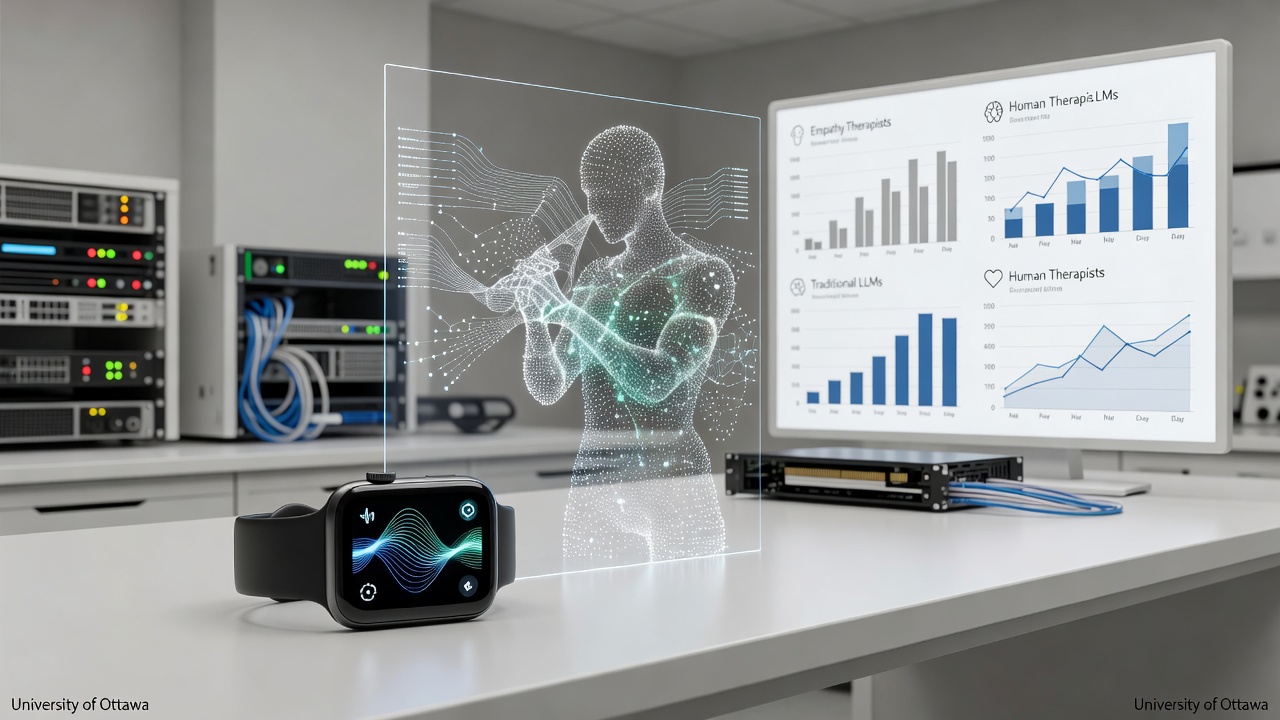
The prototype runs on smartwatches, smartphones and earbuds most people already own. It doesn’t wait for someone to open an app and type “I’m anxious.” Instead it watches for signals. Heart rate variability from the wrist. Changes in speech tone picked up by earbuds or phone mics. Even the content and style of written messages. When those cues suggest rising distress, the system responds with suggestions drawn from clinical psychology literature, the user’s own medical history and the live emotional context.
At its heart sits what the team calls a digital twin. This isn’t science fiction. It’s a dynamic model that updates continuously. It folds in a person’s diagnoses and medications. It references established psychological knowledge bases. And it layers on real-time emotional state data. The result is an AI that tailors replies not just to the words spoken but to the individual saying them.
But, the real test came in evaluation. Researchers tested a working prototype with volunteers. Then licensed therapists reviewed the outputs for therapeutic soundness. UbiMyTherapist scored higher on empathy and personalization than standard large language models such as ChatGPT. “Seeing UbiMyTherapist consistently outperform standard AI setups, especially on empathy and personalization, confirmed that integrating real-time emotional context makes a real difference,” Alghoul said. (TechXplore, June 27, 2026)
From reactive chat to proactive signal-driven support
Most mental health apps today are reactive. The user must initiate contact, often at the very moment when motivation or clarity is lowest. UbiMyTherapist flips that script. It monitors passively. It can intervene proactively based on biosignals before the user reaches out. That shift matters. Access barriers – cost, stigma, long wait times for appointments – leave many without help precisely when they need it. This approach aims to bridge that gap without claiming to substitute for professional care.
The research team, which also included Dr. Hussein Al Osman, Dr. Abdulmotaleb El Saddik from the Faculty of Engineering and psychology student Raina Sharma, published its work in the 2026 IEEE International Conference on Consumer Electronics. The paper details the multimodal large language model architecture and emotion detection methods. (IEEE Xplore)
Recent coverage highlights how this fits into a broader push. Just yesterday, discussions around AI wearables for mental health emphasized early detection of depressive symptoms or stress through heart rate and activity patterns. One analysis noted that such tools could alert patients or doctors to worsening conditions faster than self-reporting alone. (IEEE Pulse, recent)
Yet challenges remain. Privacy. Data accuracy across different body types and lifestyles. The risk that an algorithm misreads a temporary spike in heart rate as emotional distress. The uOttawa group stresses clinical alignment. They evaluated outputs with licensed therapists and plan further collaboration to keep responses grounded. Future iterations will add near real-time proactive interventions triggered directly by smartwatch biosignals.
This isn’t the first attempt at AI mental health support. Chatbots like Wysa and Elomia have gained users seeking 24/7 availability. Companies such as Feel Therapeutics market wearable rings that combine physiological data with AI for insights into depression and stress. But UbiMyTherapist stands out for its explicit integration of medical history, clinical knowledge bases and multimodal inputs into a single proactive system. It doesn’t just track. It builds a profile that evolves with the user.
Alghoul sees wider implications. “This work opens the door to accessible, personalized, and context-aware mental well-being support anytime, anywhere. It can also help psychotherapists better understand and support their patients.” The system could give clinicians richer data on how patients fare between sessions. Or flag when someone might benefit from reaching out to a human professional.
Still, the prototype stays in the lab for now. No consumer app exists yet. The team continues refining the technology and expanding therapist involvement. Their caution reflects the stakes. Mental health tools must earn trust. One wrong suggestion at the wrong moment could erode confidence in the entire approach.
Interest in this space has grown sharply. A recent umbrella review of 29 studies found AI tools, including wearables and sensors, show promise for early detection and personalized support across conditions, though evidence quality varies and privacy concerns persist. (Telehealth.org, April 2026)
Other work explores similar ground. Researchers at institutions like the University of Pennsylvania develop biosensor systems for objective mental health tracking. Commercial efforts from Feel Therapeutics and others push FDA-cleared devices that monitor sleep, heart metrics and activity to infer emotional states. The uOttawa prototype adds the digital twin layer and therapist-validated responses, aiming for something closer to a true assistant than a simple mood logger.
So what comes next? Near-term, the team wants live interventions based on smartwatch data. Longer term, tighter integration with existing health records and broader testing across populations. Success depends on proving the system remains safe, accurate and genuinely helpful without creating new dependencies or false reassurance.
The promise is clear enough. Millions struggle to access care. Wearables sit on wrists collecting data anyway. Connecting those streams to clinically informed AI could shift mental health support from episodic to continuous. From waiting for crisis to preventing it. UbiMyTherapist offers one concrete example of how that future might work. Its creators have taken the first measured steps. The rest of the field will watch closely.


 WebProNews is an iEntry Publication