
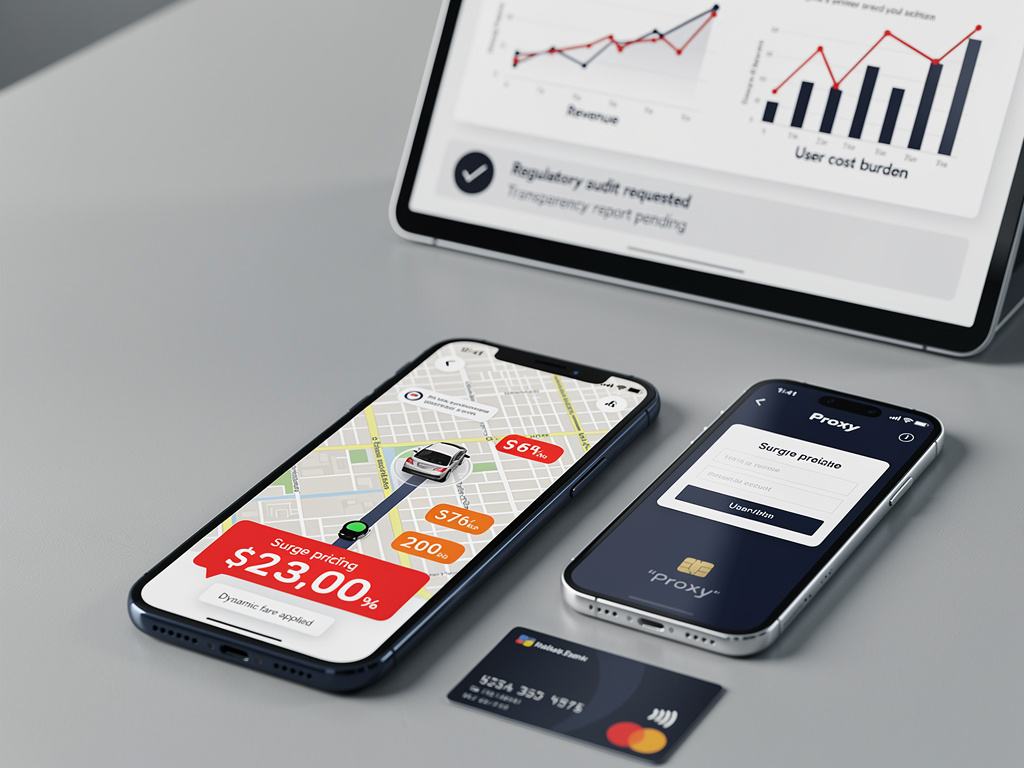
Uber Technologies Inc. faces fresh scrutiny over allegations that its pricing engine quietly penalizes frequent users by inflating fares based on perceived dependency, prompting riders to fight back with burner accounts and virtual cards. A viral thread on X by software engineer Carter Laidlaw, known as @Carter_OW, ignited the debate, claiming his daily commutes ballooned from an average of $9.50 to $23 over six months after the app inferred his reliance on rides due to vision impairment.
Laidlaw detailed a countermeasure: a program that spins up fresh Uber accounts paired with proxy credit cards, instantly slashing prices back to baseline levels. ‘Tech companies are so comically evil that it’s transcended unfunny,’ he posted on X on January 20, 2026. Even generosity backfires, he alleged—after tipping a driver $20 for a U-turn to retrieve his laptop, fares jumped from $14 to $18 within days. New accounts hold steady for about five days before escalation resumes, he added, with credit card fingerprinting as a sporadic check but IP addresses ignored.
Uber has long defended its dynamic pricing as market-driven, responding to real-time supply-demand imbalances rather than user history. Yet academic probes and driver audits paint a more opaque picture, suggesting algorithms dissect rider behavior to maximize revenue.
Academic Probes Uncover Profit-Boosting Code
A June 2025 study by University of Oxford researchers, published amid a series of revelations, found Uber’s shift to dynamic pricing hiked passenger fares while trimming driver pay, boosting the company’s revenue cut to over 50% in some cases. ‘Uber’s use of dynamic pricing has led to higher fares for passengers and lower earnings for drivers, whilst increasing Uber’s share of revenue,’ the Oxford study stated. A companion paper, ‘Not Even Nice Work If You Can Get It,’ analyzed 1.5 million trips from 258 UK drivers, revealing post-dynamic pricing declines in pay predictability and rises in wait times.
The Guardian reported on a second U.S. academic analysis in June 2025, asserting Uber’s ‘computer code systematically raised fares at expense of drivers and passengers.’ Its ‘take rate’—the platform’s slice of each ride—surged post-algorithm tweak, sometimes exceeding half the fare, as detailed in that coverage and a follow-up on the quiet rollout.
These findings echo earlier concerns. In 2024, Sen. Sherrod Brown demanded transparency from Uber and Lyft on surge mechanisms, citing opaque surges during crises, per a Senate Banking Committee release.
Rider Workarounds Expose Pricing Flaws
Laidlaw’s thread, amassing over 1 million views, resonated with users sharing similar hacks. Proxy cards evade card-based tracking, he noted, while device fingerprinting appears underutilized. Tipping exacerbates hikes: ‘If I tip far over the normal amount, my price for the ride goes up,’ he posted in a reply. Lyft fares often exceed fresh Uber accounts, he claimed.
Posts on X from Uber’s official account historically deny personalization beyond surge tiers, insisting ‘Surge pricing changes in real-time and has nothing to do with the identity of the rider,’ as in a 2021 response. Yet rider experiments contradict this, fueling accusations of price discrimination akin to airline yield management.
Broader web discussions, including a Medium analysis by Len Sherman, warn of firms venturing into ‘opaque algorithmic pricing’ black holes, where personalization risks backlash without transparency, per his September 2025 post.
Regulatory Spotlights Intensify
As of January 2026, Uber grapples with unrelated pressures like sexual assault lawsuits, per The New York Times, but pricing opacity looms larger. A 2019 ScienceDirect paper modeled surge prediction, highlighting how apps infer desperation from patterns, though Uber claims no such targeting.
Driver unions, involved in the arXiv longitudinal study, decry reduced job allocation fairness. CEO Dara Khosrowshahi has touted flexibility, but 2026 outlooks from AInvest and Motley Fool emphasize profitability via delivery and autonomy over ride-hailing purity.
Laidlaw’s saga underscores a cat-and-mouse dynamic: Algorithms evolve to capture surplus from ‘loyal’ users, while tech-savvy riders deploy scripts and virtual cards. Without code audits, trust erodes.
Implications for Platform Economics
Price discrimination, long a staple in tech, thrives when users can’t coordinate or switch easily. Uber’s network effects amplify this, but leaks like Laidlaw’s expose vulnerabilities. Fresh accounts dilute loyalty programs like Uber One, which offers student discounts at $4.99 monthly, per Uber’s 2024 promo.
Investors eye 2026 growth playbooks stressing scale, yet opaque pricing invites antitrust eyes. Oxford’s audit calls for participatory oversight, blending driver input with code reviews to curb inequality spikes.
For insiders, the real question: Can Uber sustain yields without alienating its core? Laidlaw’s proxy success suggests not indefinitely, as circumvention scales via open-source tools.


 WebProNews is an iEntry Publication