
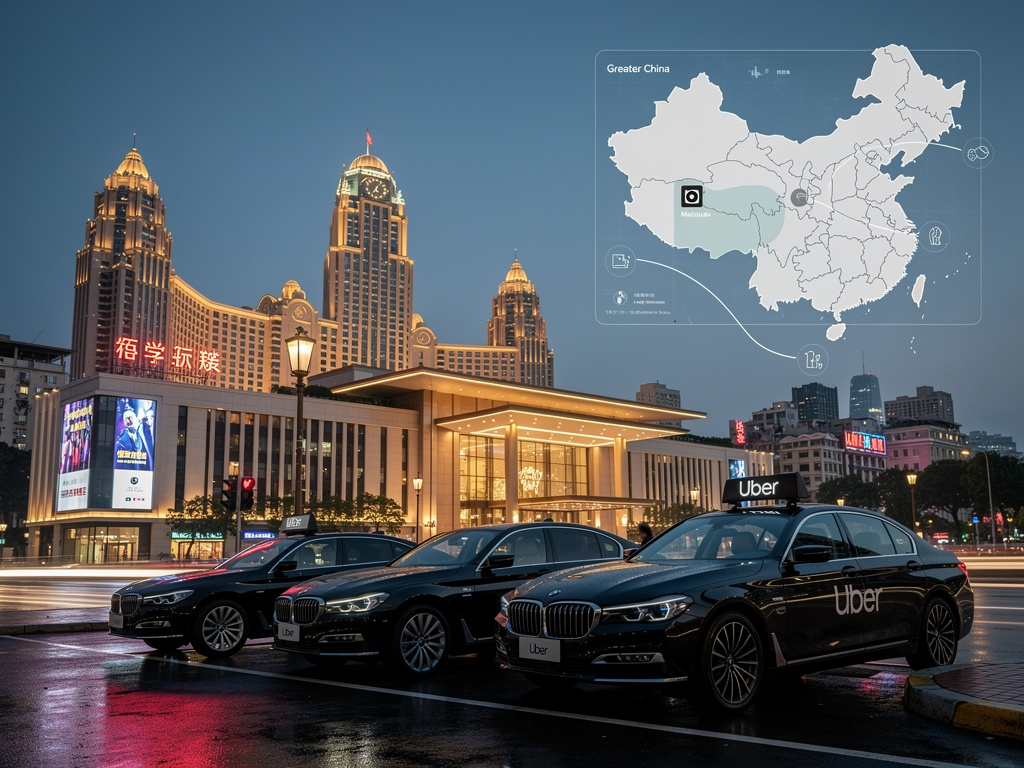
Eight years after its bruising retreat from mainland China, Uber Technologies Inc. is making a carefully calibrated return to the world’s most populous region. The ride-hailing giant’s decision to launch services in Macau represents far more than a simple market expansion—it signals a fundamental reassessment of Asian growth opportunities and a willingness to test whether the company can succeed in Chinese-speaking markets without repeating the costly mistakes that led to its 2016 capitulation to Didi Chuxing.
According to Bloomberg, Uber’s entry into Macau marks its first new Asian market launch in years, a significant milestone for a company that has largely focused on consolidating existing operations rather than pursuing aggressive territorial expansion in the region. The special administrative region, known globally as a gambling and entertainment destination, presents unique characteristics that make it an intriguing testing ground for Uber’s renewed Asian ambitions.
The Macau market, while geographically small at just 32.9 square kilometers, attracts approximately 30 million visitors annually, creating demand patterns distinct from typical urban centers. This high concentration of tourists, many unfamiliar with local transportation options, provides Uber with a customer base potentially more receptive to its brand than price-sensitive local residents who might favor established competitors. The territory’s status as a special administrative region of China, with its own legal and regulatory framework separate from the mainland, offers Uber a foothold in Greater China without directly confronting the regulatory complexities that contributed to its previous withdrawal.
The Ghosts of China Past: Lessons from a $35 Billion Miscalculation
Uber’s 2016 exit from mainland China remains one of the most expensive strategic retreats in technology history. After investing more than $2 billion and accumulating losses reportedly exceeding $1 billion annually, the company sold its China operations to Didi Chuxing in exchange for an 18% stake in the combined entity, valued at approximately $35 billion at the time. The deal, while allowing Uber to stem its hemorrhaging cash reserves, represented a fundamental acknowledgment that the company could not compete effectively against a well-funded local rival with deeper government relationships and superior market knowledge.
The China experience taught Uber painful lessons about regulatory navigation, local competition, and the importance of sustainable unit economics. Didi had leveraged its relationships with Chinese authorities, its integration with popular local payment platforms like Alipay and WeChat Pay, and aggressive subsidization to capture dominant market share. Uber, despite its global brand recognition and technological capabilities, found itself perpetually playing catch-up in a market where being foreign was a liability rather than an asset.
As reported by Skift, Uber’s approach to Macau reflects a dramatically different strategy—one characterized by measured expansion, realistic expectations, and a focus on specific customer segments where the company’s brand carries particular value. Rather than attempting to dominate all mobility segments immediately, Uber appears to be targeting the premium end of the market and the substantial tourist population that cycles through Macau’s casinos and resorts.
Macau’s Unique Market Dynamics: Tourism, Geography, and Regulatory Autonomy
Macau’s economy revolves almost entirely around gaming and tourism, with the territory generating more gambling revenue than Las Vegas despite its significantly smaller size. This economic structure creates transportation demand patterns that differ markedly from typical Asian megacities. Peak demand occurs during evenings and weekends when casino activity intensifies, and a substantial portion of riders are tourists from mainland China, Hong Kong, Taiwan, and other Asian markets who may already be familiar with Uber from their home countries or international travels.
The territory’s compact geography presents both opportunities and challenges for Uber. While the small size limits the total addressable market and potential ride volumes, it also reduces operational complexity, allows for efficient driver utilization, and minimizes the infrastructure investment required to provide comprehensive coverage. Drivers can traverse the entire territory quickly, reducing dead-heading time and improving earnings potential per hour worked.
According to Tech in Asia, Uber’s relaunch in Macau comes after years of absence from the market, suggesting the company has been carefully evaluating the opportunity and preparing its approach. The regulatory environment in Macau, while requiring compliance with local licensing and operational requirements, operates independently from mainland China’s regulatory apparatus, potentially offering Uber more predictable operating conditions than it experienced on the mainland.
Strategic Implications: Testing Ground for Regional Expansion
Industry analysts view Uber’s Macau launch as potentially more significant for what it represents than for the immediate revenue it will generate. The territory’s small market size means it will likely never rank among Uber’s top-performing cities globally. However, its value as a proving ground for refined strategies in Chinese-speaking markets and as a signal of Uber’s renewed confidence in Asian expansion could prove substantial.
If Uber can successfully establish operations in Macau, demonstrating an ability to work effectively with local regulators, compete against established players, and build a sustainable business model, it may embolden the company to consider other markets in Greater China or Chinese-speaking regions. Taiwan, with its 23 million residents and developed economy, represents one potential expansion target where Uber previously operated but withdrew. Singapore, where Uber sold its operations to Grab in 2018, might also be reconsidered if the company believes it has developed sufficiently improved strategies.
The Macau launch also reflects Uber’s broader strategic evolution under CEO Dara Khosrowshahi, who replaced co-founder Travis Kalanick in 2017. Khosrowshahi has emphasized profitability over growth-at-any-cost, selective market expansion rather than ubiquitous presence, and sustainable competitive positioning instead of subsidy-driven market share battles. The measured approach to Macau aligns with this philosophy, suggesting the company will expand only where it can build economically viable operations.
Competitive Environment: Incumbents and Market Structure
Uber enters Macau facing established local competition, though the market structure differs significantly from the mainland China environment it fled in 2016. Local taxi services have traditionally dominated ground transportation, supplemented by hotel shuttle services and public buses. Ride-hailing services have existed in various forms, but the market has not experienced the intense competition and consolidation that characterized mainland China.
This relatively less-developed ride-hailing ecosystem may provide Uber with opportunities to establish itself before facing well-funded, aggressive local competitors. The company’s global brand, particularly its recognition among international tourists, could provide differentiation that proves valuable in a tourism-dependent market. Travelers familiar with Uber from their home countries may preferentially select it over unfamiliar local alternatives, providing a customer acquisition advantage that Uber lacked when competing for price-sensitive local riders in mainland Chinese cities.
The regulatory framework governing ride-hailing in Macau will significantly influence competitive dynamics. Requirements around driver licensing, vehicle standards, insurance coverage, and pricing restrictions will shape the economics for all operators and determine whether the market can support multiple competitors or will consolidate around one or two dominant players. Uber’s experience navigating diverse regulatory environments globally should provide advantages in adapting to local requirements.
Economic Viability: Unit Economics and Path to Profitability
The fundamental question surrounding Uber’s Macau launch concerns economic viability: Can the company generate sustainable profits in a small market with established competition? This question becomes particularly acute given Uber’s history of sustaining massive losses in pursuit of market share, a strategy that proved unsustainable in China and contributed to operational challenges globally.
Macau’s high tourism volumes and concentration of affluent visitors suggest the potential for premium pricing that could support healthier unit economics than Uber achieves in many markets. Casino visitors and business travelers typically demonstrate lower price sensitivity than daily commuters, potentially allowing Uber to maintain pricing that covers costs plus reasonable margins without aggressive subsidization. The territory’s small size also reduces operational costs related to driver management, customer support, and local infrastructure.
However, the limited market size constrains total revenue potential regardless of pricing power. Even capturing significant market share in Macau would generate relatively modest absolute revenues compared to major metropolitan markets. This reality suggests Uber views Macau primarily as a strategic beachhead rather than a significant standalone revenue contributor, with success measured more by operational learnings and strategic positioning than immediate financial returns.
Technology and Operational Adaptations
Uber’s technology platform, refined through operations in more than 70 countries, provides significant advantages in launching new markets efficiently. The core ride-matching algorithms, payment processing systems, driver management tools, and customer applications require relatively modest localization to function in new territories. This technological infrastructure allows Uber to launch with capabilities that would require years of development for local startups to replicate.
However, successful operations in Macau will require adaptations beyond simple translation. Integration with local payment methods popular among mainland Chinese visitors, particularly Alipay and WeChat Pay, will prove essential for capturing tourist demand. Navigation systems must account for Macau’s unique street layouts and the prevalence of large integrated casino resorts with complex pickup and drop-off procedures. Customer service must accommodate multiple languages, including Cantonese, Mandarin, Portuguese, and English, reflecting the territory’s diverse visitor base.
Driver recruitment and retention strategies must also adapt to local labor market conditions. Macau’s casino-driven economy offers numerous employment alternatives, potentially requiring Uber to offer competitive earnings and flexible scheduling to attract sufficient driver supply. The company’s experience building driver networks globally should inform these efforts, though local conditions will require tailored approaches.
Regional Implications and Future Expansion Possibilities
Uber’s Macau launch occurs within a broader context of evolving mobility markets across Asia. The region has seen significant consolidation in recent years, with dominant players like Didi in China, Grab in Southeast Asia, and Gojek in Indonesia establishing strong positions. Uber’s previous strategy of competing head-to-head with these regional champions proved unsustainable, leading to its exits from China and Southeast Asia through mergers with Didi and Grab respectively.
The question now becomes whether Uber can identify and successfully serve niches within Asian markets without triggering destructive competition with established players. Macau represents one such potential niche: a small, tourism-oriented market where Uber’s global brand provides specific advantages and where the limited size may not justify aggressive competitive responses from regional giants focused on larger opportunities.
Other potential markets sharing similar characteristics might include tourist-heavy destinations like Bali, Phuket, or specific districts within larger cities where Uber could focus on premium services for international visitors rather than competing for mass-market local transportation. This strategy would represent a significant departure from Uber’s historical approach of seeking dominant positions in entire metropolitan areas, instead accepting smaller market shares in carefully selected segments.
Investor Perspective and Market Reception
From an investor standpoint, Uber’s Macau launch represents a low-risk test of renewed Asian ambitions. The modest investment required to establish operations in the small territory limits downside exposure while providing valuable strategic optionality. If the launch succeeds, it validates a potential pathway for selective Asian expansion that could incrementally improve growth prospects without requiring the massive capital commitments that characterized Uber’s previous China adventure.
Public market investors have increasingly focused on Uber’s path to sustainable profitability rather than growth at any cost, a shift that began under Khosrowshahi’s leadership and accelerated following the company’s 2019 initial public offering. The Macau approach aligns with this emphasis, suggesting disciplined expansion guided by realistic assessments of competitive positioning and economic viability rather than growth targets disconnected from profitability considerations.
The broader strategic question concerns whether Uber can meaningfully participate in Asian mobility markets given the strength of regional champions. Asia represents the world’s largest and fastest-growing mobility market, and Uber’s limited presence represents a significant gap in its global footprint. However, the company’s previous experiences demonstrate that presence without sustainable competitive advantages merely destroys capital without creating long-term value.
Regulatory Navigation and Government Relations
Uber’s ability to successfully launch in Macau depends significantly on effective regulatory navigation and relationship-building with local authorities. The company’s global history includes numerous regulatory conflicts, from battles over driver classification and licensing requirements to disputes over data sharing and safety standards. These experiences have taught Uber the importance of proactive engagement with regulators and willingness to adapt operations to local requirements.
Macau’s regulatory environment, while independent from mainland China, still reflects Chinese administrative traditions and expectations around government oversight of commercial activities. Uber’s approach to working with Macau authorities will likely emphasize compliance, transparency, and collaboration rather than the confrontational tactics that characterized some of its earlier market entries globally. The company’s success or failure in building constructive regulatory relationships in Macau could influence its prospects for expansion elsewhere in Greater China.
The special administrative region status that Macau shares with Hong Kong provides interesting precedents and potential templates for Uber’s operations. Hong Kong has maintained a functioning ride-hailing market with multiple competitors operating under specific regulatory frameworks. Uber’s experiences in Hong Kong, where it has maintained operations despite regulatory challenges, may inform its Macau strategy and vice versa.
Long-Term Strategic Vision: Reimagining Asian Presence
Uber’s Macau launch ultimately represents a tentative first step in what could become a reimagined Asian strategy—one based on selective presence in specific markets and segments rather than comprehensive regional coverage. This approach acknowledges the reality that dominant regional players like Didi, Grab, and Gojek have established positions that would require unsustainable capital investments to challenge directly.
Instead, Uber appears to be identifying opportunities where its specific advantages—global brand recognition, technological capabilities, existing relationships with international travelers—provide differentiation that justifies market entry. Tourism-oriented markets, premium service segments, and territories with unique regulatory environments that limit regional champions’ expansion may offer such opportunities.
The success of this strategy will depend on Uber’s ability to operate profitably in these niches without triggering competitive responses that erode economics. If regional champions view Uber’s selective presence as non-threatening to their core markets, they may allow it to persist in peripheral segments. However, if Uber’s activities are perceived as beachheads for broader expansion, they could provoke competitive reactions that make even niche positions unsustainable. The Macau launch will provide early indications of how this dynamic unfolds and whether Uber has truly found a viable path back into Asian markets or is merely setting the stage for another costly retreat.


 WebProNews is an iEntry Publication