
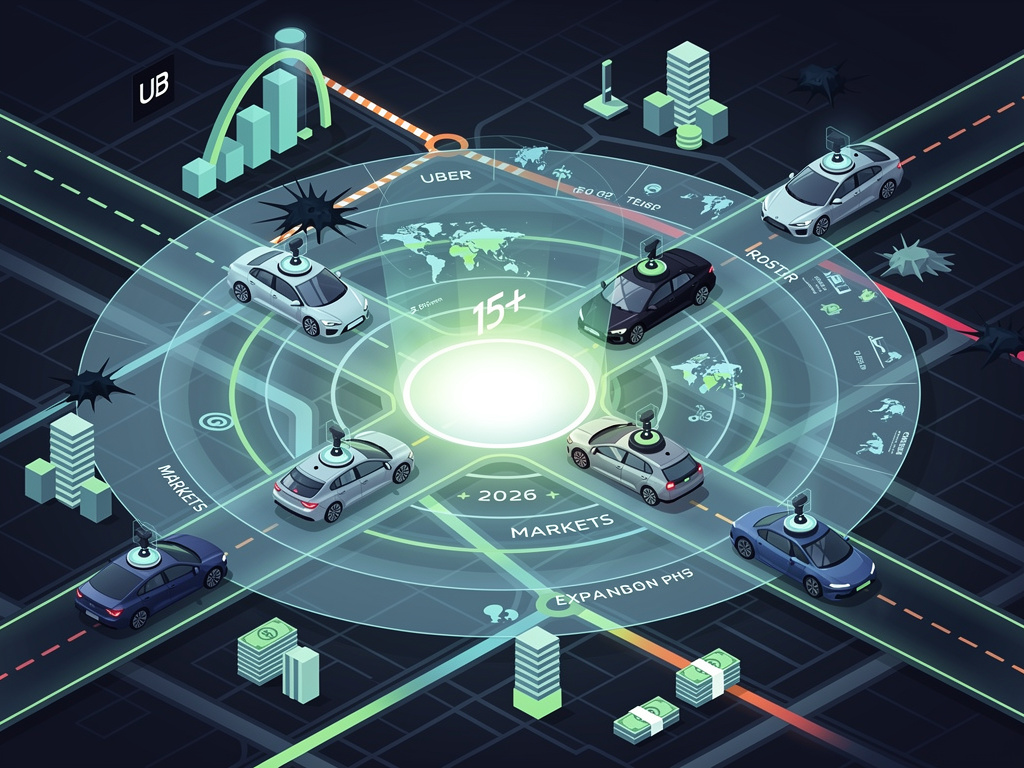
Uber once sold its self-driving unit. Now the company is pouring more than $10 billion into autonomous vehicles. The shift marks a stark reversal. Executives no longer talk about staying asset-light. They speak of owning stakes in makers and buying fleets outright.
The ride-hailing giant has struck deals with more than two dozen autonomous developers. Partnerships span Waymo, Cruise, Motional, Zoox, Rivian, Lucid, Nuro and others. This network approach positions Uber as the central marketplace. Riders open one app. The system matches them to the best available vehicle, human-driven or not.
TechCrunch reported that Uber has always wanted to become more than a ride provider. Recent competitive pressure from Tesla and Waymo gives the company reason to accelerate those ambitions. CEO Dara Khosrowshahi sees a trillion-dollar self-driving market. He expects Uber to offer autonomous rides in more than 15 markets by the end of 2026.
But the path carries risks. Last week federal investigators opened a probe into one Uber partner. TechCrunch detailed how NHTSA is examining Avride after more than a dozen crashes. The incidents, many in Dallas and Austin, involved lane-change errors, failures to stop for stationary objects and one minor injury. All occurred with safety monitors aboard. Avride, which launched robotaxi service with Uber in Dallas late last year, received up to $375 million in commitments from Uber and parent Nebius.
Such setbacks highlight the technical and regulatory hurdles ahead. Yet Uber shows no signs of slowing. The company committed more than $10 billion total. Roughly $2.5 billion goes toward equity stakes. Another $7.5 billion targets direct fleet purchases, according to calculations in a Reuters report citing the Financial Times.
Consider the Rivian agreement. Uber invested $300 million initially. The deal could reach $1.25 billion. It calls for 10,000 autonomous R2 SUVs by 2028 in cities such as San Francisco and Miami. Options exist for 40,000 more by 2031. Rivian brings its own autonomy hardware. Uber supplies the demand and operational know-how.
Lucid represents an even larger bet. Uber raised its stake to $500 million, now owning about 11.5% of the EV maker. The commitment covers at least 35,000 Gravity SUVs equipped with Nuro technology. Electrek reported that Nuro just secured a California DMV permit for driverless testing of these vehicles in Santa Clara and San Mateo counties. Speeds reach 45 mph, day or night. First paid rides in the Bay Area could arrive late this year pending further approvals.
Volkswagen enters the picture too. MOIA, its mobility unit, plans to deploy autonomous ID. Buzz vans on Uber in Los Angeles by the end of 2026. The list grows. NVIDIA supplies computing architecture. Stellantis pledged thousands of vehicles. Baidu, Wayve and Motional fill international and domestic gaps.
This hybrid strategy stands out. Uber doesn't aim to replace every driver overnight. Instead it envisions years of coexistence. Human drivers handle suburban trips, long distances and areas where robotaxis prove uneconomical. The approach addresses criticism head-on.
In a new policy paper, Uber acknowledges real concerns. Job displacement. Added congestion. Public skepticism on safety. Axios obtained the document exclusively. Andrew Macdonald, Uber's president and chief operating officer, wrote on LinkedIn that legitimate worries about jobs, accessibility and safety cannot be afterthoughts. The paper calls for honest conversation with cities and labor groups. It pushes for federal legislation tied to highway funding. And it stresses that hybrid networks can serve every neighborhood, not just dense urban cores where pure robotaxi operators concentrate for profit.
The contrast with Uber's past feels deliberate. A decade ago the company fought regulators and drivers aggressively. Trust suffered. Macdonald admitted as much. That experience changed the company. It forged dozens of labor agreements and city partnerships. Now Uber applies those lessons to autonomy.
Competition looms large. Waymo already logs hundreds of thousands of paid trips weekly, many booked through Uber's app in Phoenix, San Francisco, Austin and Atlanta. Tesla promises unsupervised Full Self-Driving and dedicated Cybercab vehicles. Khosrowshahi insists the market isn't winner-take-all. Still, he wants Uber to lead in volume.
Financially the math tempts. In 2025 Uber generated $193 billion in gross bookings. Drivers received $85 billion. Remove that cost and margins expand dramatically. The platform's 15 years of trip data offer unmatched insight into where and when to deploy vehicles. Utilization becomes the decisive advantage.
Analysts project Uber could field 100,000 autonomous vehicles by 2027. Launches target at least 15 cities this year alone, including international spots in London, Dubai and Munich. By 2028 the company eyes 28 cities total.
Challenges remain. Regulatory approval varies wildly by jurisdiction. Infrastructure for charging and maintenance lags. Public trust erodes with every headline crash, even if data shows improvement over human drivers. Labor groups watch closely. Some cities already signal reluctance to approve large robotaxi fleets without job protections.
Uber's policy paper attempts to get ahead of those fights. It recommends collaboration on congestion management. It accepts that some displacement is inevitable but argues for gradual transition. Serve all communities, the document urges. A pure robotaxi model leaves rural and low-density riders behind. Hybrid fixes that.
So far the bet appears to resonate with investors. Uber trades at a price-to-sales multiple far below many tech peers. If autonomy scales, that gap could close quickly. The company already turns profitable on adjusted basis. Removing driver pay would accelerate gains.
Yet execution matters most. Past AV efforts at Uber ended in sale of the unit to Aurora in 2020 after a fatal Arizona crash. The firm learned caution. This time it avoids owning the full technology stack. It buys access instead. That marketplace model echoes the original rideshare playbook, updated for a driverless era.
Recent X discussions reflect the stakes. Users debate whether Uber becomes the operating system for autonomy or gets bypassed by direct-to-consumer robotaxi apps. Many point to convenience. Most riders won't download multiple apps. They open Uber. The system handles the rest.
One recent analysis on X noted Uber's network effect. More than 20 developers already integrate. No single operator matches that reach. Another highlighted the driver data asset. Millions of trips train better routing and pricing algorithms that pure AV companies lack.
The coming months will test these assumptions. Nuro's driverless testing in California marks a concrete step. Rivian and Lucid vehicles should follow. Regulators will scrutinize every incident, as the Avride probe demonstrates. Uber must balance speed with credibility.
Its executives sound ready. Khosrowshahi talks of a trillion-dollar prize. Macdonald stresses partnership over confrontation. The policy paper reads like a peace offering to cities and workers who clashed with Uber before.
Whether that outreach succeeds will shape the next decade of urban mobility. One thing looks clear. Uber no longer waits on the sidelines. It invests heavily. It builds relationships. And it races to become the indispensable platform when the roads fill with robotaxis.


 WebProNews is an iEntry Publication