
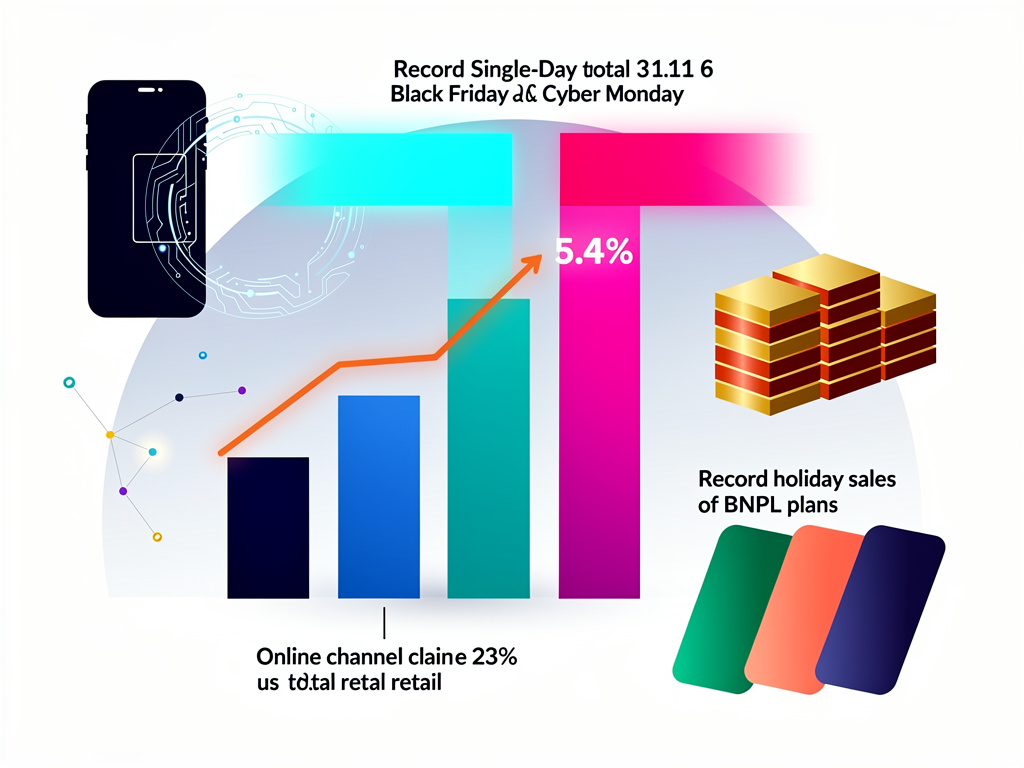
American consumers pushed U.S. online retail sales to roughly $1.234 trillion in 2025. That figure marked a 5.4 percent increase from the prior year, according to an analysis by Digital Commerce 360. Growth has now logged four straight years in single digits. The pace stands as the second-slowest expansion since the Great Recession.
Yet the absolute dollars keep climbing. Online sales have more than tripled since 2015 and stand roughly ten times higher than in 2005. E-commerce now claims 23.1 percent of total U.S. retail sales, a fresh high. The shift looks permanent.
Holiday trade told the clearest story. Between Nov. 1 and Dec. 31, Americans spent a record $257.8 billion online. The sum rose 6.8 percent from 2024, beating Adobe’s own forecast of $253.4 billion. Reuters first reported the numbers drawn from Adobe Analytics, which tracks more than one trillion visits to U.S. retail sites each year.
The five-day stretch from Thanksgiving through Cyber Monday generated $44.2 billion, up 7.7 percent. Cyber Monday alone hit $14.25 billion, still the single biggest e-commerce day of the year. Black Friday delivered $11.8 billion, a 9.1 percent jump. Even Thanksgiving Day online sales climbed to $6.4 billion. Twenty-five separate days saw more than $4 billion change hands online, up from 18 such days the year before.
Mobile devices carried more than half the load. Smartphones accounted for 56.4 percent of all online transactions during the holiday stretch, up from 54.5 percent in 2024. On Christmas Day that share climbed to 66.5 percent. Shoppers clearly prefer to browse and buy from their pockets.
Buy-now-pay-later options fueled part of the surge. BNPL spending reached $20 billion over the final two months of 2025, a 9.8 percent increase. On Cyber Monday alone the method drove $1.03 billion. Consumers stretched budgets with deferred payments while retailers booked immediate revenue. The pattern raises questions about future defaults, yet it undeniably lifted volumes in the moment.
Artificial intelligence left its own mark. Traffic to retail sites from generative-AI shopping assistants jumped 693.4 percent year over year. On Cyber Monday the increase hit 670 percent. Consumers turned to chat tools for product recommendations, price comparisons and gift ideas. Electronics, toys and video games saw especially heavy AI-driven interest. Discounts helped too. Electronics averaged 30.9 percent off. Apparel and home goods followed similar patterns.
Electronics led category spending at $59.8 billion for the holiday period, up 8.2 percent. Apparel added $49 billion, furniture $31.1 billion. Everyday essentials also gained ground, a sign that online grocery and household staples continue to mature beyond pure discretionary purchases.
The broader picture shows online retail maturing. After the pandemic-fueled explosion, growth has settled into a steadier rhythm. U.S. Census Bureau data released in May 2026 showed first-quarter 2026 e-commerce at $302.3 billion unadjusted, up nearly 10 percent from the same quarter a year earlier. Adjusted figures reached $326.7 billion. E-commerce represented 16.9 percent of total retail sales in that period, according to the U.S. Census Bureau.
Recent events reinforce the trend. On the first day of Amazon’s 2026 Prime Day, U.S. online spending hit $8.3 billion across retailers, a 5.3 percent increase from the prior year. Adobe called it the biggest single e-commerce day of 2026 so far and stuck to its four-day forecast of $26.3 billion. Electronics, appliances, tools and home improvement led the way, but everyday essentials posted noticeable gains too. Yahoo Finance carried the Reuters dispatch.
Retailers have responded with faster fulfillment and wider mobile optimization. Walmart, for instance, now delivers same-day groceries to 93 percent of U.S. households in many categories, a capability that blurs lines between online and physical commerce. Amazon maintains a commanding share of the market, yet competitors chip away by matching speed and selection.
Still, caution lingers. Inflation, high household debt and shifting trade policies left many families guarded in late 2025. Higher-income households drove a disproportionate share of the gains. Lower-income buyers leaned harder on discounts and financing. The result produced record totals even as percentage growth moderated.
Analysts expect the pattern to continue. Online penetration will likely keep rising toward 25 percent or higher within a few years. Mobile will remain dominant. AI tools will grow more sophisticated, potentially smoothing discovery and reducing cart abandonment. BNPL volumes may expand further if credit conditions stay tight.
The numbers paint a clear portrait. U.S. consumers have not abandoned stores, but they have decisively expanded their digital habits. Every major shopping event sets another high-water mark. The infrastructure built during the pandemic now supports steady, large-scale commerce that shows little sign of reversing. Retail executives, supply-chain managers and investors must calibrate for an environment where online channels command a permanent and still-growing slice of the pie.
That reality shapes everything from inventory planning to advertising budgets to last-mile logistics. The days of double-digit online growth may have passed, but the sheer scale of spending continues to reshape American retail in fundamental ways. And the data keeps confirming it.


 WebProNews is an iEntry Publication