
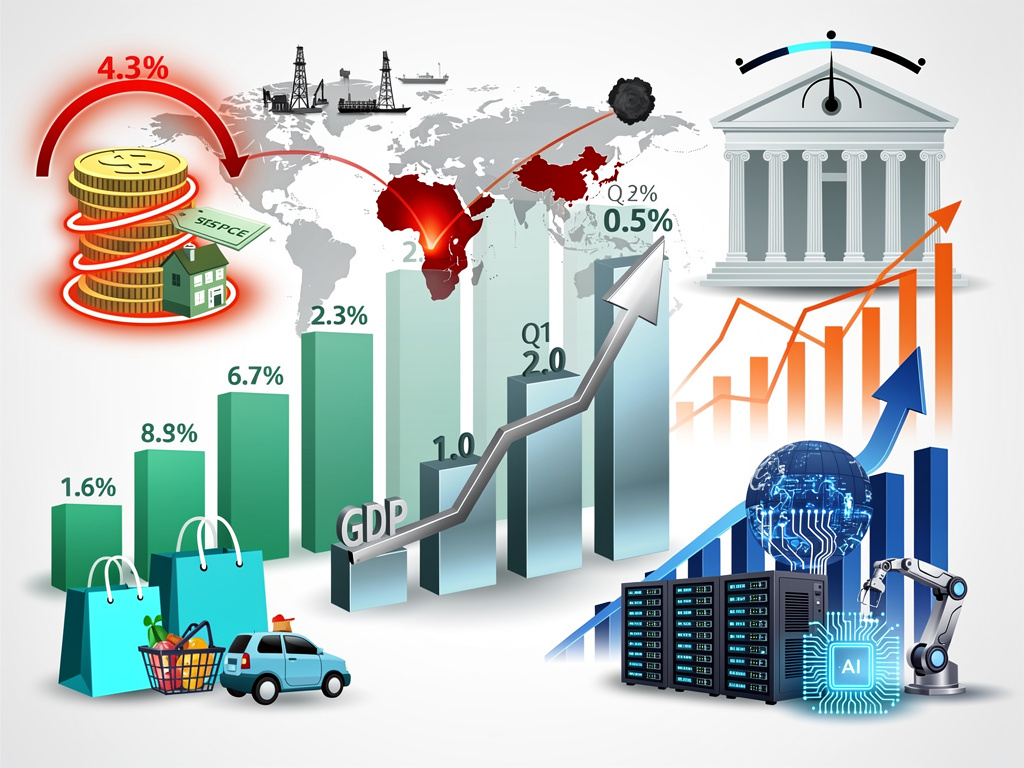
Real gross domestic product climbed at a 2.0% annualized pace in the first quarter of 2026. That’s the advance estimate from the U.S. Bureau of Economic Analysis, released April 30. The figure beat the prior quarter’s anemic 0.5% but fell short of the 2.3% median forecast from economists polled by Reuters.
Growth got a lift from investment, exports, consumer spending, and government outlays. Imports rose too, subtracting from the total since they’re deducted in GDP calculations. Consumer spending, the economy’s biggest engine, advanced 1.6%. Business investment surged 10.4%, fueled by AI-driven equipment buys. Government spending jumped 4.4%, rebounding from a shutdown that dragged on Q4 2025.
But inflation flared. The GDP price index hit 3.6%, below the 3.9% expected but up from 3.7% last quarter. Core PCE, the Fed’s favored gauge, rocketed to 4.3% annualized—nearly double Q4’s 2.7% and above the 4.1% estimate, per X posts citing BEA data.
Growth Rebound Masks Mounting Headwinds
Atsi Sheth, chief credit officer at Moody’s Ratings, called the economy’s state “fragile resilience.” Businesses and consumers hold up. Yet pillars thin as shocks pile on. “On the employment side, for instance, there’s just now a narrower range of sectors that are actually adding jobs, healthcare being a big one among them, not that many other sectors are adding jobs,” she told Business Insider.
Jobs added 178,000 in March, powered by health care and leisure. February saw a 133,000 drop from weather and strikes. Unemployment sticks near 4%. CPI jumped 3.3% year-over-year, the biggest since May 2024, thanks to energy spikes from the Iran war. Core prices lag—for now.
Jason Draho, head of asset allocation for UBS Global Wealth Management, urged focus on private sector final demand. It strips out volatile inventories and net exports. Trade policies and the Iran conflict distort imports, exports, commodity prices. “Once you strip out some of the volatility and noise from some of these factors that are still being buffeted by the tariffs and then later in the quarter by the Iran conflict, that mechanically, again, can distort import prices, export prices, and the value of it based on moving commodity prices,” Draho said to Business Insider.
Residential investment plunged 8%. Trade subtracted 1.3 percentage points as imports surged ahead of tariff hikes. Inventories added 0.4 points. Year-over-year, GDP rose 2.7%.
The Fed held rates steady April 29—Jerome Powell’s last meeting as chair. An 8-4 vote, rare since 1992. Four dissents pushed for cuts, eyeing soft growth. But today’s data flips the script. Core PCE at 4.3% screams action. Not cuts. Maybe hikes.
Fed’s Tight Spot: Growth Versus Price Surge
Mark Zandi, chief economist at Moody’s Analytics, highlighted Powell’s shocks: pandemic, Ukraine war, tariffs, immigration shifts, now Iran. “He’s had to deal with just what is seemingly never-ending string of massive shocks to the economy,” Zandi said in the Business Insider report.
Atlanta Fed’s GDPNow tracked lower pre-release, dipping to 1.2% by April 29 on weak net exports and government spending, offset by consumers. New York Fed held at 2.4%. Polymarket bettors priced 46% odds on 2.0-2.5%—nailed it.
And markets? S&P 500 and Nasdaq hit records. AI capex—$700 billion from hyperscalers—powers through. But stagflation whispers grow. 2% growth with 4.3% core inflation. Consumers spend, get less. Nominal expansion, real squeeze.
Next: Second GDP estimate May 28. Revisions loom. Iran war pumps oil past $100, per CNBC. Goldman trimmed 2026 GDP to 2%. Barclays sees moderate ahead, deficits cushioning. EY’s Gregory Daco notes AI-led business invest boom.
Fragile. Resilient. Heading for test. Incoming Fed chair Kevin Warsh faces stagflation echoes. Rates at 3.5-3.75%. Trump eyes 1%. Data says no.
Two percent growth. Four-point-three inflation. Same quarter. Watch private demand. Watch prices. The real story brews beneath.


 WebProNews is an iEntry Publication