
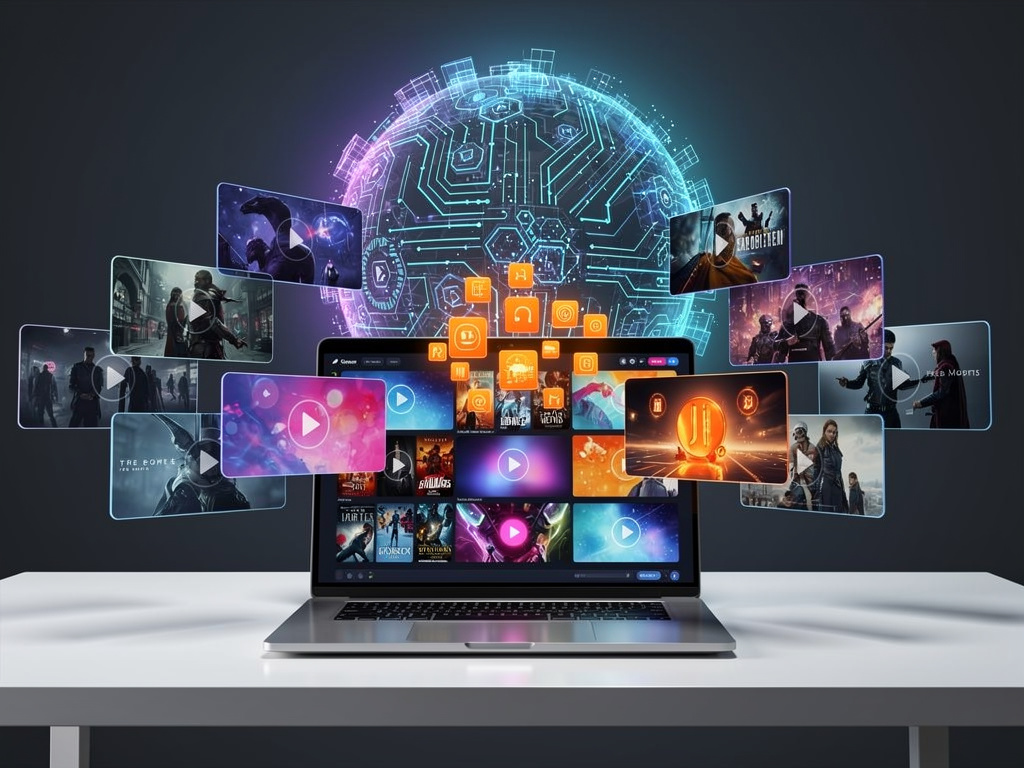
Ask ChatGPT what to watch tonight and you’ll now get something you couldn’t before: a direct line to Tubi’s free streaming library, complete with links that drop you straight into the show. No subscription. No paywall. Just a recommendation engine powered by the most talked-about AI chatbot on the planet, tethered to a catalog of over 250,000 movies and TV episodes that cost nothing to stream.
Fox Corporation’s ad-supported streaming service launched its integration with ChatGPT on June 24, making Tubi one of the first entertainment platforms to go live inside OpenAI’s chatbot as a dedicated plugin — or what OpenAI now calls an “action.” The tool lets users describe what they’re in the mood for in natural language, and ChatGPT responds with tailored picks from Tubi’s library, each with a direct link to start watching. It works across ChatGPT’s free and paid tiers, according to CNET, which first reported the integration’s launch.
The timing isn’t accidental.
Streaming has a discovery problem that’s only gotten worse as the number of services has multiplied. Audiences are overwhelmed. According to a 2024 Nielsen report, the average U.S. household now has access to more than four streaming services, and viewers spend an estimated 10 minutes just deciding what to watch before they press play. That friction is a real business concern for platforms like Tubi, which depend on eyeballs staying long enough to see ads. If a viewer can’t find something appealing in the first few scrolls, they leave — and the ad impression evaporates with them.
Tubi’s bet is that conversational AI solves this faster than any algorithm-driven homepage carousel ever could. “We want to meet users where they are,” a Tubi spokesperson told CNET. And increasingly, where they are is inside ChatGPT. OpenAI’s chatbot now has more than 400 million weekly active users, a figure CEO Sam Altman disclosed in April 2025. That’s a massive surface area for Tubi to plant its flag — especially when the competition for attention among streamers is as fierce as it’s ever been.
Here’s how it works in practice. A user opens ChatGPT and types something like, “I want a creepy thriller from the ’90s that isn’t too gory.” ChatGPT processes the request, queries Tubi’s catalog through the integrated action, and returns a curated list of titles that match. Each recommendation includes a synopsis and a clickable link that opens the Tubi app or website. The experience is conversational — users can refine their request, ask for something funnier, request a different decade, or specify actors they like. It’s less like browsing a menu and more like talking to a friend who’s seen everything.
This matters because Tubi’s catalog is enormous but largely composed of titles that lack the brand recognition of a new Netflix original or a Disney blockbuster. The service specializes in older films, cult classics, international content, and network TV libraries — the kind of programming that benefits enormously from being surfaced at the right moment to the right person. A traditional recommendation algorithm might bury a 2003 Korean horror film deep in the interface. A conversational prompt like “something scary and foreign” brings it to the top instantly.
Tubi isn’t the only streamer eyeing AI-powered discovery. Netflix has been experimenting with AI-generated thumbnails and personalized trailers. Amazon’s Prime Video added an AI search feature in late 2024 that lets users ask questions about plot details. But Tubi’s approach is distinct in one critical way: it’s happening outside Tubi’s own app, inside a third-party platform with hundreds of millions of users who may not have been thinking about Tubi at all. It’s a customer acquisition play wrapped in a recommendation tool.
And it’s free. That part can’t be overstated.
In a market where consumers are increasingly resistant to adding yet another monthly subscription, Tubi’s value proposition is straightforward: you don’t pay anything. The company makes money through advertising, a model that has proven resilient even as the broader digital ad market has fluctuated. Fox Corporation reported in its most recent earnings that Tubi generated $1 billion in revenue in fiscal year 2024, a milestone that underscored the viability of ad-supported streaming when done at scale. Tubi claims more than 97 million monthly active users globally.
The ChatGPT integration also signals something broader about how OpenAI is positioning its platform. The company has been steadily building out what amounts to an app layer within ChatGPT, allowing third-party services to plug in and serve users without those users ever leaving the chat interface. It’s a model that echoes what WeChat achieved in China — a single app that becomes the gateway to dozens of services. Shopping, travel booking, food delivery, and now entertainment discovery are all accessible through ChatGPT’s expanding roster of actions and plugins.
For OpenAI, each new integration makes ChatGPT stickier. For Tubi, each new recommendation is a potential viewer who might never have opened the app on their own. The incentives align neatly.
But there are risks. Disintermediation is the obvious one. When a third-party AI becomes the primary way users find content, the streaming service loses some control over the experience. Branding gets diluted. The emotional connection between viewer and platform weakens. If ChatGPT is the front door, Tubi becomes the back room — useful but invisible. That’s a trade-off Tubi appears willing to make right now, given its position as a challenger brand fighting for attention against Netflix, Hulu, Max, Peacock, Paramount+, and a dozen others.
There’s also the question of accuracy. AI recommendation systems are only as good as the data they’re trained on and the catalog metadata they query. If Tubi’s integration returns irrelevant suggestions or links to content that’s been removed from the platform, the user experience degrades quickly. Early reviews from users on X have been mostly positive, with several noting that the recommendations felt surprisingly specific and on-target. But it’s early days, and the real test will come as millions more users start hammering the system with increasingly obscure requests.
Content licensing adds another wrinkle. Tubi’s library shifts constantly as licensing agreements expire and new ones are signed. A title recommended by ChatGPT on Monday might not be available by Friday. Managing that in real time across an AI interface is a technical challenge that Tubi will need to solve if the integration is going to maintain credibility.
So where does this go? The most likely next step is deeper personalization. Right now, the ChatGPT integration doesn’t appear to incorporate individual viewing history — it’s responding to the prompt in isolation. But if Tubi eventually allows users to connect their accounts, the recommendations could factor in what they’ve already watched, what they abandoned halfway through, and what genres they gravitate toward. That would make the tool significantly more powerful and significantly more useful for Tubi’s ad-targeting apparatus.
There’s also the possibility of voice integration. OpenAI has been pushing its voice capabilities aggressively, and a scenario where a user simply says, “Find me something funny on Tubi” to their phone and gets a curated list read back to them is not far-fetched. It’s arguably the most natural interface for entertainment discovery — closer to asking a friend than typing into a search bar.
The competitive implications extend beyond streaming. This integration is a proof of concept for how any content-heavy platform — podcasts, music, news, gaming — might use conversational AI as a distribution channel. Spotify, YouTube, and Apple could all pursue similar integrations, or they could build their own AI discovery tools to keep users inside their own walls. The strategic question for every media company is whether to partner with the dominant AI platforms or compete against them. Tubi has made its choice.
Fox Corporation has been notably aggressive about AI across its portfolio. The company struck a deal with OpenAI in late 2024 that covered content licensing and technology partnerships, making the Tubi integration a natural extension of an existing relationship. Lachlan Murdoch, Fox’s CEO, has spoken publicly about AI as a priority for the company’s digital strategy, framing it as essential to reaching younger audiences who increasingly discover content through non-traditional channels.
And that’s really the core insight here. The way people find things to watch is fragmenting. It used to be channel surfing. Then it was browsing Netflix. Then it was scrolling TikTok and seeing a clip that sent you to a streaming app. Now it might be asking an AI chatbot. Each new discovery channel creates an opportunity for the platforms nimble enough to show up there first. Tubi, despite being smaller and less well-known than its subscription-based rivals, has consistently punched above its weight in this regard — launching on new devices early, optimizing for search engines, and now embedding itself inside the most popular AI product in the world.
Whether this integration moves the needle on Tubi’s user growth or revenue will take quarters to assess. But the strategic logic is sound: go where the attention is, make it effortless to start watching, and let the content do the rest. In a streaming market that’s saturated with options and starved for attention, that’s not a bad playbook.


 WebProNews is an iEntry Publication