
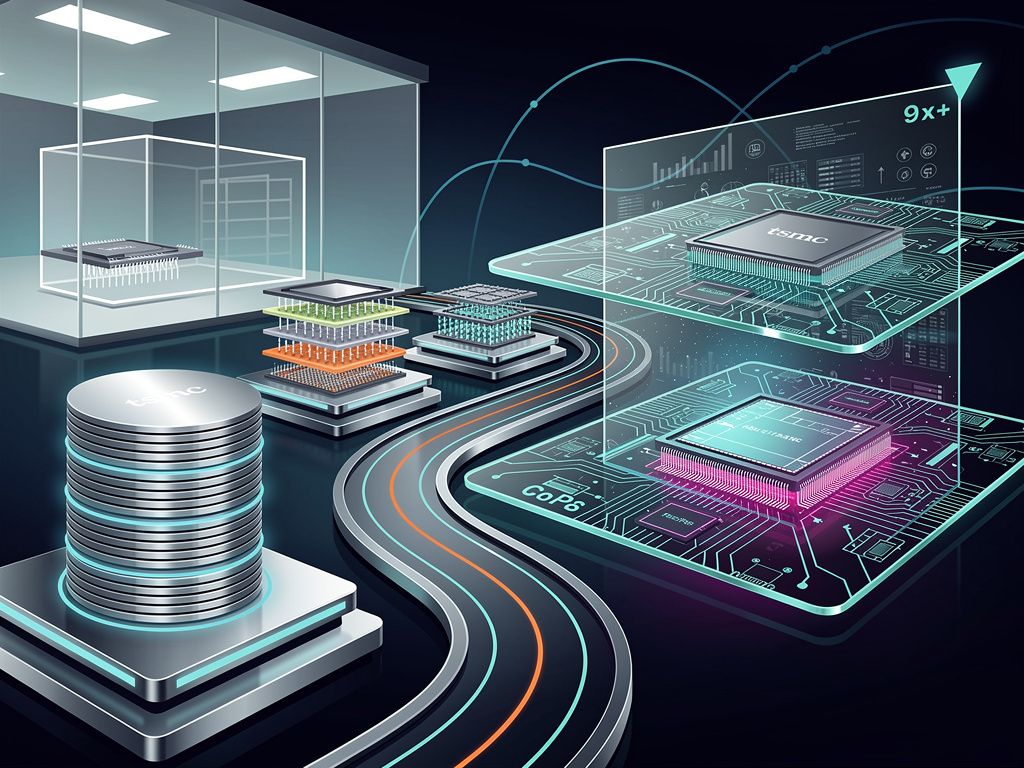
TSMC faces no greater test than satisfying the explosive appetite for advanced packaging. Demand from NVIDIA, Broadcom, AMD and hyperscalers has kept CoWoS capacity sold out for years. Yet the company has expanded output aggressively. Capacity stood near 13,000 wafers per month at the end of 2023. Projections show it reaching 75,000 by end of 2025, then 115,000 to 130,000 by end of 2026. TSMC in 2026: Full Power On, Racing to Max Out Capacity reports the Chiayi site will become the world’s largest packaging hub.
That growth matters. Every major AI accelerator depends on these 2.5D packages to connect logic dies with stacks of high-bandwidth memory. Without them, even the most advanced process nodes deliver limited value. But silicon interposers hit physical limits. They warp and crack beyond roughly 3.3 times the reticle size, around 2,700 square millimeters. TSMC responded with CoWoS-L. It combines a redistribution layer interposer with embedded local silicon interconnects. The approach supports larger dies, higher routing density and more HBM stacks. Yields on the 5.5-reticle version now exceed 98 percent, according to executives speaking at the 2026 Technology Symposium.
Scaling Beyond Reticle Limits
TSMC isn’t stopping at incremental fixes. Plans call for 9x reticle CoWoS packages by 2027, offering more than 7,700 square millimeters of space. That size accommodates up to twelve HBM4 memory stacks alongside multiple compute chiplets. A 9.5x version follows in 2028, then 14x. These jumps address the reality that AI models keep demanding more memory bandwidth and compute cores. TSMC Unfolds Map for Process, Packaging Tech quotes company leaders confirming the roadmap and noting that CoWoS shortages should ease as new lines come online.
Yet bigger silicon still brings trade-offs. Material waste rises on round wafers. Warpage risks grow. Thermal issues multiply when power density climbs. So TSMC has turned to alternatives. One path involves glass. Used first as a temporary carrier in panel-level flows, glass offers flatter surfaces, better thermal stability and lower coefficient of thermal expansion mismatch. Recent reports show TSMC preparing 310 by 310 millimeter CoPoS panels. A pilot line at VisEra is slated for 2026, with trial production in 2027 and mass output targeted for the second half of 2028. Glass Substrates Are Breaking Through the AI Chip Bottleneck details how the square format boosts redistribution layer utilization and cuts edge losses compared with round carriers.
Analyst Ming-Chi Kuo spelled out the advantages in a June 2026 post. “CoPoS is currently expected to enter mass production in 2H28. It is designed to improve the economics of ultra-large packages above the 9.5x reticle-size class.” He later clarified that glass serves only as a temporary carrier during manufacturing. The finished package relies on conventional substrates. The shift still promises lower costs through reduced waste and higher throughput. NVIDIA’s future Feynman AI chip appears a likely early candidate. Digital Trends covered Kuo’s comments and noted the technology complements rather than replaces CoWoS.
But. The transition brings fresh complexities. Panel-level equipment differs from wafer tools. Yield learning curves start over. Supply chains for glass carriers must scale. TSMC works with material and equipment partners to solve these. Early indications suggest the effort will pay off. CoPoS could support packages beyond current reticle limits while trimming manufacturing expense by double-digit percentages in some scenarios. That matters when customers pay 10 to 20 percent premiums for CoWoS today. TSMC’s CoWoS Packaging Price Hike: A 20% Surge and Impact on Tech Giants highlighted the pricing pressure that packaging bottlenecks create.
Customers already feel the pinch. NVIDIA claims the lion’s share of CoWoS-L output, perhaps 70 percent or more. The remainder splits among Broadcom, AMD, Google, Meta, Amazon and others racing to build custom AI silicon. When TSMC routes overflow to partners such as ASE Technology and Powertech Technology, those firms respond with their own variants. Powertech’s PiFO technology, for instance, uses square glass panels and claims roughly 30 percent lower costs than traditional flows. Its 2026 capital spending jumps to NT$40 billion to chase the opportunity. Recent X discussions show the industry watching these moves closely. One thread from June 15, 2026, described how the CoWoS-to-CoPoS evolution could reshape the entire supply chain by fixing material utilization problems at the panel level.
TSMC pairs these packaging advances with process progress. Its A16 technology, featuring nanosheet transistors and backside power delivery, targets production in the second half of 2026. When married to larger CoWoS or future CoPoS packages with SoIC 3D stacking, the combination delivers both density gains and bandwidth improvements. Executives at the 2026 symposium stressed that advanced packaging now drives as much performance uplift as front-end shrinks. One presentation slide outlined CoWoS-L supporting 12 HBM stacks on A16-based systems. Another highlighted integration of active dies, local silicon interconnects and integrated voltage regulators inside the package.
And the pressure keeps mounting. AI training clusters grow to gigawatt scale. Inference workloads shift toward agentic systems that demand massive token throughput and low latency. Hyperscalers want custom accelerators that pack more compute and memory per package. TSMC’s response mixes capacity builds, technology jumps and ecosystem coordination. It has committed roughly $3 billion to new packaging facilities. Older 8-inch fabs are being converted. U.S. sites in Arizona will add SoIC and CoPoS capabilities starting later this decade to reduce geographic risk.
Challenges remain. Glass interposers require tighter process control than silicon. Hybrid bonding pitches must shrink below 10 microns for future 3D gains. Substrate supply, dominated by players like Ibiden and Unimicron, stays tight. Yet the momentum appears clear. CoWoS capacity ramps have already narrowed the supply gap from 20 percent to around 10 percent in some forecasts. When CoPoS reaches volume, the economics of ultra-large packages should improve further. Costs drop. Performance rises. Systems that once seemed constrained by packaging now gain headroom.
Industry watchers expect TSMC to maintain its lead. No rival matches its combination of scale, yield and customer trust in 2.5D flows. Intel pushes EMIB and Foveros, Samsung offers its own I-Cube variants, but TSMC’s installed base and roadmap give it the inside track. Recent capacity data from CoWoS Packaging Capacity (TSMC) shows the company on pace to quadruple output in three years. That pace, paired with panel-level innovation, positions TSMC to keep feeding the AI boom long after current bottlenecks fade.
The packaging layer has become the new frontier. Transistor shrinks continue, yet the real gains often sit in how those transistors talk to each other across dies and memory. TSMC’s latest moves signal confidence that it can solve the problem at scale. Lower costs. Higher bandwidth. Larger packages. For an industry spending hundreds of billions on AI infrastructure, those three outcomes could prove decisive.


 WebProNews is an iEntry Publication