
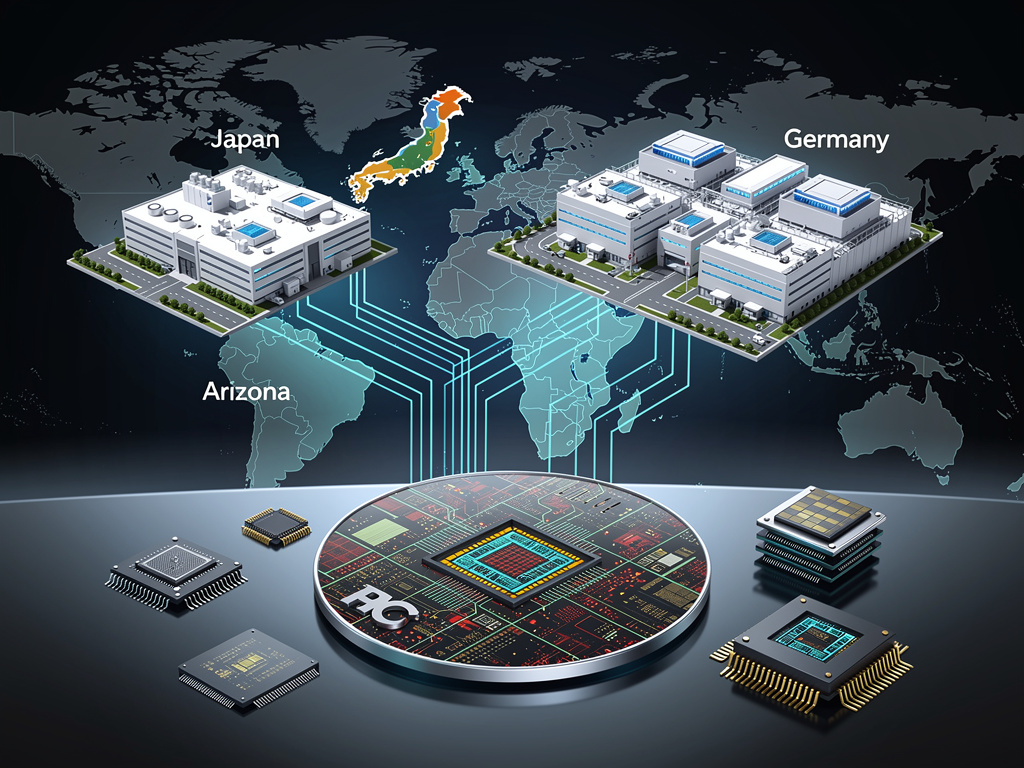
Taiwan Semiconductor Manufacturing Co., the linchpin of the global semiconductor supply chain, is accelerating an unprecedented international expansion that is reshaping how and where the world’s most advanced chips are produced. From the deserts of Arizona to the flatlands of rural Japan and the industrial corridors of Germany, TSMC is building a manufacturing empire that reflects both the enormous demand unleashed by artificial intelligence and the intensifying geopolitical pressures that have made chip production a matter of national security for governments around the world.
The company’s latest moves underscore a strategic pivot that would have been nearly unthinkable a decade ago, when TSMC concentrated virtually all of its cutting-edge production on the island of Taiwan. Now, with billions of dollars flowing into overseas fabrication plants and governments competing to lure the company’s investment, TSMC finds itself at the center of a high-stakes contest that will determine technological supremacy for decades to come.
Japan Emerges as TSMC’s Most Willing Partner
Perhaps nowhere is TSMC’s expansion more warmly received than in Japan, where the chipmaker has moved with remarkable speed to establish a major manufacturing presence. As reported by the Associated Press, TSMC’s first Japan-based fab in Kumamoto, on the southern island of Kyushu, has already begun production — a milestone reached in record time compared to the company’s other overseas ventures. A second Kumamoto fab is under construction, and TSMC has announced plans for a third facility in the region, collectively representing an investment that could exceed $20 billion.
The Japanese government has been an enthusiastic financial backer, providing generous subsidies that cover a substantial portion of the construction costs. Tokyo views the TSMC investment as essential to reviving Japan’s once-dominant semiconductor industry, which has atrophied over the past two decades as manufacturing shifted to Taiwan and South Korea. The Kumamoto project has already transformed the local economy, driving up land prices, attracting suppliers, and creating thousands of high-paying engineering jobs in a region that had been experiencing population decline. Local officials have described the impact as nothing short of transformational, with restaurants, housing developments, and infrastructure projects springing up to accommodate the influx of workers.
The AI Boom Fuels an Insatiable Appetite for Chips
Underpinning TSMC’s global push is the explosive growth of artificial intelligence, which has created demand for advanced semiconductors that far outstrips current manufacturing capacity. Nvidia, Apple, AMD, and a growing roster of AI-focused companies rely on TSMC to fabricate their most sophisticated processor designs. The company’s advanced nodes — particularly its 3-nanometer and forthcoming 2-nanometer process technologies — are essential for producing the GPUs and accelerators that power large language models, autonomous vehicles, and cloud computing infrastructure.
TSMC reported record quarterly revenue in early 2025, driven overwhelmingly by AI-related orders. The company’s dominance is staggering: it manufactures more than 90% of the world’s most advanced logic chips, a concentration of capability that has made it arguably the most strategically important company on the planet. Chief Executive C.C. Wei has repeatedly emphasized that AI demand is “real and sustainable,” pushing the company to accelerate capital expenditure plans that now exceed $30 billion annually. This spending spree is not merely about meeting current orders but about positioning TSMC to capture the next wave of AI infrastructure buildout, which analysts expect to intensify through the end of the decade.
Arizona’s Troubled but Pivotal Expansion
While Japan has provided a relatively smooth path for TSMC’s overseas ambitions, the company’s massive investment in Arizona has been fraught with challenges. The Phoenix-area project, which now encompasses three planned fabs with a total investment exceeding $65 billion, has faced construction delays, labor disputes, and cultural friction between Taiwanese management and American workers. Early difficulties in sourcing skilled construction labor led TSMC to bring in experienced workers from Taiwan, a decision that generated controversy and highlighted the shortage of semiconductor manufacturing expertise in the United States.
Despite these setbacks, the Arizona project has reached critical milestones. The first fab is expected to begin volume production of 4-nanometer chips in 2025, with subsequent facilities targeting even more advanced process nodes. The investment was catalyzed by the CHIPS and Science Act, signed into law in 2022, which allocated $52.7 billion in federal subsidies and incentives to revitalize domestic semiconductor manufacturing. TSMC has been awarded a significant share of those funds, reflecting Washington’s determination to reduce American dependence on chips manufactured in Taiwan — a vulnerability that has become a central concern amid rising tensions between the United States and China over Taiwan’s political status.
Geopolitical Imperatives Driving the Decentralization of Chipmaking
The geopolitical dimension of TSMC’s expansion cannot be overstated. For years, defense analysts and policymakers in Washington, Tokyo, and European capitals have warned that the concentration of advanced chip manufacturing in Taiwan represents a single point of failure for the global economy. A Chinese military blockade or invasion of Taiwan — however unlikely — could sever access to the chips that power everything from smartphones to military systems, potentially triggering an economic catastrophe dwarfing any previous supply chain disruption.
This concern has driven a bipartisan consensus in the United States and similar political alignment in Japan and Europe that subsidizing domestic chip production is a national security imperative. Germany has attracted TSMC to build a fab in Dresden, with the European Union providing substantial financial support as part of its own chips sovereignty initiative. The Dresden facility, a joint venture with NXP Semiconductors, Infineon, and Robert Bosch, is focused on automotive and industrial chips rather than the cutting-edge AI processors being produced in Arizona and planned for Japan, but it nonetheless represents a significant expansion of TSMC’s geographic footprint.
The Delicate Balance Between Homeland and Outposts
Even as TSMC expands abroad, the company has been careful to maintain Taiwan as the center of gravity for its most advanced research and manufacturing. The most cutting-edge process technologies — including the 2-nanometer node expected to enter production in 2025 — will be manufactured first in Taiwan before being transferred to overseas fabs. This sequencing ensures that Taiwan retains its technological edge and that TSMC’s most sensitive intellectual property remains close to its core engineering teams in Hsinchu.
Taiwanese officials have publicly supported TSMC’s international expansion while also expressing concern about the potential hollowing out of the island’s semiconductor ecosystem. The government has responded by increasing its own incentives for domestic investment, ensuring that TSMC and other chipmakers continue to build next-generation facilities on Taiwanese soil. The dynamic creates a delicate balancing act for TSMC: it must satisfy the demands of foreign governments eager for local production while reassuring Taiwan that the island’s strategic importance will not be diminished.
Supply Chain Ripple Effects and the Rise of Semiconductor Clusters
TSMC’s overseas fabs are catalyzing the development of entirely new semiconductor ecosystems in their host regions. In Kumamoto, as the AP detailed, the arrival of TSMC has attracted dozens of supplier companies, from specialty chemical manufacturers to equipment makers, creating a cluster effect that amplifies the economic impact far beyond the walls of the fab itself. Similar dynamics are playing out in Arizona, where suppliers and packaging companies are establishing operations near the TSMC site to reduce logistics costs and improve coordination.
The clustering phenomenon is critical because modern semiconductor manufacturing depends on an extraordinarily complex web of suppliers. A single advanced chip may require hundreds of process steps using chemicals, gases, photomasks, and equipment sourced from companies across the globe. By anchoring a fab in a new location, TSMC effectively seeds the growth of an entire industrial ecosystem — a process that takes years to mature but that, once established, creates a self-reinforcing cycle of investment and innovation.
What Lies Ahead for the Chipmaking Titan
Looking forward, TSMC faces a set of challenges as formidable as any in its four-decade history. The capital requirements for building and equipping advanced fabs continue to escalate, with a single cutting-edge facility now costing upward of $20 billion. Managing a globally distributed manufacturing network introduces operational complexity that TSMC has never before confronted at this scale. Cultural differences, regulatory environments, and workforce capabilities vary dramatically across the United States, Japan, and Europe, requiring the company to adapt management practices that were honed over decades in Taiwan.
Yet the strategic logic of diversification is compelling, and the financial incentives offered by host governments substantially offset the cost disadvantages of manufacturing outside Taiwan. With AI demand showing no signs of abating and governments around the world treating semiconductor self-sufficiency as a top priority, TSMC is positioned to remain the indispensable player in an industry that increasingly underpins every facet of modern life. The company’s willingness to plant its flag on multiple continents — while keeping its most advanced capabilities rooted in Taiwan — represents a calculated bet that the future of chipmaking will be defined not by a single geography, but by a carefully orchestrated network of world-class fabs spanning the globe.


 WebProNews is an iEntry Publication