
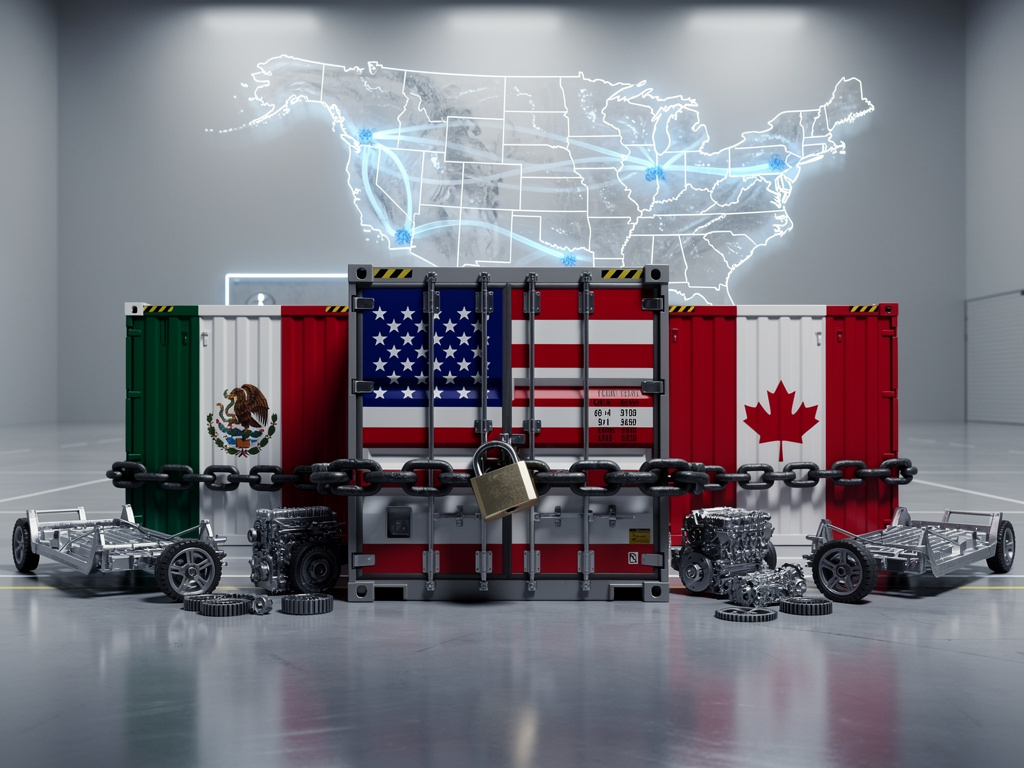
Jamieson Greer delivered a blunt message this week. The U.S. Trade Representative told an audience at the Council on Foreign Relations that tariffs on imports from Mexico and Canada will stay. No return to the old zero-tariff world. Even with close neighbors. Even under the United States-Mexico-Canada Agreement.
“We’re going to have tariffs as long as we have a giant trade deficit,” Greer said. Short. Direct. The reality, he added, is that American officials have spent the past year and a half telling trading partners they must accept some level of tariffs. The comments, made Tuesday, mark the clearest signal yet that the Trump administration views the current USMCA framework as insufficient. And that the upcoming joint review will not simply renew the status quo.
Greer spoke ahead of the first formal negotiating rounds with Mexico this week in Mexico City. Those talks exclude Canada for now. They focus on revised rules of origin and economic security measures. Changes, Greer explained, will aim to boost U.S. content in goods traded within the region. Mexico, in turn, should raise its tariffs on imports from outside North America. That would make preferential treatment inside the bloc more meaningful. “Ultimately for national security reasons, I want to have our supply chain sourced from this hemisphere, right from North America,” he said.
The numbers tell part of the story. The overall U.S. goods trade deficit fell more than 30 percent last year to $202.1 billion. Yet the deficit with Mexico rose nearly 15 percent to $196.9 billion, according to U.S. Census Bureau data cited by Reuters. Greer wants that gap narrowed. Tariffs provide the pressure. They also serve as a permanent feature, not a temporary tool.
His remarks echo what he told Mexican auto and steel executives last month. Tariffs are here to stay. President Trump likes them. Zero tariffs are off the table. Those private sessions, first reported by Reuters in April, set the tone for this week’s public confirmation. Industry leaders in Mexico now know the renegotiation will not eliminate duties on their key sectors.
Canada faces sharper words. Greer described U.S. issues with Ottawa as “significant.” They go well beyond typical trade irritants. Canada retaliated against U.S. tariffs. Only China shares that distinction. “So they’re just in a different spot, and it’s hard to see necessarily where that ends,” Greer said. He singled out Canadian auto production. It exists not because of natural competitive advantage but because of government policy requiring local output. “We want to build cars here.”
Those comments land as the USMCA faces its mandatory six-year review beginning in July 2026. The pact, which replaced NAFTA in 2020, has delivered measurable gains in North American integration. Compliance with rules of origin jumped sharply in 2025. For Mexico, the share of trade value meeting USMCA terms climbed to 76.1 percent. Canada reached 78.7 percent. Firms shifted sourcing to qualify for duty-free treatment and avoid the higher rates applied to non-compliant goods.
Trade volumes reflect the shift. Mexico overtook both Canada and China as the top U.S. trading partner last year, with total two-way goods trade hitting $873 billion compared with Canada’s $719 billion and China’s $419 billion. Manufacturing trade between the U.S. and Mexico reached $791 billion. North American content in Mexican exports to the United States now stands around 74 percent, up from 72.6 percent in 2017. In transportation equipment the figure approaches 77 percent. Such statistics, compiled by the Brookings Institution in an analysis published earlier this year, show how tariffs have accelerated regional supply chain tightening rather than fragmenting it.
But the gains come with friction. Average effective U.S. tariff rates rose to 16.9 percent in early 2026. Mexico faces 12.8 percent. Canada sees 8.1 percent. Non-USMCA goods from those countries carry 25 percent or 35 percent duties depending on the product. Steel, aluminum, and autos have drawn particular attention. Greer has testified before Congress that the administration has no plans for broad exclusion processes on Section 232 or Section 301 duties. Exclusions reduce pressure to bring production back to the United States. Reshoring remains the goal.
Canadian officials express little appetite for major rewrite. They seek relief from existing tariffs on steel, aluminum, and vehicles. Yet Greer’s latest statements suggest limited room for concessions. Bilateral dynamics with Mexico appear more constructive. Mexican legislators recently advanced measures to raise tariffs on over 1,400 products from countries outside the USMCA bloc. That move aligns with U.S. desires to limit third-country, especially Chinese, access to the North American market through back doors.
Automakers on both sides of the borders have voiced concerns. Higher duties raise costs. They disrupt just-in-time supply chains built over decades. Some executives worry that stricter rules of origin could make North American production less competitive globally. Others see opportunity if the changes successfully draw more investment stateside. The administration argues the current pact still allows too many loopholes. Manufacturers can locate in Canada or Mexico, import components, and ship finished goods into the United States with minimal U.S. content.
Greer has stressed in congressional testimony that U.S. manufacturers must receive treatment equal to or better than their counterparts in partner countries. The joint review offers the chance to close those gaps. Rules of origin for non-auto industrial goods will receive close scrutiny. So will Mexican policies on foreign investment and trade with third countries. The goal is not to dismantle the agreement but to make it serve American workers and factories more effectively.
Markets reacted with familiar caution to Greer’s comments. Cross-border equity and currency moves remained modest Tuesday. Longer term, the direction is clear. Tariffs form part of a broader strategy that includes reciprocal duties, national security measures, and pressure on trading partners to align on issues from border security to fentanyl flows. The USMCA review sits at the center of that effort.
Whether Canada and Mexico will accommodate the demands remains uncertain. Mexico has shown willingness to adjust its external tariff regime. Canada’s retaliation and defensive posture on dairy, softwood lumber, and other files complicate talks. Greer’s characterization of the relationship suggests the path forward with Ottawa could prove rocky. “It’s hard to see necessarily where that ends.”
The next several weeks of negotiations will test these positions. U.S. officials enter with explicit instructions from the president. Maintain leverage. Reduce deficits. Increase domestic content. Accept tariffs as the new baseline. For an administration that campaigned on rewriting trade deals to favor American industry, the message from Greer leaves little ambiguity. North America’s free trade era, at least in its purest form, is over.
Recent coverage reinforces the shift. A Brookings Institution report from March highlighted how 2025 tariffs accelerated USMCA usage and deepened integration even as they raised costs. Brookings noted no clear surge in Chinese transshipment through Mexico or Canada, suggesting the measures have curbed diversion without fully resolving underlying imbalances. Earlier WSJ reporting detailed Canadian resistance to revisions and the search for tariff relief.
Industry stakeholders continue to weigh the trade-offs. Some welcome stronger rules that could spur fresh investment. Others fear higher prices and retaliatory actions that hit U.S. exporters. Greer and his team face the task of threading that needle. The rhetoric this week suggests they intend to keep the pressure high. Tariffs, it appears, are no longer a negotiating tactic. They have become policy.


 WebProNews is an iEntry Publication