
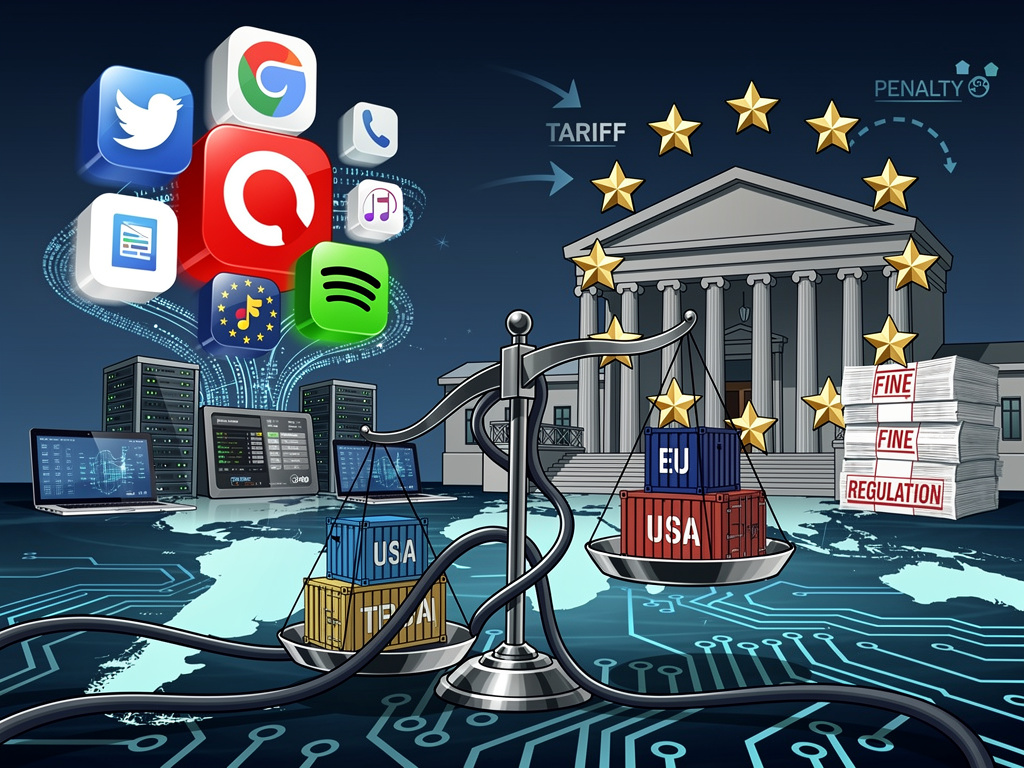
Washington’s escalating feud with Brussels over digital regulations took a sharp turn Tuesday, as the Trump administration named European companies including Spotify Technology SA for potential penalties unless the European Union dismantles its aggressive crackdown on American tech giants. The U.S. Trade Representative’s office issued a stark warning, accusing the EU of “discriminatory and harassing lawsuits, taxes, fines, and directives against U.S. service providers.” This move signals a potential trade war redux, pitting U.S. platforms like Alphabet Inc. and X against Europe’s regulatory arsenal.
The announcement, detailed in a statement from the USTR, comes amid mounting tensions following recent EU fines on Elon Musk’s X and probes into Google. Officials explicitly called out Spotify, Accenture Plc and Siemens AG as possible targets for fees or restrictions, framing the EU’s Digital Markets Act and Digital Services Act as unfair barriers that harm American exporters providing “substantial free services to EU citizens.” Posts on X from the USTR amplified the message, underscoring the administration’s resolve.
Roots of the Regulatory Rift
The conflict traces back to Europe’s post-GDPR era of tech oversight, intensified under the DMA and DSA, which mandate changes to app stores, search engines and content moderation. The Trump team argues these rules impose asymmetric burdens, with U.S. firms footing billions in compliance costs while European rivals like Spotify benefit from market access without reciprocal openness. A New York Times report highlighted how the White House views this as economic discrimination, threatening countermeasures akin to past tariff battles.
European officials have pushed back defiantly. After fining X earlier this month, EU regulators asserted their “sovereign right to enforce its laws,” per Reuters. This defiance has fueled White House ire, with administration figures decrying the penalties as “an attack on all American tech platforms,” according to Politico.
Spotify’s Precarious Position
Spotify, Europe’s streaming powerhouse, finds itself awkwardly sandwiched. While it has lobbied Brussels against Apple’s App Store dominance—winning concessions under the DMA—the U.S. now eyes it as retaliation fodder. Bloomberg reported the firm alongside others for potential restrictions, noting its reliance on U.S. markets for growth. CEO Daniel Ek has navigated these waters carefully, praising EU rules for fostering competition yet warning of overreach in past earnings calls.
USTR’s post on X explicitly tied the threat to ongoing EU actions, stating the bloc “persisted in a continuing course of discriminatory” measures. This specificity raises stakes for Spotify, whose shares dipped in after-hours trading amid the news, reflecting investor fears of disrupted U.S. access or new levies.
Broader Economic Fallout Looms
Analysts warn of cascading effects. The U.S. services trade surplus with the EU—$100 billion annually—could erode if tit-for-tat measures escalate. Bloomberg detailed how digital taxes in France and elsewhere already irk Washington, with Trump officials mulling IEEPA invocations for swift penalties. European firms risk U.S. market barriers, mirroring steel tariff precedents from Trump’s first term.
Inside the Beltway, USTR Katherine Tai’s office has ramped up rhetoric, linking this to a $1.2 trillion U.S. goods deficit. Recent USTR X posts boast of tariff successes elsewhere, positioning the EU standoff as integral to “America First” rebalancing.
EU’s Defiance and Internal Cracks
Brussels shows no signs of retreat. A Reuters update Tuesday captured EU commissioners vowing to protect digital sovereignty, even as some member states whisper about softening stances amid tariff fears. Germany’s auto sector, already reeling from U.S. duties, urges caution, per industry lobbying.
Yet cracks appear. A New York Times piece from November noted Europe’s rethinking of AI and privacy rules, scaling back amid competitiveness concerns. Trump’s pressure may accelerate this pivot, though ideologues in the European Commission resist.
Tech Giants Rally Behind Washington
U.S. tech leaders, long chafing under DMA probes, welcome the pushback. Elon Musk has publicly backed Trump, tweeting defiance of EU fines, while Google’s parent faces ongoing scrutiny. The administration’s strategy leverages these alliances, with X posts from USTR reinforcing solidarity against “harassing” regulations.
Legal fronts intensify too. Pending DSA challenges in EU courts could buy time, but U.S. threats bypass judiciary, invoking executive trade powers. Investors eye 2026 transatlantic flows, with potential for $50 billion in disrupted services trade.
Global Ripples and Precedents
Beyond the Atlantic, allies watch warily. India’s digital taxes face similar U.S. ire, and Asia-Pacific markets brace for spillover. Trump’s playbook—tariffs first, negotiate later—drew praise from USTR X threads on deals with Switzerland and others, securing billions in U.S. exports.
For industry insiders, the calculus is clear: EU rules risk isolating the bloc’s innovators like Spotify, whose U.S. revenue tops 40%. As one trade lawyer noted anonymously to Reuters, “This isn’t bluffing; it’s calibrated escalation.” The next moves—from Section 301 probes to targeted duties—could redefine digital trade norms by mid-2026.
Pathways to De-escalation
Diplomatic channels hum. Backchannel talks, hinted in Politico, explore carve-outs for U.S. firms in exchange for digital tax moratoriums. Yet Trump’s team demands full DMA rollbacks, a nonstarter for Ursula von der Leyen. Spotify’s silence on X amid the storm underscores corporate tightrope-walking ahead.


 WebProNews is an iEntry Publication