
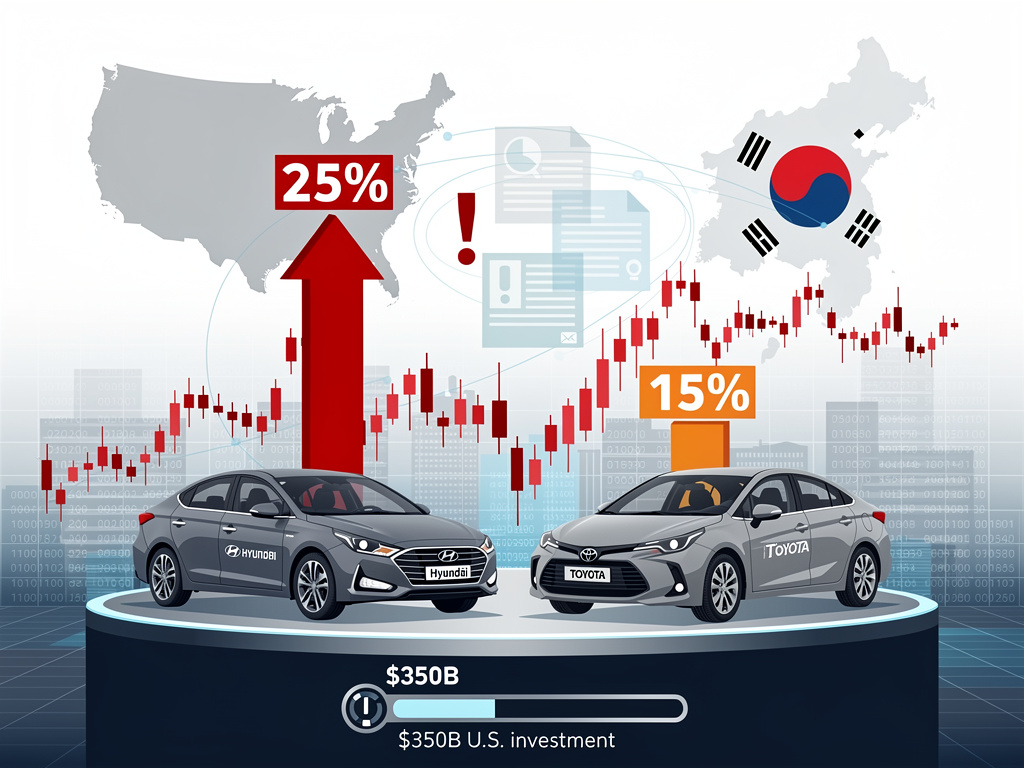
President Donald Trump’s abrupt decision to hike tariffs on South Korean imports to 25% from 15% has thrust Hyundai Motor Group into a precarious position against Japanese rivals like Toyota, reigniting trade tensions just months after a hard-won deal. The move, announced via Truth Social, targets autos, lumber, pharmaceuticals and other goods, citing delays in Seoul’s legislature ratifying a July 2025 trade pact. Hyundai shares plunged as much as 4.77% in early trading before recovering slightly, underscoring the immediate market jolt.
“Because the Korean Legislature hasn’t enacted our Historic Trade Agreement, which is their prerogative, I am hereby increasing South Korean TARIFFS on Autos, Lumber, Pharma, and all other Reciprocal TARIFFS, from 15% to 25%,” Trump posted on his platform, as reported by Automotive News. South Korea’s autos, which comprise 25% to 27% of its U.S. exports, now face duties exceeding those on Japanese vehicles, eroding price competitiveness overnight. Hyundai, Kia and Genesis, reliant on Korean plants for most U.S.-bound shipments despite a new Georgia facility, stand to absorb steep costs.
Tariff Hike Roots in Stalled Trade Pact
The escalation stems from a July 30, 2025, agreement between Trump and South Korean President Lee Jae-myung, reaffirmed during Trump’s October Seoul visit, promising $350 billion in U.S. investments—including $150 billion for shipbuilding, semiconductors and nuclear—in exchange for capping tariffs at 15%, down from 25%. That deal took effect November 1, aligning Korean rates with Japan’s, previously raised from 2.5% to 15%. But Seoul’s National Assembly has stalled ratification amid governance debates, prompting Trump’s reversal.
South Korea dispatched trade and industry ministers to Washington after a U.S. letter two weeks prior urged action; the investment bill lingers in committee, slated for next month’s debate, per Reuters. Presidential officials convened urgently, insisting no formal U.S. notification arrived, while reaffirming commitment. Choi Seok-young, ex-trade negotiator, called it “a political move… to force concessions during ongoing negotiations over non-tariff barriers.”
Hyundai’s Exposure Dwarfs Rivals’
Hyundai Motor Group ships the bulk of its U.S. sales from Korea—around 60% per prior analyses—making it acutely vulnerable, unlike Toyota with just 23% from Japan. Japanese Trade Minister Ryosei Akazawa noted the prior 2.5% gap already conferred “price competitiveness over South Korea,” a chasm now widened to 10 points, as detailed in Automotive News. Kia shares dropped up to 6%, Hyundai Mobis 5.7%, though markets later stabilized with Kospi up 2.7% amid skepticism on enforcement.
U.S. importers foot the bill, likely passing costs to consumers amid stubborn inflation where prior tariffs hit buyers hardest. South Korea exported $131.6 billion in goods to the U.S. in 2024, ranking top 10; autos dominate at nearly half its car exports. Hyundai’s new Georgia metaplant offers partial relief, but Korean factories feed high-volume models, per CNBC.
Market Ripples and Stock Swings
Hyundai Motor closed down 0.81% after volatility; Kia 1%, reflecting investor doubts Trump will fully implement without talks, akin to EU Greenland U-turns. The won weakened 0.52% to 1,451 per dollar. Analysts eye Supreme Court review of Trump’s tariff authority under the 1970s International Emergency Economic Powers Act, potentially curbing such unilateral hikes, as flagged by The New York Times.
Beyond autos, pharma and lumber face hits, though semiconductors may dodge practical enforcement to spare U.S. tech giants. Hyundai overhauled plans post-July relief, now scrambling anew. South Korea eyes a fund for dollar stability to fund investments without market chaos, per Bank of Korea Governor Rhee Chang-yong.
Broader Trade War Echoes
Trump’s tactic deploys tariffs as foreign policy leverage, from Canada’s 100% China threats to EU pressures. Japanese firms like Toyota gain breathing room, but all importers brace. U.S. vehicle prices, up 1.2% yearly to $48,907 average, face further strain; prior tariffs added $1,760 per unit per AlixPartners estimates.
Seoul pledges swift ratification, dispatching envoys amid diplomatic scramble, as BBC reports. Hyundai’s U.S. reliance—19% of Korean exports—amplifies risks, potentially ceding share to U.S.-built or lower-tariff imports. Industry insiders watch for price wars, production shifts or deal breakthroughs reshaping global auto flows.
Strategic Shifts Ahead
For Hyundai, accelerating U.S. localization via Georgia and Louisiana steel plants—$21 billion committed—becomes imperative, though ramps lag. Toyota’s diversified footprint cushions blows. Korean officials reassure on $350 billion pledges, eyeing project committees for viability. As tensions simmer, automakers recalibrate supply chains in Trump’s reciprocal trade era.


 WebProNews is an iEntry Publication