
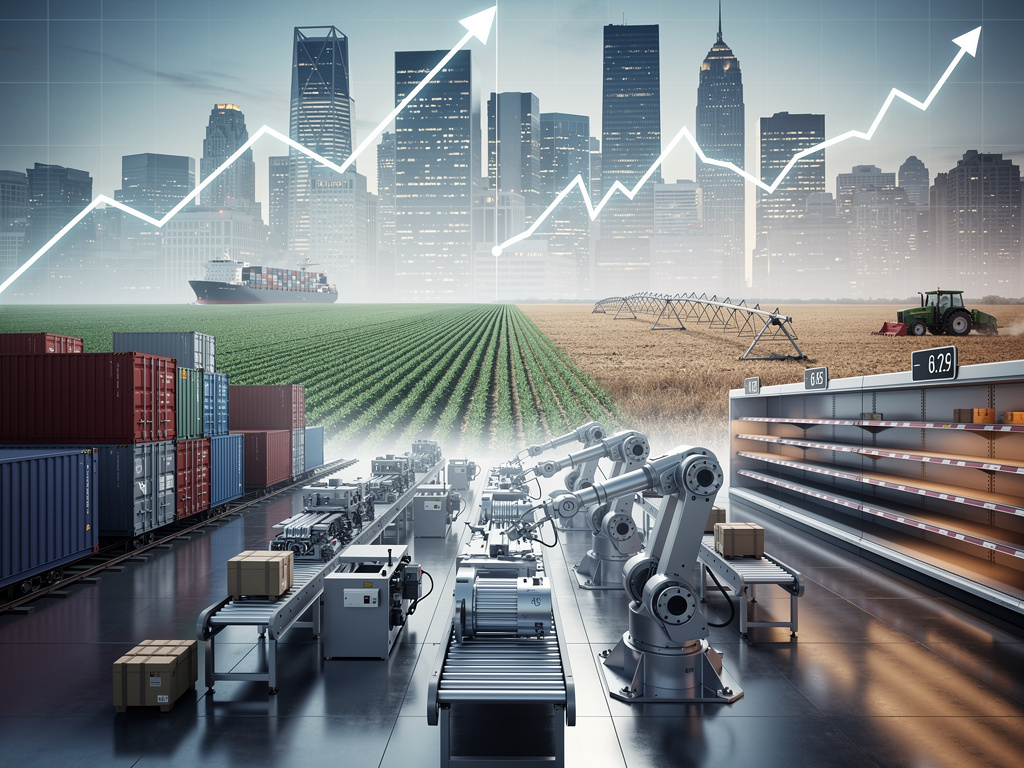
As President Donald Trump’s second term approaches its first anniversary, the U.S. economy presents a mosaic of achievements and challenges that defy simple narratives. Trump has frequently highlighted tariff revenues and a narrowing trade deficit as cornerstones of his economic strategy, positioning them as victories in restoring American manufacturing and fairness in global trade. Yet, economists across the spectrum argue that these metrics tell only part of the story, often overshadowed by rising consumer costs, supply chain disruptions, and uneven growth patterns.
Recent data from the Bureau of Labor Statistics shows unemployment hovering at 4.6%, a slight uptick from the 3.8% inherited from the previous administration, while inflation has ticked up to around 3%, driven in part by tariff-induced price hikes on imported goods. Stock markets have seen gains, with the S&P 500 up 11% year-to-date, buoyed by corporate tax cuts and deregulation efforts. However, these positives are tempered by warnings from institutions like the Penn Wharton Budget Model, which projected in an April analysis that Trump’s tariffs could reduce GDP by about 8% and wages by 7% over time, equating to a $58,000 lifetime loss for middle-income households (Penn Wharton Budget Model).
Interviews with economists reveal a consensus that while tariff revenues have indeed swelled government coffers—generating an estimated $100 billion in 2025 alone—the broader implications are more nuanced. “It’s not just about the dollars coming in; it’s about who pays the price,” notes one analyst, pointing to how these levies function as a regressive tax, disproportionately affecting lower-income consumers through higher prices on everyday items like electronics and apparel.
Tariffs’ Double-Edged Sword
The administration’s trade policies, including blanket tariffs on imports from China and other nations, have shrunk the U.S. trade deficit by roughly 15% compared to 2024 levels, according to Commerce Department figures. Trump has touted this as evidence of “winning” the trade war, with executive orders aimed at reciprocity and national security playing a central role. A fact sheet from the White House details these efforts, declaring a national emergency to bolster competitive edges and protect sovereignty (White House).
However, this shrinkage comes at a cost. Agricultural exports have plummeted as retaliatory tariffs from trading partners hit U.S. farmers hard, leading to bankruptcies and a $3 billion loss in tourism-related revenue in states like Nevada, where empty hotels signal broader economic ripple effects. Economists at the Tax Foundation estimate that these tariffs equate to an average $1,200 tax increase per household in 2025, exacerbating inflationary pressures and slowing consumer spending (Tax Foundation).
Critics argue that the policies echo elements of Project 2025, a blueprint associated with Trump’s allies that proposes deep cuts to federal programs, including education and housing initiatives. A Democratic analysis highlights how such proposals could eliminate Title I grants, potentially displacing 72,000 teachers and weakening middle-class supports (House Democrats Appropriations). While the White House distances itself from the full document, echoes in funding bills suggest its influence on fiscal priorities.
Industrial Policy Under Scrutiny
Trump’s approach to industrial policy—favoring sectors like manufacturing and energy through subsidies and deregulation—has drawn both praise and criticism. Proponents point to reshoring efforts that have brought capital back to U.S. shores, with investments in domestic production rising by 20% in key industries. Yet, a Politico interview with a top economist warns that this strategy may weaken the economy by picking winners and losers inefficiently, blurring lines between government and business (Politico).
NPR’s coverage describes this as a shift toward “crony capitalism,” where policies favor certain companies, potentially stifling innovation and free-market dynamics (NPR). For instance, tax cuts extended from Trump’s first term have primarily benefited the top 1%, with the middle class seeing minimal wage gains amid rising living costs. Forecasts from Moody’s, shared widely on social media platforms like X, predicted a recession by mid-2025 if tariffs and tax extensions persisted, a sentiment echoed in posts from economic analysts warning of halted growth and skyrocketing prices.
Public sentiment, as gauged from polls and online discussions, remains divided. An Axios survey reveals low approval for Trump’s economic handling, with many Americans reporting persistent financial strain despite administration claims of a “golden age” (Axios). On X, users debate outcomes, with some highlighting steady GDP growth at 2.1-3% and low gas prices under $3 per gallon as wins, while others decry inflation and job losses in vulnerable sectors.
Fiscal Pressures and Long-Term Forecasts
The extension of tax cuts, coupled with increased spending on defense and infrastructure, has ballooned the federal deficit, prompting concerns from fiscal watchdogs. The Federal Register’s compilation of 2025 executive orders underscores a flurry of actions aimed at deregulation, but economists warn of volatility (Federal Register). Holland & Knight’s tracking chart details these orders, noting their focus on trade and security, yet potential overreach in areas like education cuts (Holland & Knight).
International ramifications add another layer. Global stock markets have fluctuated wildly since tariff implementations, with the OECD downgrading U.S. growth forecasts from 2.8% to 2.2%, and the Federal Reserve further to 1.7%, signaling recession risks. Posts on X from macroeconomists like those analyzing long-term interest rates predict higher deficits leading to fiscal strain, potentially culminating in broader economic resets if unchecked.
In sectors like technology and AI, Trump’s policies have spurred investments, as charted by The New York Times in its year-end review, linking trade stances to climbing stock prices (The New York Times). However, this boom masks underlying issues, such as labor shortages from immigration restrictions, which have tightened supply and driven up wages in some areas while suppressing them in others.
Consumer Realities and Sectoral Shifts
For everyday Americans, the economy’s performance feels far from the rosy picture painted by the administration. The Guardian reports that while Trump promises a new golden age, most citizens have yet to experience it, grappling with food prices up 3.1% year-over-year and tariffs adding to household burdens (The Guardian). ABC News notes that despite efforts to promote the agenda, public negativity persists, with polls showing approval ratings lagging (ABC News).
Energy wins, including deregulation boosting domestic production, have lowered gas prices and supported job growth in fossil fuels, but at the expense of renewable transitions. Tourism and agriculture suffer, with Vegas reporting empty venues and farmers facing trade barriers leading to a trillion-dollar deficit with China, as discussed in various X analyses.
Looking ahead, The New Yorker’s financial page warns that Trump’s chaotic style could undermine 2026 growth predictions, turning potential upturns into downturns (The New Yorker). Economists emphasize that while short-term gains in stock values and deficit reductions appear promising, the long-term effects of protectionism may erode competitiveness.
Navigating Uncertainty in Policy Implementation
Implementation of these policies has not been without hurdles. Mass deportations, promised as part of the economic reset, have disrupted labor markets, particularly in agriculture and construction, contributing to the unemployment rise. X posts from users tracking real-time data highlight how immigration exits have tightened labor supply, altering behaviors in ways that are hard to reverse, such as reshoring investments and adjusted tax planning.
Holland & Knight’s chart, referenced earlier, illustrates the breadth of executive actions, from trade declarations to regulatory rollbacks, each with cascading effects on sectors. The White House’s emergency declaration, as detailed in its fact sheet, aims to rebuild sovereignty, but critics see it as overreach that could harm civil rights protections in housing, per the Democratic analysis.
Ultimately, the complicated picture painted by economists in outlets like Business Insider underscores that Trump’s 2025 outcomes are a blend of bold moves and unintended consequences (Business Insider). As midterms loom, the administration’s narrative of triumph clashes with ground-level realities, where tariff revenues fund ambitions but at the cost of broader economic stability.
Voices from the Ground and Expert Insights
Industry insiders, including those in manufacturing, report mixed results: some factories thrive under protection, while others struggle with higher input costs. Tax Foundation’s analysis, cited previously, quantifies the household impact, reinforcing that the trade war’s burdens fall unevenly.
On X, sentiment ranges from optimistic forecasts of rising wages and investments to dire warnings of fiscal collapse, with users debating GDP steadiness versus inflation spikes. NPR’s exploration of crony capitalism, as mentioned, highlights how policies blur business-government lines, potentially fostering inefficiency.
In energy and tech, gains are evident, but The New York Times’ charts show inflation and trade policies as dominant shapers, with AI investments offsetting some losses. As 2025 closes, the economy’s path hinges on balancing these forces, with economists urging a nuanced view beyond headlines.


 WebProNews is an iEntry Publication