
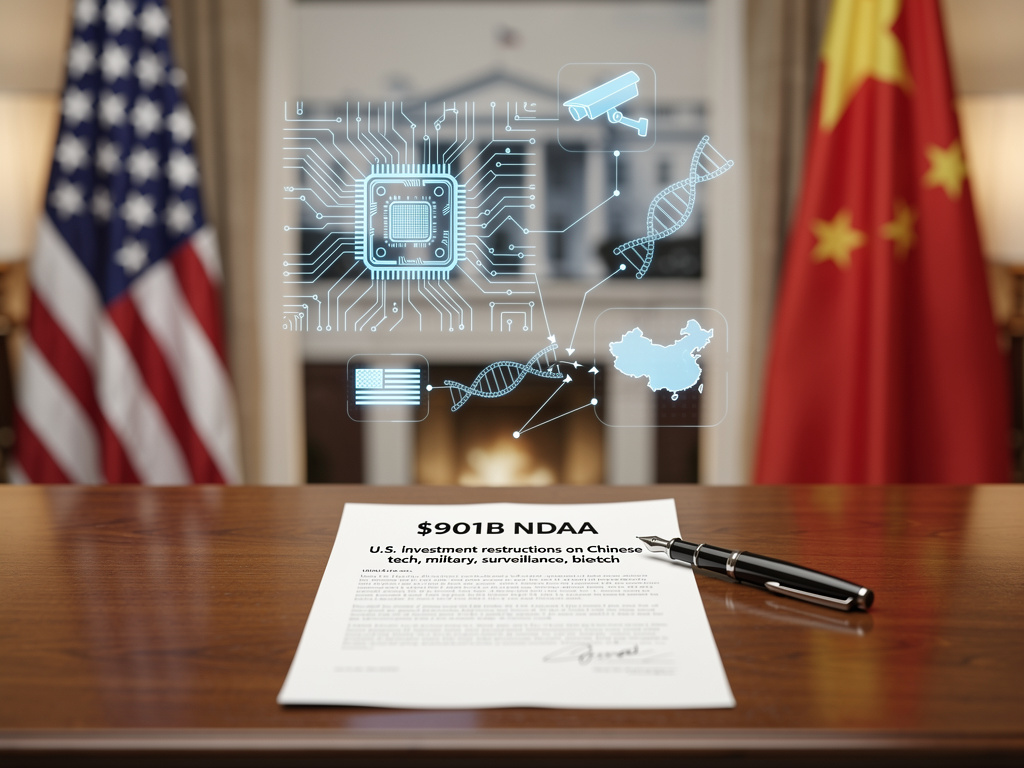
President Donald Trump on Thursday signed the National Defense Authorization Act for Fiscal Year 2026, embedding sweeping restrictions on American investment into Chinese technology firms tied to military and surveillance activities. The $901 billion defense package, passed by Congress with bipartisan support, authorizes the president to screen and block U.S. financing for sensitive Chinese projects, marking a pivotal escalation in financial decoupling from Beijing.
Key provisions revive stalled outbound investment rules, targeting technologies with dual-use military applications. The bill prohibits federal contracts with Chinese biotech companies and mandates divestment from entities on U.S. blacklists, aiming to prevent American capital from fueling China’s defense capabilities. Sources close to the White House described the signing as a quiet but firm step amid fragile U.S.-China trade truces.
Legislative Path to Presidential Desk
The Senate approved the NDAA in a 77-20 vote on Wednesday, sending it to Trump after House passage earlier. Sponsored elements like the FIGHT China Act, led by Rep. Andy Barr (R-Ky.) and Sen. John Cornyn (R-Texas), passed the Senate and embed permanent sanctions on investments into Communist Party-linked military firms. ‘This legislation will make President Donald J. Trump’s America First Investment Policy permanent,’ Barr said in a press release.
Sen. Tim Scott (R-S.C.) highlighted China-focused measures during Senate debates, emphasizing protections for chips, AI, and military bases. ‘We’re pushing an aggressive posture against China,’ Scott told Fox Business. The package also includes a 4% pay raise for troops and $900 billion in overall defense spending.
Targeting Biotech and Dual-Use Tech
Provisions ban U.S. government contracts with Chinese biotech entities, signaling hardened Capitol Hill views on Beijing’s sector dominance. The South China Morning Post reported that the bill ‘tightens controls on American investment in Chinese technology’ while restricting federal biotech ties, per its coverage of congressional unveilings (SCMP).
Dimsum Daily noted the NDAA ‘curbs U.S. investment in Chinese tech and federal biotech contracts,’ framing it against trade tensions (Dimsum Daily). Wall Street Journal analysis detailed how the act empowers screening of outbound flows to firms in military surveillance (WSJ).
Investor Implications and Market Ripples
U.S. investors have poured billions into Chinese tech, inadvertently funding blacklisted companies like those in surveillance. The NDAA mandates funds to divest from such entities within set timelines, potentially triggering selloffs in ETFs and mutual funds exposed to mainland markets. Compliance costs for asset managers will rise, with new reporting on China holdings required.
Fox News reported the bill as a ‘$900B defense measure targeting China with investment crackdowns’ (Fox News). Posts on X from Fox Business underscored Senate momentum, noting the bill ‘unlocks funding for Trump’s national defense priorities’ amid China curbs.
Broader Geopolitical Maneuvers
The measures build on Trump-era executive orders, now codified to withstand future administrations. AP News covered early drafts pushing restrictions despite White House trade truce softening (AP News). SCMP highlighted revived outbound investment screens stalled previously.
For industry insiders, the NDAA signals intensified CFIUS scrutiny on deals involving Chinese tech. Venture capital firms with China exposure face heightened due diligence, while domestic AI and semiconductor sectors gain from redirected capital. Fox Business posts reflected real-time Senate passage excitement, tying it to competition in chips and AI.
Enforcement Mechanisms and Timelines
Implementation starts in early 2026, with Treasury and Commerce departments tasked with rule-making. The president gains authority to designate additional firms for investment bans, expanding beyond existing Entity Lists. Barr emphasized preventing ‘American investors from unknowingly bankrolling military and tech companies that threaten U.S. national security.’
ABC News echoed congressional pushes for Beijing curbs in the massive bill (ABC News). SCMP’s earlier piece on the unveiled bill noted ‘curbs on China tech investment’ as a Capitol Hill signal (SCMP).
Reactions from Beijing and Wall Street
Chinese state media has downplayed the signing, but outbound investment channels like Hong Kong listings may see U.S. fund pullbacks. Wall Street firms are reviewing portfolios; BlackRock and Vanguard, with heavy China weightings, disclosed potential impacts in recent filings. Scott’s Fox Business interview stressed base protections alongside investment walls.
The NDAA’s passage cements a bipartisan consensus on economic security, with Trump’s signature ensuring swift rollout. Fox Business confirmed the quiet Oval Office ceremony, aligning with administration priorities on troop pay and tech rivalry (Fox News).
Long-Term Strategic Shifts


 WebProNews is an iEntry Publication