
Trump’s AI Power Play: Forging a Federal Fortress Against State Overreach
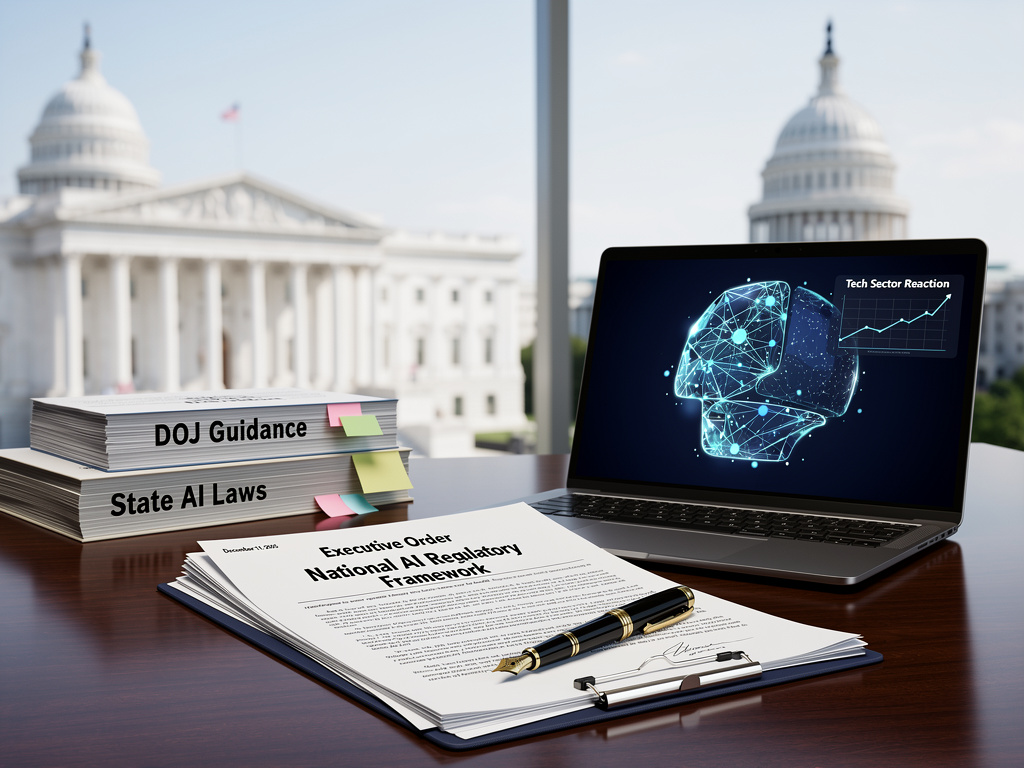
President Donald Trump’s latest executive order on artificial intelligence marks a pivotal shift in how the United States approaches the governance of this rapidly evolving technology. Signed on December 11, 2025, the order aims to establish a unified national framework for AI regulation, effectively curtailing the ability of individual states to impose their own rules. This move comes amid growing concerns from tech industry leaders about a patchwork of state-level regulations that they argue stifles innovation and creates unnecessary compliance burdens. By centralizing oversight at the federal level, the administration seeks to streamline processes and foster a more cohesive environment for AI development.
The executive order, titled “Ensuring a National Policy Framework for Artificial Intelligence,” directs the Department of Justice to challenge state laws that are deemed to obstruct national AI policy. It also establishes a task force dedicated to litigating against such state measures, signaling a aggressive stance toward preempting local regulations. According to reports, this initiative is seen as a boon for major tech companies that have long advocated for federal preemption to avoid navigating a maze of differing state requirements. The order lacks the full force of law but sets a clear directive for federal agencies to prioritize national standards over state ones.
Industry insiders view this as a direct response to actions in states like California and New York, where lawmakers have pushed for stringent AI safety measures, including requirements for transparency in algorithmic decision-making and protections against bias. Trump’s order explicitly warns that states imposing “excessive” regulations could face cuts in federal funding, a tactic that echoes previous administration strategies in areas like immigration and environmental policy. This approach has already sparked backlash from state officials who argue it undermines their authority to protect citizens from potential AI harms.
Federal Ambitions in AI Governance
The timing of the order aligns with broader efforts by the Trump administration to bolster U.S. competitiveness in the global AI race. As detailed in coverage from The New York Times, Trump announced the measure in the Oval Office, emphasizing the need for a single regulatory playbook to override disparate state laws. He described it as essential for maintaining America’s edge against international rivals like China, where government-backed AI initiatives proceed with fewer regulatory hurdles. The order builds on previous executive actions, including those from Trump’s first term that promoted AI research and development within federal agencies.
Further insights from NBC News highlight how congressional attempts to pass comprehensive AI legislation have faltered this year, leaving a vacuum that the executive branch is now filling. Without bipartisan support on Capitol Hill, the order serves as a stopgap measure, though its longevity could be tested by future administrations or court challenges. Legal experts note that while executive orders can direct federal policy, they often face scrutiny over issues of federalism, particularly when they encroach on states’ rights.
Reactions from the tech sector have been largely positive, with companies like Meta, Google, and Microsoft standing to benefit from reduced regulatory fragmentation. Posts on X, formerly Twitter, from industry watchers underscore this sentiment, with many praising the move as a win for innovation. For instance, discussions on the platform emphasize how a national standard could accelerate AI deployment in critical areas such as healthcare and transportation, where varying state rules currently complicate rollout.
State Pushback and Legal Battles Ahead
State governors and attorneys general, particularly in Democratic-led states, have wasted no time in condemning the order. California’s Governor Gavin Newsom issued a statement criticizing it as an overreach that prioritizes corporate interests over public safety, as reported by BBC News. Newsom pointed to his state’s recent AI regulations, which mandate safety testing for advanced models, arguing that federal intervention could expose residents to unchecked risks like deepfakes and automated discrimination.
Similarly, coverage in CNBC notes that the order is perceived as a victory for Big Tech lobbyists who have pushed for federal oversight to supersede state efforts. This perspective is echoed in X posts, where users debate the implications for smaller AI startups that might struggle under a one-size-fits-all federal regime. The establishment of the AI Litigation Task Force within the Justice Department is particularly contentious, as it empowers federal lawyers to sue states directly, potentially leading to protracted legal fights.
Beyond immediate reactions, the order raises questions about enforcement mechanisms. The White House document, available on The White House website, outlines directives for agencies to review and challenge state laws that conflict with national priorities. This includes potential withholding of federal grants, a lever that could pressure states into compliance but might also invite constitutional challenges under the Tenth Amendment.
Implications for Innovation and Ethics
For industry insiders, the order represents a double-edged sword. On one hand, it promises to eliminate regulatory silos that hinder cross-state operations, allowing AI firms to scale more efficiently. As explored in an article from Mashable, the move aligns with Trump’s pro-business agenda, aiming to unleash AI’s potential in boosting economic growth. Tech executives have lauded this as a step toward making the U.S. the undisputed leader in AI, with investments in research and infrastructure likely to follow.
On the other hand, ethicists and consumer advocates worry that diminishing state oversight could lead to a race to the bottom in terms of safety standards. Reports from The Guardian detail concerns that without robust local regulations, issues like privacy invasions and job displacement from AI could escalate unchecked. This tension is evident in ongoing debates on X, where posts highlight fears of monopolistic control by tech giants under a lax federal umbrella.
Moreover, the order’s focus on national security aspects, such as integrating AI into defense and intelligence operations, underscores its strategic intent. Drawing from earlier executive actions referenced in Reuters, Trump has consistently positioned AI as a cornerstone of American dominance, with this latest order extending that vision by consolidating regulatory power.
Broader Economic and Global Ramifications
Economically, the executive order could reshape investment patterns in the AI sector. By signaling a more permissive federal environment, it may attract foreign capital and talent, countering brain drain to countries with lighter regulatory touches. Analysis in The Washington Post suggests this could exacerbate divisions within the Republican Party, where some members favor state autonomy while others prioritize national economic strategy.
Globally, the move positions the U.S. in stark contrast to the European Union’s more stringent AI Act, which emphasizes risk-based regulation. Industry observers on X note that Trump’s order might encourage a divergence in standards, complicating international trade in AI technologies. For U.S. firms operating abroad, this could mean navigating dual regimes, but domestically, it streamlines compliance.
Looking ahead, the order’s impact will depend on judicial interpretations and potential legislative follow-through. If Congress enacts supporting laws, it could solidify the federal framework; otherwise, it remains vulnerable to reversal. As CBS News reports, states like Minnesota are already assessing how their nascent AI rules might be affected, with local lawmakers vowing to defend their prerogatives.
Evolving Dynamics in Tech Policy
The executive order also intersects with ongoing discussions about AI ethics and equity. Advocates for marginalized communities argue that state-level protections are crucial for addressing biases in AI systems, which federal oversight might overlook in favor of speed. X posts from activists amplify these concerns, calling for a balanced approach that doesn’t sacrifice safeguards for innovation.
In the corporate sphere, companies are recalibrating strategies in anticipation of reduced state interference. This could accelerate AI adoption in sectors like finance and autonomous vehicles, where regulatory clarity is paramount. However, as highlighted in various news outlets, the lack of detailed federal guidelines in the order itself leaves room for interpretation, potentially leading to uncertainty until further directives emerge.
Ultimately, Trump’s AI executive order encapsulates a bold vision for federal leadership in technology governance. By challenging state authority, it aims to create a streamlined path for AI advancement, but at the potential cost of localized protections. As the tech industry and policymakers grapple with its ramifications, the coming months will reveal whether this centralization fosters the innovation boom the administration envisions or ignites a new front in federal-state conflicts. With global competitors watching closely, the stakes for getting this right are extraordinarily high, shaping not just domestic policy but America’s role in the international arena of artificial intelligence.


 WebProNews is an iEntry Publication