
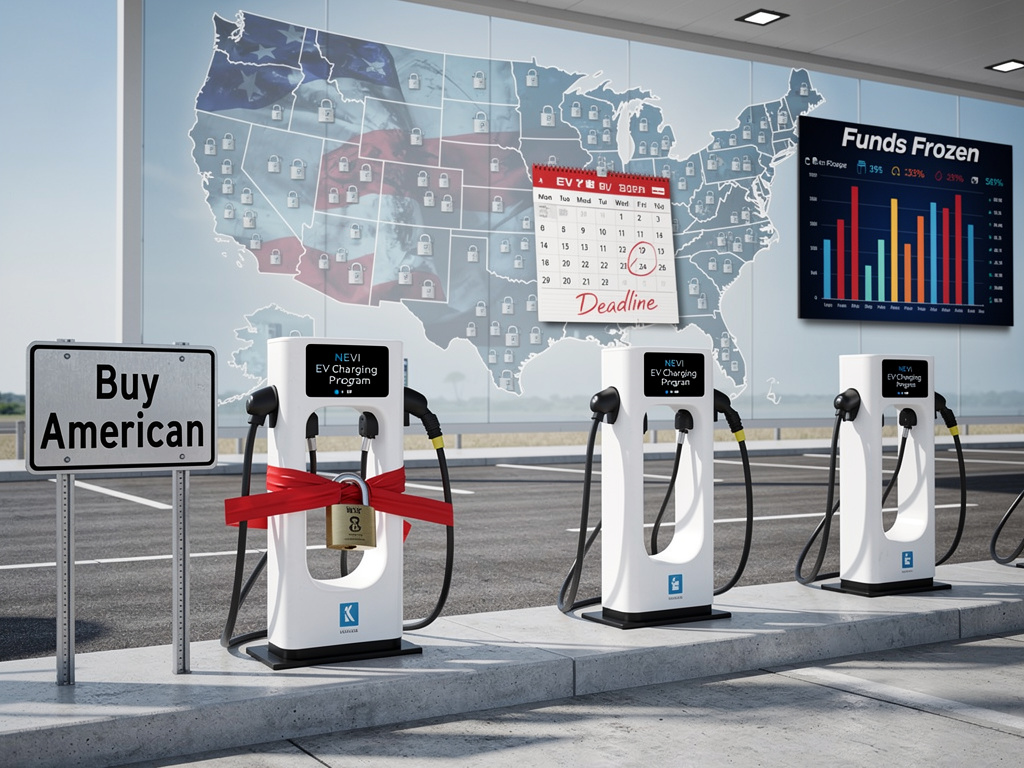
The federal government’s ambitious plan to blanket American highways with electric vehicle charging stations has hit yet another obstacle — this time from the very administration that claims to champion domestic manufacturing. New Buy American requirements imposed by the Trump administration on the National Electric Vehicle Infrastructure (NEVI) program are threatening to freeze billions of dollars in funding at a moment when the charging network was finally gaining momentum.
The tension between promoting American-made products and accelerating the deployment of EV infrastructure has created a policy paradox that is leaving states, charging companies, and automakers in a state of uncertainty. With deadlines looming and supply chains still maturing, the consequences of inaction could ripple across the broader electric vehicle market for years to come.
Billions on the Line as Buy American Rules Tighten
At the center of the dispute is the NEVI program, a $5 billion initiative established under the 2021 Bipartisan Infrastructure Law to fund the construction of EV chargers along major highways. The program was designed to ensure that no American driver would be too far from a reliable fast-charging station, regardless of what state they lived in. But as The Verge reported, the Trump administration’s tightened Buy American requirements are now jeopardizing the flow of those funds to states and charging operators.
The Buy American provisions require that EV chargers funded through NEVI meet strict domestic content thresholds — meaning a significant percentage of the components used in the chargers must be manufactured in the United States. While the Biden administration had set initial domestic content requirements, the Trump administration has raised the bar considerably, demanding higher percentages of American-made parts and imposing stricter enforcement mechanisms. The problem, according to industry stakeholders, is that the domestic supply chain for EV charging components is not yet mature enough to meet these elevated standards.
A Supply Chain That Isn’t Ready
The EV charging industry has been scaling rapidly, but much of the critical hardware — power electronics, cables, connectors, and display screens — is still largely sourced from overseas manufacturers, particularly in Europe and Asia. Companies like ABB, Tritium, and Kempower, which are among the leading global suppliers of DC fast chargers, manufacture significant portions of their equipment outside the United States. Even ChargePoint and Blink Charging, two of the most prominent American charging companies, rely on global supply chains for key components.
According to reporting by The Verge, the stricter requirements have created a bottleneck. States that had been moving forward with NEVI-funded projects are now pausing to reassess whether their chosen equipment vendors can meet the new thresholds. Some charging companies have warned that compliance could take months or even years, as they work to establish or expand domestic manufacturing capabilities. In the interim, the funds sit idle — a frustrating outcome for an administration that has simultaneously criticized the slow pace of charger deployment under its predecessor.
States Caught in the Crossfire
The NEVI program distributes funds to states through a formula-based allocation, and each state is required to submit a plan detailing how it will deploy the chargers. Many states had already awarded contracts and begun construction when the new rules took effect. Now, some are facing the prospect of having to rebid contracts or seek waivers — a process that adds time, cost, and complexity to projects that were already behind schedule.
The frustration is bipartisan. Republican and Democratic governors alike have expressed concern that the Buy American mandates, while well-intentioned, are effectively functioning as a brake on infrastructure deployment. Transportation departments in states like Ohio, Texas, and California have all flagged challenges in finding compliant equipment. The irony is not lost on observers: the very policy meant to boost American manufacturing may be delaying the construction of infrastructure that would support the domestic auto industry’s transition to electric vehicles.
The Political Calculus Behind the Mandate
The Trump administration’s approach reflects a broader ideological commitment to economic nationalism. President Trump has repeatedly emphasized the importance of bringing manufacturing jobs back to the United States, and the Buy American requirements for NEVI are consistent with that vision. Administration officials have argued that temporary delays are an acceptable trade-off for building a truly domestic EV charging supply chain.
But critics counter that the policy is penny-wise and pound-foolish. The EV market is at a critical inflection point, with sales growing but consumer anxiety about charging availability remaining one of the top barriers to adoption. A 2024 survey by J.D. Power found that charging infrastructure concerns ranked as the number-one reason potential buyers hesitated to purchase an EV. Every month of delay in deploying chargers is a month in which potential EV buyers may choose to stick with gasoline-powered vehicles — undermining both environmental goals and the business case for domestic EV manufacturing.
Industry Players Scramble to Adapt
Some charging companies are attempting to get ahead of the requirements by investing in U.S.-based manufacturing. Tesla, which operates the largest fast-charging network in the country through its Supercharger system, manufactures much of its charging equipment domestically and is well-positioned to meet Buy American thresholds. The company has also opened its Supercharger network to non-Tesla vehicles, making it eligible for NEVI funds — a strategic advantage that the new rules only amplify.
Other companies are racing to catch up. Tritium, an Australian charging manufacturer, opened a factory in Lebanon, Tennessee, in 2023 specifically to serve the U.S. market and comply with domestic content requirements. ABB E-mobility has expanded its manufacturing footprint in the United States as well. But building out factory capacity takes time, and the gap between current domestic production capabilities and the administration’s requirements remains significant. Smaller charging startups, which lack the capital to build U.S. factories, may find themselves locked out of the NEVI program entirely — potentially consolidating the market in the hands of a few large players.
A Ticking Clock and Expiring Funds
Adding urgency to the situation is the fact that NEVI funds come with expiration dates. Under the terms of the Bipartisan Infrastructure Law, states must obligate their allocated funds within specific timeframes or risk losing them. As The Verge noted, the combination of tightened Buy American rules and looming deadlines has created a pressure cooker for state transportation agencies. Some states are exploring whether they can apply for waivers to the domestic content requirements — a process that the Federal Highway Administration oversees but that has been slow and opaque under the current administration.
The stakes extend beyond the immediate NEVI funding. The second phase of the program, which allows states to deploy chargers in locations beyond highway corridors — such as urban neighborhoods, apartment complexes, and rural communities — represents an even larger opportunity to expand access to EV charging. But if the first phase remains mired in regulatory uncertainty, the second phase could be delayed indefinitely, leaving vast swaths of the country underserved.
What Comes Next for America’s Charging Network
The path forward is unclear. Industry groups, including the Zero Emission Transportation Association (ZETA) and the Edison Electric Institute, have urged the administration to adopt a phased approach — gradually increasing domestic content requirements over time rather than imposing them all at once. This would allow the supply chain to mature while still incentivizing domestic manufacturing. Some members of Congress have also weighed in, with bipartisan letters to the Department of Transportation requesting greater flexibility.
For now, the EV charging buildout remains in a holding pattern in many parts of the country. The administration’s insistence on strict Buy American compliance has succeeded in sending a signal to manufacturers that domestic production matters. But whether that signal translates into a stronger American supply chain — or simply a slower, more expensive, and less reliable charging network — will depend on how quickly the policy is refined and how nimbly the industry responds.
What is certain is that the window for action is narrowing. Every quarter of delay means fewer chargers on the ground, fewer EV sales, and a longer timeline for the United States to build the infrastructure that both parties agree is essential. The question is whether Washington can find a way to reconcile its competing priorities before the opportunity — and the funding — slips away.


 WebProNews is an iEntry Publication