
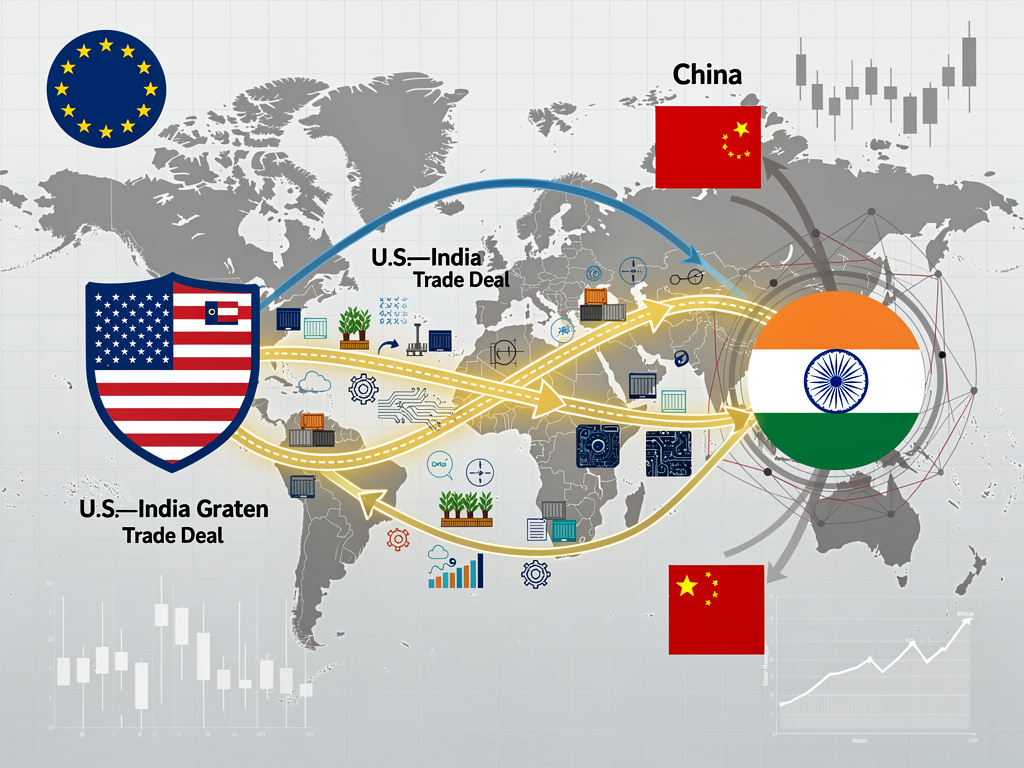
In a striking display of competitive diplomacy, President Donald Trump signed a comprehensive trade agreement with India on February 3, 2026, mere weeks after the European Union finalized its own landmark deal with New Delhi. The timing was no coincidence. According to CNBC, Trump explicitly referenced the EU-India agreement during the signing ceremony, declaring that America “will not take a back seat to anyone when it comes to securing favorable terms with the world’s fastest-growing major economy.”
The U.S.-India Trade and Investment Framework Agreement, as the pact is formally known, represents the culmination of eighteen months of intensive negotiations that accelerated dramatically once Brussels announced its own breakthrough with Prime Minister Narendra Modi’s government. Trade representatives from both nations worked around the clock in January to finalize terms that would position the United States as India’s preferred Western trading partner, even as European officials celebrated what they believed would be an exclusive advantage in accessing India’s 1.4 billion consumers.
The agreement encompasses tariff reductions on approximately $500 billion worth of goods over the next decade, with immediate cuts on agricultural products, pharmaceuticals, and technology hardware. India has committed to reducing its average tariff rate from 17% to 8.5% on American goods, while the United States will lower barriers on Indian textile imports, information technology services, and generic pharmaceuticals. The pharmaceutical provisions alone are expected to save American consumers an estimated $12 billion annually, according to industry analysts who briefed reporters on background.
The European Shadow: How Brussels Inadvertently Sparked Washington’s Urgency
The European Union’s trade agreement with India, signed in mid-January 2026, was heralded as a geopolitical coup for Brussels. European Commission President Ursula von der Leyen called it “a defining moment in EU-India relations” that would “reshape global trade architecture for generations.” That agreement, which took nearly a decade to negotiate, provided European manufacturers with preferential access to Indian markets for automobiles, machinery, and luxury goods while opening European markets to Indian agricultural exports and professional services.
However, the EU’s celebration proved premature. Within 72 hours of the Brussels signing ceremony, Trump convened an emergency meeting with U.S. Trade Representative Katherine Tai and Commerce Secretary Howard Lutnick, instructing them to “get a better deal done faster” than their European counterparts. According to sources familiar with the discussions who spoke on condition of anonymity, Trump was particularly focused on ensuring that American technology companies and agricultural exporters would not face disadvantages compared to their European competitors in the Indian market.
The competitive dynamic between Washington and Brussels over India access reflects broader tensions in transatlantic relations under Trump’s second administration. While European officials had hoped their early-mover advantage would establish them as India’s primary Western economic partner, the Trump administration’s willingness to make concessions on issues like H-1B visa allocations and intellectual property protections for Indian generic drug manufacturers ultimately proved more attractive to New Delhi. Indian officials, speaking privately, acknowledged that playing Washington against Brussels provided leverage that resulted in more favorable terms than either agreement would have contained in isolation.
Tariff Cuts and Market Access: Comparing the Transatlantic Approaches
The substantive differences between the U.S.-India and EU-India agreements reveal divergent strategic priorities. The European deal emphasizes manufactured goods and climate technology, with provisions requiring joint investment in renewable energy infrastructure and electric vehicle production facilities. European automakers like Volkswagen and Stellantis secured commitments for reduced tariffs on vehicles imported into India, dropping from 100% to 40% over seven years, in exchange for establishing manufacturing plants that would employ at least 50,000 Indian workers.
By contrast, the American agreement prioritizes services, digital trade, and agricultural exports. U.S. negotiators secured unprecedented access for American technology companies to Indian government procurement contracts, a concession that European negotiators failed to obtain. The agreement also includes provisions allowing American financial services firms to establish wholly-owned subsidiaries in India without local partnership requirements, opening a market that has been largely closed to foreign banks and insurance companies since India’s independence.
Agricultural provisions represent perhaps the starkest difference between the two agreements. American farmers will benefit from immediate elimination of Indian tariffs on almonds, walnuts, apples, and cherries—products where California and Washington state producers have long sought market access. India’s 70% tariff on American almonds, which effectively priced them out of the Indian market despite superior quality, will drop to zero within 18 months. European negotiators, lacking equivalent agricultural export interests, focused instead on protecting European geographical indications for products like Champagne and Parmigiano-Reggiano, provisions that offer little immediate economic benefit but satisfy domestic political constituencies.
The Pharmaceutical Provisions: A Calculated American Concession
Perhaps the most controversial element of the U.S.-India agreement involves intellectual property protections for pharmaceuticals. The Trump administration agreed to limit the duration of data exclusivity for biologics to six years in the Indian market, down from the twelve years typically required in American trade agreements. This concession allows Indian generic manufacturers to bring biosimilar versions of expensive American drugs to market more quickly, potentially undercutting the profitability of U.S. pharmaceutical companies.
Industry groups reacted with alarm. The Pharmaceutical Research and Manufacturers of America issued a statement calling the provision “a dangerous precedent that undermines innovation incentives.” However, Trump administration officials defended the decision as necessary to secure broader market access for American goods and services. During a background briefing, a senior Commerce Department official argued that “the pharmaceutical industry has enjoyed monopolistic protections for too long, and American consumers will benefit from lower-cost generic alternatives produced in India under stringent quality standards.”
The pharmaceutical provisions also include a novel dispute resolution mechanism that allows either country to challenge the other’s drug pricing policies if they are deemed to constitute unfair trade practices. This framework, which has no equivalent in the EU-India agreement, could potentially limit India’s ability to impose price controls on American medications while simultaneously constraining American efforts to restrict Indian generic imports. Legal experts suggest this mechanism may face constitutional challenges in both countries, as it appears to constrain sovereign authority over domestic healthcare policy.
Technology Transfer and Digital Trade: The Hidden Strategic Victory
While tariff reductions dominate headlines, the agreement’s most significant long-term implications may lie in its digital trade and technology transfer provisions. The U.S.-India pact establishes a framework for cooperation on artificial intelligence development, quantum computing research, and semiconductor manufacturing that positions both nations as counterweights to Chinese technological dominance. India has committed to purchasing $50 billion worth of American semiconductor manufacturing equipment over the next five years as it builds domestic chip fabrication capacity, a commitment that directly benefits American companies like Applied Materials and Lam Research.
The agreement also addresses data localization requirements that have frustrated American technology companies for years. India will exempt American companies from requirements to store user data within Indian borders, provided they meet specified cybersecurity standards and allow Indian authorities access to data for law enforcement purposes. This represents a significant departure from India’s previous insistence on data sovereignty and mirrors provisions that China has used to restrict foreign technology companies’ operations within its borders.
European technology companies, by contrast, remain subject to India’s data localization requirements under the EU-India agreement. This asymmetry gives American cloud computing providers like Amazon Web Services, Microsoft Azure, and Google Cloud a substantial competitive advantage in the rapidly growing Indian market. Industry analysts estimate this advantage could translate into $30 billion in additional revenue for American technology companies over the next decade, far exceeding the value of tariff reductions on physical goods.
Strategic Implications: Reshaping Indo-Pacific Economic Architecture
The U.S.-India trade agreement extends beyond bilateral economic relations to reshape broader Indo-Pacific strategic dynamics. By deepening economic integration with India, the Trump administration advances its objective of building a coalition of democracies to counter Chinese influence in Asia. The agreement includes security-related provisions requiring both nations to screen investments from “countries of concern” in sensitive technology sectors, language that clearly targets Chinese investment without explicitly naming China.
India’s willingness to accept these provisions marks a significant shift in its traditional non-aligned foreign policy stance. For decades, New Delhi maintained equidistant relationships with major powers, refusing to formally align with either Washington or Beijing despite border tensions with China. The trade agreement’s security provisions effectively commit India to the American sphere of economic influence, though Indian officials carefully avoid characterizing it as a formal alliance. During the signing ceremony, Prime Minister Modi emphasized that the agreement “reflects India’s commitment to free and open trade with all nations that respect our sovereignty and territorial integrity,” phrasing that Indian diplomats confirmed was intended to signal continued engagement with China while acknowledging deteriorating bilateral relations.
The agreement also includes provisions for joint infrastructure development in third countries, particularly in South Asia and Southeast Asia. The United States and India will establish a $25 billion development finance facility to fund transportation, energy, and telecommunications projects in countries like Bangladesh, Sri Lanka, and Vietnam. This initiative directly competes with China’s Belt and Road Initiative, offering nations in the region an alternative source of infrastructure financing that doesn’t require the debt-heavy arrangements that have characterized Chinese projects.
Domestic Political Calculations: Trump’s Trade Policy Evolution
The U.S.-India agreement represents a notable evolution in Trump’s approach to trade policy. During his first term and the early months of his second administration, Trump emphasized bilateral trade deficits as the primary metric for evaluating trade relationships, frequently threatening tariffs on countries running surpluses with the United States. India, which exported $77 billion more to the United States than it imported in 2025, would seemingly be a target for Trump’s ire under this framework.
However, the agreement focuses on expanding overall trade volume rather than balancing bilateral flows. Trump administration officials have begun articulating a more sophisticated understanding of trade economics, acknowledging that bilateral deficits are less important than ensuring American companies have fair access to foreign markets. During a press conference following the signing ceremony, Trump stated that “we’re not worried about whether we buy more from India than they buy from us, as long as our companies can compete on a level playing field and American workers have opportunities to sell their products and services to 1.4 billion Indian consumers.”
This rhetorical shift reflects the influence of Treasury Secretary Scott Bessent and Commerce Secretary Lutnick, both of whom have backgrounds in international finance and understand the limitations of mercantilist trade policy. Their influence has moderated some of Trump’s more protectionist instincts, though the administration continues to pursue aggressive tariff policies toward China and maintains threats of auto tariffs on European imports. The India agreement suggests that Trump’s trade policy is becoming more selective, distinguishing between strategic partners deserving preferential treatment and economic competitors requiring confrontation.
Implementation Challenges: The Devil in the Details
Despite the fanfare surrounding the agreement’s signing, significant implementation challenges remain. The pact requires ratification by both the U.S. Congress and India’s Parliament, processes that could take months and face opposition from protectionist factions in both countries. In the United States, progressive Democrats have already signaled concerns about the pharmaceutical provisions, arguing they don’t go far enough to lower drug prices for American consumers. Senator Elizabeth Warren issued a statement calling the agreement “a giveaway to Indian generic manufacturers that does nothing to address the fundamental problem of pharmaceutical price gouging in America.”
In India, nationalist opposition parties have criticized Modi for making excessive concessions to American interests, particularly regarding data localization and technology sector regulations. The Bharatiya Janata Party’s parliamentary majority ensures eventual ratification, but the political debate could force Modi to seek side agreements or interpretive statements that clarify or limit certain provisions. Indian technology sector representatives have expressed concern that exempting American companies from data localization requirements while maintaining them for other foreign companies could violate World Trade Organization non-discrimination principles, potentially exposing India to legal challenges from European and Asian trading partners.
The agreement also faces implementation challenges related to regulatory harmonization and standards recognition. Many of the tariff reductions are contingent on both countries recognizing each other’s product safety certifications, testing procedures, and quality standards. Achieving this regulatory convergence requires coordination among dozens of agencies in both countries, a process that historically has taken years to complete. Trade experts suggest that while the headline tariff cuts may take effect relatively quickly, many of the agreement’s more transformative provisions won’t produce tangible benefits for several years.
Global Trade System Implications: Bilateralism Ascendant
The parallel U.S.-India and EU-India agreements signal a broader shift away from multilateral trade negotiations toward competitive bilateralism. The World Trade Organization, which has struggled to complete a major trade round since the Uruguay Round concluded in 1994, appears increasingly irrelevant as major economies pursue preferential bilateral arrangements that exclude other trading partners. This fragmentation of the global trading system creates complexity for multinational corporations that must navigate multiple overlapping trade regimes, each with different rules of origin, regulatory standards, and dispute resolution mechanisms.
Smaller economies face particular challenges in this new environment. Countries lacking the market size or strategic importance to attract major bilateral agreements from the United States, European Union, or China risk being left behind as trade preferences are allocated to geopolitically favored partners. The U.S.-India agreement, for example, will divert some trade from other Asian exporters as American importers shift sourcing to India to take advantage of preferential tariffs. Vietnam, Thailand, and Indonesia could see reduced exports to the United States as Indian manufacturers gain competitive advantages in textiles, electronics assembly, and other sectors where these countries currently compete.
Trade economists have begun questioning whether this bilateral approach serves long-term global economic interests. While individual agreements may benefit the signing parties, the proliferation of different standards and regulations increases transaction costs for international commerce and could ultimately reduce global economic efficiency. However, political realities suggest this trend will continue. With the WTO paralyzed by disputes over dispute settlement procedures and developing country status, major economies have concluded that bilateral negotiations offer the only viable path to liberalizing trade in the current geopolitical environment.
Looking Forward: The Race for Emerging Market Access
The U.S.-India agreement is likely just the opening salvo in a broader competition among developed economies for preferential access to large emerging markets. Indonesia, with its 280 million consumers and rapidly growing middle class, represents the next major prize. Both the United States and European Union have initiated exploratory trade discussions with Jakarta, though Indonesia’s complex regulatory environment and protectionist tendencies pose significant negotiating challenges. Brazil, despite its membership in Mercosur, has also signaled interest in bilateral agreements with major developed economies as it seeks to diversify its export markets beyond China.
The competitive dynamic between Washington and Brussels over emerging market access could paradoxically benefit developing countries by giving them greater leverage in negotiations. India’s ability to extract concessions from both the United States and European Union by playing them against each other demonstrates how large emerging markets can exploit great power competition to their advantage. This represents a significant shift from previous decades, when developed countries could largely dictate terms to developing nations desperate for market access and foreign investment.
However, this competition also creates risks of a race to the bottom in which developed countries offer increasingly generous concessions to secure agreements, potentially undermining domestic industries and labor standards. The pharmaceutical provisions in the U.S.-India agreement, which American drug manufacturers view as excessively favorable to Indian generic producers, may set a precedent that other emerging markets demand in future negotiations. As the United States and European Union compete for agreements with Indonesia, Brazil, and other large emerging markets, they may find themselves forced to accept terms that would have been unthinkable in previous trade negotiations, fundamentally altering the balance of power in global economic relations.


 WebProNews is an iEntry Publication