
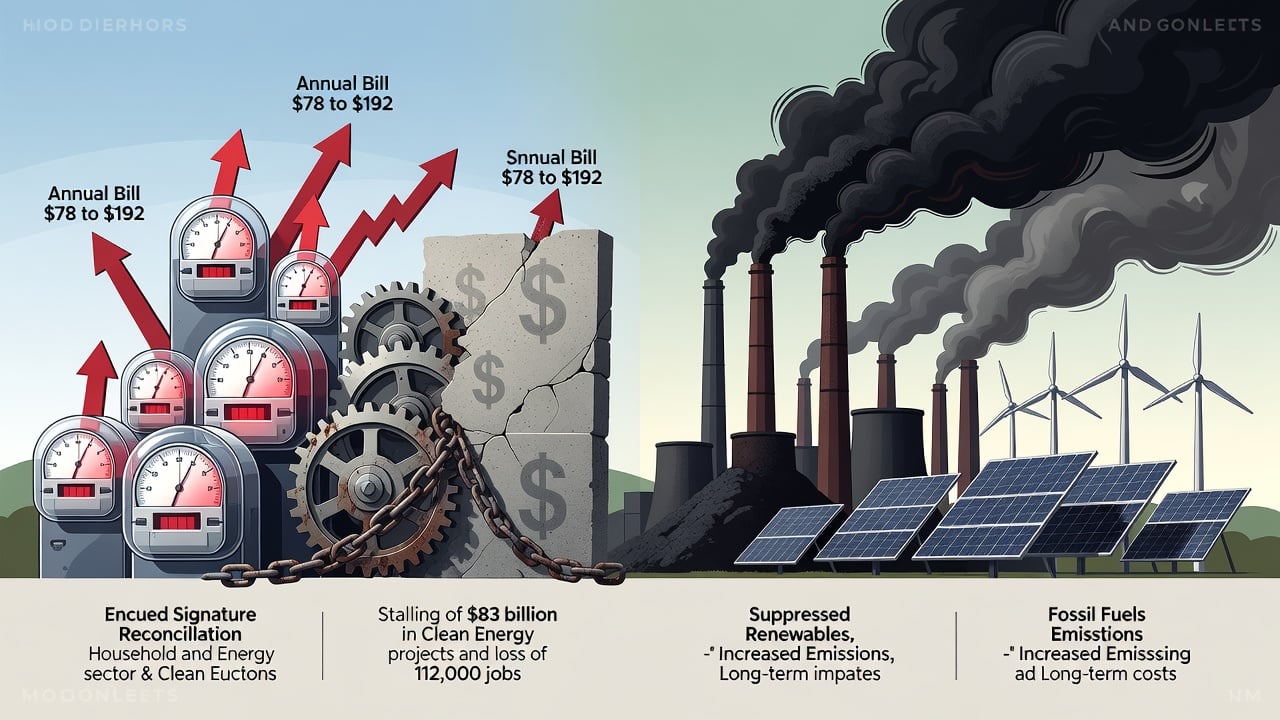
President Donald Trump called it his “one big beautiful bill.” Signed into law on July 4, 2025, the massive reconciliation package extended 2017 tax cuts, boosted border spending and delivered on promises to unleash American fossil fuels. But its energy provisions have triggered sharp cost increases for households and businesses alike. They have also halted billions in clean-energy investments.
Less than a year later, the effects show up in project cancellations, delayed factories and forecasts of pricier electricity. A fresh report released this week tallies the damage at nearly $83 billion so far. And analysts warn the long-term price tag will keep climbing.
The legislation, formally known as the One Big Beautiful Bill Act, scaled back or eliminated many Inflation Reduction Act tax credits that had fueled a boom in solar, wind, batteries and electric vehicles. It tightened eligibility rules. It added domestic-content requirements. It imposed new deadlines that many projects could not meet. The result? A rapid slowdown in renewable deployment and a shift back toward oil, gas and coal.
Energy Costs Rise as Renewables Stall
Independent modelers saw this coming. Rhodium Group projected that the law would raise national average household energy bills by $78 to $192 in 2035, a 2% to 4% increase over baseline forecasts. Industrial energy expenditures would climb by $7 billion to $11 billion in the same year. Those figures come from Rhodium Group research published July 11, 2025.
But some estimates land higher. The Center for American Progress cited analyses showing electricity costs for families could jump $110 next year in some states more than $200 annually. Businesses face nearly 10% higher energy expenses by 2026. Gasoline prices may rise 25 to 37 cents per gallon by 2035. American Progress laid out those numbers in its July 7, 2025 overview.
Why the increases? Clean power from wind and solar had become the cheapest new generation on most grids. Removing subsidies slows that build-out. Demand for electricity keeps rising from data centers, electrification and population growth. Supply tightens. Prices follow. But the bill also restores 100% immediate expensing for oil and natural gas equipment. That tilts investment back toward fossil fuels.
Columbia University’s Center on Global Energy Policy examined the tax-credit changes in detail. The law phases out credits for solar and wind over roughly two years. It preserves some support for nuclear and carbon capture but shortens timelines for hydrogen production credits. Trump followed up with an executive order directing agencies to end wind and solar subsidies even sooner. Columbia’s assessment appeared July 14, 2025.
The shift favors enhanced oil recovery. By equalizing tax credits for carbon capture used in oil production, the bill makes some projects viable at oil prices around $75 a barrel. The International Energy Agency expects enhanced oil recovery to grow through 2040. U.S. producers stand to gain market share. Yet that comes at the expense of cleaner alternatives that had been gaining ground.
Renewable deployment takes the biggest hit. Rhodium Group forecasts a 53% to 59% cut in new clean-power capacity additions from 2025 through 2035. Energy Innovation modeled even steeper declines: 57% to 62% less renewables over the next decade, with 340 gigawatts of generation capacity lost overall. Electricity rates could rise 10% to 18% by 2035 in their scenarios. Those projections appear in analyses referenced by the Union of Concerned Scientists in its October 2025 blog post.
Emissions rise too. Rhodium Group expects U.S. greenhouse gases to end up 315 million to 574 million metric tons higher in 2035 than without the bill. Power-sector emissions would jump 19% to 79%. The extra fossil-fuel burning would erase hundreds of millions of tons in anticipated reductions.
Project Cancellations Mount as Markets React
The human and financial toll has materialized faster than many expected. On July 14, 2026, the BlueGreen Alliance released its “Bait and Switch” report. It documented 223 manufacturing, clean-energy and industrial projects canceled or delayed, representing $82.9 billion in lost investment and 111,765 jobs. Another 3,034 projects now face stricter tax-credit rules under the bill, putting $695.2 billion in capital and nearly 1.2 million jobs at risk.
Reuters covered the findings the same day. Labor leaders met with Senate Democrats as the report dropped. Brent Booker, a union official, spoke of lost paychecks and pensions. Sen. Chris Van Hollen highlighted risks to electricity supply and prices. Reuters reported those details July 14, 2026.
The Yahoo Finance article that appeared one day later drew directly from the same BlueGreen Alliance data. It noted the rollback of the $7,500 electric-vehicle tax credit, solar and storage incentives, and support for offshore wind. One high-profile casualty involved a GM and LG Energy Solution battery plant. OSHA regulatory changes added further pressure. Author Badar Shaikh quoted the report: “At the heart of the GOP legislation is an aggressive rollback of clean energy tax credits and investments.” Yahoo Finance published the piece July 15, 2026.
Market reactions have been swift. Clean-energy company stocks dropped after passage. Project developers rushed some facilities to meet old deadlines but scrapped others. Solar and wind pipelines that looked robust in 2024 have thinned. The Solar Energy Industries Association outlined how the bill restricts credits under sections 48E and 45Y, slows residential and utility-scale solar, and hurts domestic manufacturing. SEIA detailed those changes in its July 21, 2025 factsheet.
Even supporters acknowledge trade-offs. The White House website for the bill touts lower energy costs, small-business relief and expanded domestic oil and gas. It highlights repeal of the methane fee and faster permitting on federal lands. Yet independent forecasts from the Wharton Budget Model show the entire package adds $3.2 trillion to deficits over 10 years on a conventional basis, rising to $3.6 trillion when economic effects are included. GDP falls 0.3% in a decade and 4.6% over 30 years. Wharton’s analysis came out July 8, 2025.
The Bipartisan Policy Center put the 10-year cost at $3.4 trillion, more than $4 trillion with interest. Its explainer appeared July 23, 2025. The Congressional Budget Office estimated related health provisions alone would cause 11.8 million people to lose coverage by 2034. Those cuts helped offset some tax reductions but squeezed other priorities.
Critics from the League of Conservation Voters called the measure the most anti-environment legislation ever passed. They pointed to job losses in clean sectors, higher pollution and increased reliance on expensive fossil fuels. LCV outlined its view July 10, 2025.
Wall Street Journal coverage captured the political drama. House passage came on narrow votes, with two Republicans joining Democrats in opposition. The Senate cleared it 51-50 after marathon negotiations. Trump kept GOP lawmakers in line. Yet the celebration masked emerging economic friction. The Journal reported on House passage July 3, 2025.
One year on, the bill’s legacy looks mixed at best. Oil and gas output has risen. Some manufacturing investment has shifted to traditional energy. But clean-tech hubs in the Midwest and South have gone quiet. Factories once slated to build batteries or solar components sit idle or have been repurposed. Supply chains that were localizing now face uncertainty. And American consumers see the difference when monthly utility bills arrive.
Princeton researchers, cited in The Conversation, project household energy costs could rise more than $280 per year by 2035. That figure accounts for less efficiency, fewer electric vehicles and reduced clean power on the grid. Emissions would climb by an extra 470 million tons in that year alone. The Conversation published its analysis July 9, 2025.
So the bill achieved its political goals. It delivered tax relief to high earners and corporations. It curtailed federal climate spending. It signaled a return to energy dominance through fossil fuels. Yet the data now rolling in shows real costs. Higher prices for families. Lost jobs in growing industries. Slower progress on emissions at a time when many trading partners accelerate theirs.
Industry insiders watch closely. Utility executives adjust procurement plans. Manufacturers recalibrate capital budgets. Investors shift allocations away from projects that no longer qualify for credits. The bill’s full effects will unfold over the next decade. Early signals suggest the beauty was in the eye of the beholder. For many in the energy sector, the bill has proven expensive indeed.


 WebProNews is an iEntry Publication