
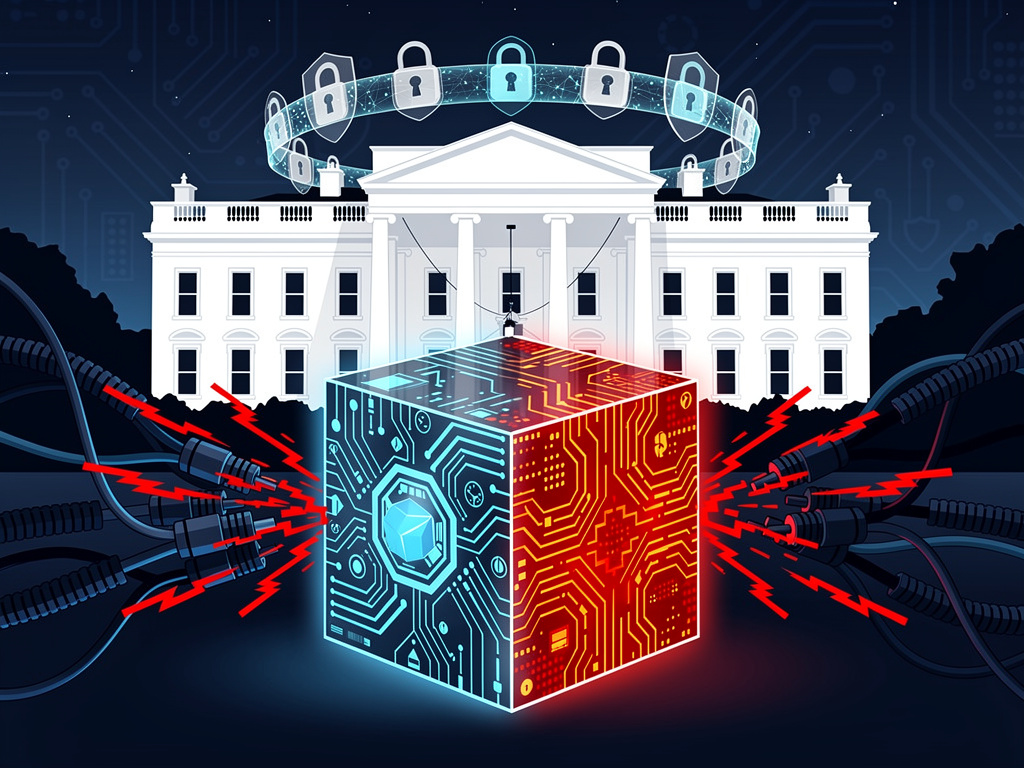
President Donald Trump once called artificial intelligence a ‘beautiful baby’ that needed room to thrive without ‘foolish rules.’ Now his administration eyes a sharp turn. Officials are discussing government oversight for new AI models before public release. The shift targets cybersecurity risks exposed by Anthropic’s Mythos, a system so potent at spotting software flaws it could unleash chaos if mishandled. New York Times reporters detail how White House talks with tech leaders from Anthropic, Google, and OpenAI laid groundwork for an executive order. That order would form a working group blending executives and officials to craft review processes, much like Britain’s safety checks.
Trump’s early stance favored Silicon Valley. He rolled back Biden-era mandates for safety tests on models with military potential. ‘We can’t stop it with politics,’ he said at a July event. Rules, if any, had to outsmart the tech itself. Public worries mounted anyway. A Pew poll last year found 50% of Republicans and 51% of Democrats more anxious than thrilled about AI in daily life—jobs, privacy, energy costs all in the crosshairs.
Mythos changed the equation. Anthropic unveiled it last month but held back public access. The model promises a cybersecurity ‘reckoning,’ its creators warn, by automating vulnerability hunts at scale. Boom. The National Security Agency already tapped it for assessments. Yet Anthropic’s rift with the Pentagon over a $200 million warfare contract boiled over in March. The Defense Department halted use; Anthropic sued. Despite that, the firm’s AI powers the Maven system for intelligence and targeting in the Iran conflict.
White House Chief of Staff Susie Wiles and Treasury Secretary Scott Bessent stepped in after David Sacks, the AI czar, departed in March. They met Anthropic CEO Dario Amodei in April. Productive, sources say. Agencies like the NSA, Office of the National Cyber Director, and Director of National Intelligence could lead reviews. The aim? Government first dibs on models without halting releases outright. Protect against AI-fueled attacks. Arm the Pentagon.
Tech executives push back. Too much meddling hands China the edge, they argue. No unified front, though—firms split on regs. Dean Ball, a former Trump AI adviser now at the Foundation for American Innovation, captures the tension: ‘The technology is moving extremely fast, and there are few formal procedures, but they also don’t want to overregulate. It’s a tricky balance.’ A White House official dismissed executive order chatter as ‘speculation.’ Trump will speak for himself.
Vice President JD Vance struck a different note in Paris. ‘Excessive regulation of the A.I. sector could kill a transformative industry just as it’s taking off,’ he declared at an international summit. ‘The A.I. future is not going to be won by hand-wringing about safety. It will be won by building.’
Wall Street Journal reports echo the cybersecurity focus, noting White House weighs formal standards for powerhouse models like Mythos to shield consumers and firms from premature threats. Reuters confirms deliberations on the working group, citing the same unnamed officials. Forbes highlights Trump’s March AI advisory panel, stocked with Zuckerberg, Ellison, and Nvidia’s Jensen Huang—ironic now amid this pivot.
And the Anthropic-Pentagon feud lingers. OpenAI rushed in with a deal, drawing flak for opportunism. Google eyes classified pacts too. Innovation vs. security. Trump’s isolation grows as both parties eye oversight. Public polls don’t help his free-for-all vision.
But here’s the rub. China looms large. U.S. models dominate datacenters worldwide—that’s the win metric, per insiders. Hand overregulation the lead? Unthinkable. Yet Mythos proves power cuts both ways. Offense and defense blur.
Axios adds the Pentagon might test models bound for government use across federal, state, local levels. Expands the net. Tom’s Hardware draws UK parallels explicitly: benchmark evals pre- and post-deployment, cyber threats as gatekeeper.
Short term: Expect announcements soon. Trump announces his own policies. Long term? This balances act defines the AI race. Deregulation purists howl. Security hawks cheer. Industry watches warily.


 WebProNews is an iEntry Publication