
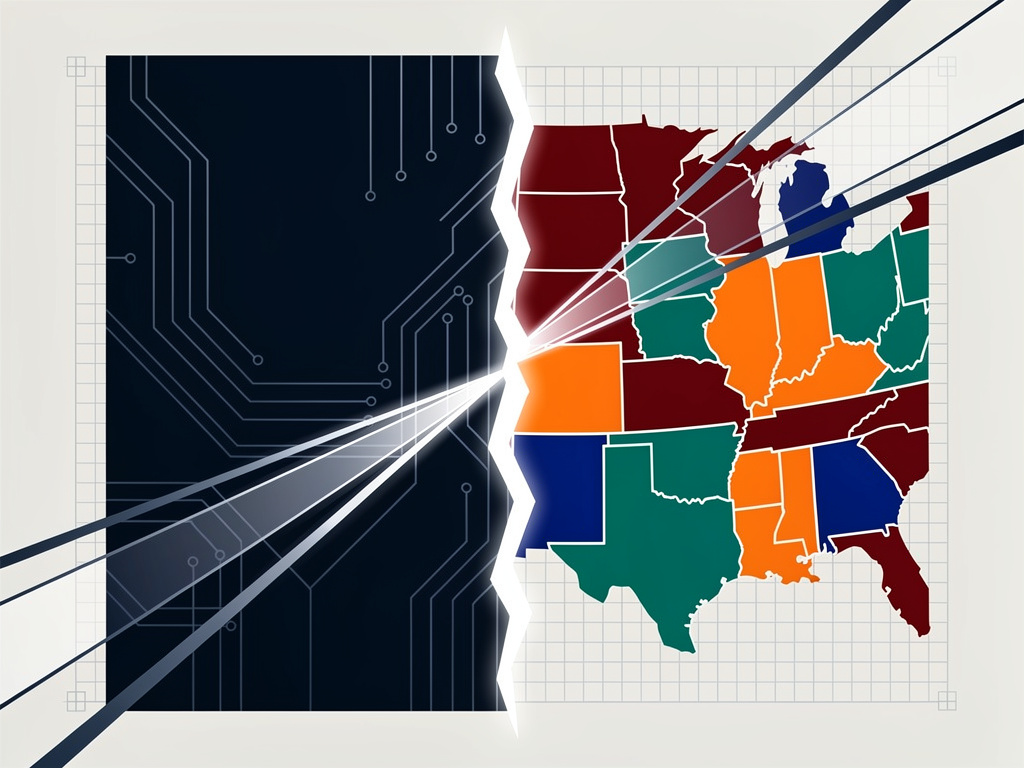
President Donald Trump signed Executive Order 14365 on December 11, 2025, launching a direct assault on state-level AI rules. The order, titled “Ensuring a National Policy Framework for Artificial Intelligence,” sets up a Department of Justice task force to sue states over laws deemed burdensome to innovation. Commerce Secretary Gina Raimondo—no, wait, under Trump it’s Howard Lutnick’s crew—evaluated measures in Colorado, California, and New York, flagging them for federal challenge. Boom. States fired back.
Fast-forward to today. The White House dropped its National Policy Framework for AI on March 20, 2026, urging Congress to wipe out state laws imposing ‘undue burdens’ in favor of one light-touch federal standard. Seven pillars guide it: child safety, infrastructure, IP rights, free speech, innovation, workforce training, preemption. No heavy mandates on bias or safety. Just freedom to build.
David Sacks, Trump’s AI and crypto czar, put it bluntly: “You’ve got 50 different states regulating this in 50 different ways, and it’s creating a patchwork of regulation that’s difficult for our innovators to comply with.” He slammed Colorado’s rules against algorithmic discrimination as raising “very serious First Amendment concerns.” Blue states? “We don’t like seeing blue states trying to insert their woke ideology in AI models.” Harsh words. But states aren’t backing down.
In 2025 alone, lawmakers introduced 1,208 AI bills across the U.S., passing 145. Early 2026 saw 78 chatbot safety measures in 27 states. Utah’s HB 286 targeted frontier AI developers with penalties; it passed a House committee unanimously but stalled in the Senate after White House flak. Rep. Doug Fiefia, a former Google salesman, called the opposition an attack on states’ rights—ironic, under a Republican president. His bill died anyway.
Utah Gov. Spencer Cox pushed back hard. “Let’s use this technology to benefit humankind, and let’s regulate it to make sure they don’t destroy humankind… I don’t think that’s a contradiction.” He announced a $10 million “pro-human” AI initiative for workforce prep. Texas rolled out its Responsible AI Governance Act on January 1, 2026. California mandated transparency for frontier models same day. Colorado delayed its AI Act to June 30 but vowed court fights.
Congress twice killed preemption bids. A 99-1 Senate vote stripped a five-year state moratorium from the One Big Beautiful Bill Act, signed July 4 without it. K Street lobbyists mostly back federal control—a Punchbowl News poll showed most leaders favoring Congress over states (Punchbowl News). Yet bipartisan resistance grows. Thirty-six state AGs warned of deepfake scams, child harms. Wisconsin Gov. Tony Evers urged his delegation April 15 to block federal overreach (Forth News).
California’s Gavin Newsom struck first with his own order March 30, tightening state procurement to bar risky AI vendors—direct shot at Trump’s hands-off stance (California Governor’s Office). “Unlike the Trump administration, California remains committed,” his team said. Newsom’s move followed Anthropic’s dust-up with the Defense Department over surveillance clauses.
Money talks. Leading the Future super PAC, backed by Andreessen Horowitz and OpenAI’s Greg Brockman, raised $125 million in 2025 for uniform federal rules (The Next Web). Anthropic countered with $20 million to pro-regulation candidates. Tech spent over $1 billion fighting state patchwork.
Sen. Marsha Blackburn’s TRUMP AMERICA AI Act draft, out March 18, adds duties for high-risk AI, repeals Section 230, creates liability—but preempts states on frontier risks and digital replicas. Congress slow. Executive limits bind Trump; real preemption needs lawmakers. Lawsuits? Two to three years minimum. Colorado’s AG promises battle.
Exceptions carve out child protections, data center zoning, state procurement. Training on copyrighted data? Legal, says the admin. Content moderation? No federal coercion on ideological grounds. Revoked Biden’s safety EO 14110 for one boosting “American leadership.” DOGE uses AI to slash regs, speed Medicare calls.
States accelerate. Fiefia notes 1,000+ bills prove they’re ahead of inert Congress (AP News). Utah Republican bucks the national tide. Innovation vs. safeguards. Federal uniformity or local experiments? Battles loom in courts, statehouses, Capitol Hill.
White House holds firm. Framework demands Congress act. States dig in. AI race heats up. Winners? Innovators or watchdogs. Time will tell.


 WebProNews is an iEntry Publication