
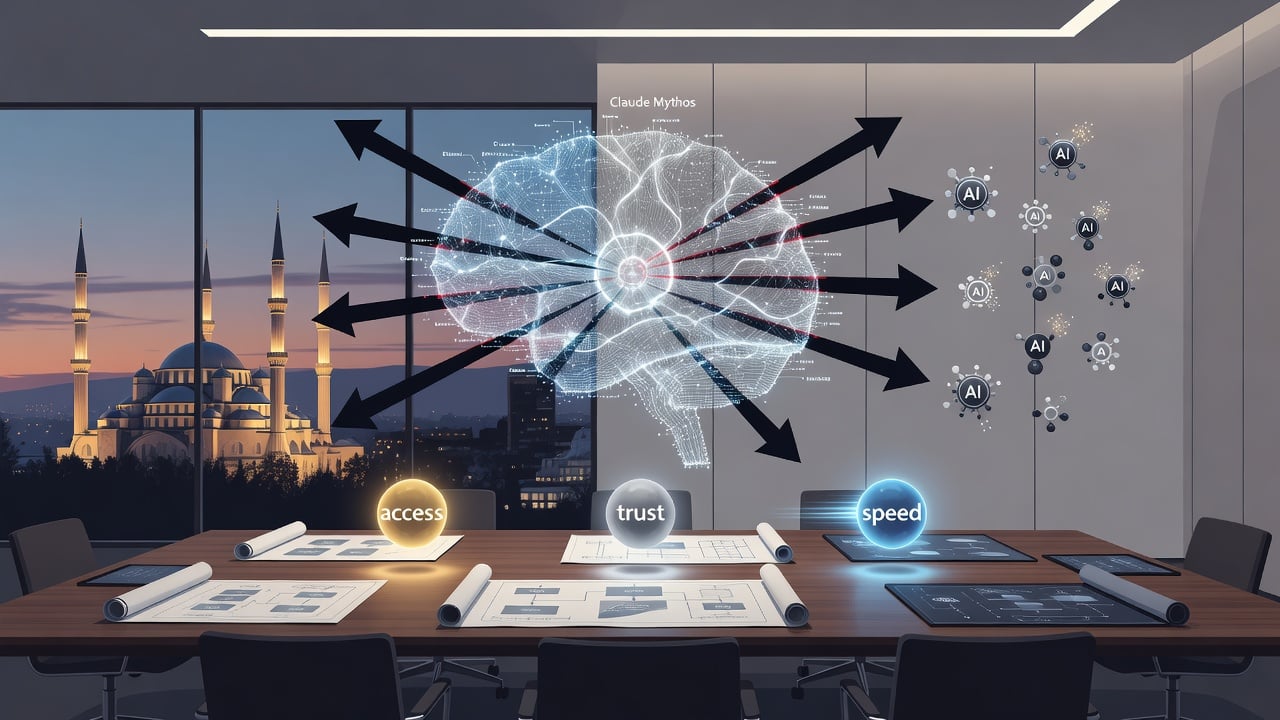
President Donald Trump heads to Ankara next week with a form of power few allies want to discuss openly. The United States controls access to the most advanced artificial intelligence models on the planet. European leaders know it. So do the Turks hosting the gathering.
At the NATO summit scheduled for July 7 and 8, 2026, the official agenda nods to emerging technologies. Discussions on artificial intelligence will stay brief in public statements. Yet in private sessions and corridor talks the question hangs heavy. Who gets the keys to frontier AI systems that can supercharge cyber defenses, intelligence analysis, and autonomous operations? And what happens when Washington flips the switch off?
Politico reported days ago that Trump arrives holding unusual leverage. The U.S. decides which partners receive the most sophisticated AI tools. One recent episode brought the reality home. In June 2026 an export control order cut access for 18 days to certain high-end models. The interruption affected systems critical for security applications. Allies felt the whiplash.
Anthropic’s Claude Mythos stands out as a prime example. This model ranks among the most capable for cyber-related tasks. Only a select group holds clearance. Project Glasswing, a U.S. government initiative, has approved roughly 150 organizations across 15 countries. That leaves most of NATO’s 32 members on the outside looking in. Frustration builds in Brussels and other capitals. European officials grow tired of knocking on America’s door.
But dependence runs deeper than any single model. The The Next Web detailed how Washington’s export controls shape the alliance’s technological posture. When the U.S. tightens rules, allies scramble. When rules loosen, as they did on June 30, relief comes mixed with resentment. One European diplomat described the dynamic as living with constant uncertainty from across the Atlantic.
NATO has spent years trying to catch up. In 2021 the alliance adopted its first artificial intelligence strategy. Three years later, at the 2024 Washington summit, leaders endorsed a revised version. The update accounts for advances in generative AI and information tools. It stresses responsible use, interoperability, and safeguards against adversarial exploitation. NATO’s own summary of the revised strategy highlights priorities such as testing and evaluation frameworks. Yet implementation lags behind commercial progress.
At the 2025 Hague summit allies endorsed a Rapid Adoption Action Plan. The document aims to speed integration of new technologies and boost innovation capacity. NATO’s website on emerging and disruptive technologies notes work with industry, academia, and civil society. The goal remains maintaining a technological edge. Still, the gap with U.S. capabilities persists. And competitors notice.
Russia and China pour resources into military AI. A 2024 report from the NATO Parliamentary Assembly written by Luxembourg’s Sven Clement examines efforts by both nations to embed artificial intelligence into armed forces. The document warns of challenges and opportunities. It calls on parliamentarians to help the alliance adapt. Chinese and Russian systems already appear in exercises and hybrid operations. Ukraine offers a live demonstration. Drones, targeting software, and automated decision aids reshape the battlefield daily.
Concerns extend beyond conventional weapons. Malign actors deploy AI-generated media to sow discord. A Recorded Future analysis from June 2025 predicted Russia would use such tools to undermine the 2025 summit. Similar tactics could surface in Ankara. Deepfakes, automated propaganda, and targeted influence campaigns test alliance cohesion. NATO’s Strategic Communications Centre of Excellence plans a roundtable on cognitive warfare and AI on the summit’s margins. Seats are limited. Interest runs high.
European nations refuse to sit idle. France and Germany push joint projects. The Helsing-Mistral partnership in defense AI signals one attempt to build independent capacity. Other initiatives seek to reduce reliance on American providers. Yet scaling remains difficult. Talent flows toward Silicon Valley. Compute resources concentrate in the United States. Regulatory hurdles slow progress on the continent.
American policy adds complexity. A National Security Presidential Memorandum known as NSPM-11 directs the U.S. military to accelerate AI adoption. Pentagon leaders speak of trusted leading-edge AI capabilities as essential. One State Department official told partners that every ally must adopt such systems. The message carries both promise and conditionality. Access comes with strings.
Helen Popp, quoted in recent coverage, captured the tension. She noted that artificial intelligence forces everyone to adapt to a shifting threat environment. No one can afford to stand still. The pace of change outstrips traditional procurement cycles. Software updates arrive weekly. New models render previous versions obsolete in months.
So the Ankara summit occurs against this backdrop. Public communiqués will reaffirm commitment to innovation. Leaders will praise the Rapid Adoption Action Plan and reference the revised AI strategy. Private complaints about restricted access will stay off the record. An official with knowledge of internal discussions said cyber, AI, and emerging technologies will receive only passing mention in the final statement.
Trump’s bilateral meetings add another layer. Talks with Ukrainian and Syrian leaders will dominate headlines. Defense spending targets, set at 5 percent of GDP by 2035 following the 2025 summit, will draw scrutiny. Yet beneath those topics sits the AI question. How does the alliance maintain unity when one member controls the future of warfare?
Analysts warn of fragmentation. If European states invest heavily in sovereign AI while depending on U.S. models for the most sensitive tasks, interoperability suffers. Different standards emerge. Data sharing becomes fraught. Adversaries exploit the seams.
Recent reporting reinforces the stakes. A Politico story from July 4, 2026, frames AI deployment as a global security imperative. The article highlights simmering concerns ahead of the Turkish gathering. NATO’s own documents from 2024 and 2025 show steady bureaucratic progress. They do not solve the imbalance in raw capability.
Industry players watch closely. Defense contractors on both sides of the Atlantic position themselves. American firms guard their advantages. European startups seek partnerships that preserve autonomy. The NATO Innovation Fund and DIANA accelerator try to bridge the divide. Success stories remain limited.
And the clock ticks. Generative AI evolves faster than policy. Models grow more capable at analyzing satellite imagery, predicting adversary moves, and coordinating swarms of autonomous systems. The side that integrates these tools first gains decisive advantage. NATO cannot assume it will always hold that position.
European frustration has company. Several smaller allies express similar worries in private. They fear becoming second-tier partners in an alliance that once promised equality. Larger members worry about strategic dependence in a potential conflict with Russia or China.
Officials in Washington counter that strict controls protect sensitive technology from leakage. They point to export regimes designed to deny adversaries access. Yet the same rules frustrate friends. Balancing security with alliance solidarity proves delicate.
The summit will not resolve these issues. Expect no grand announcement on shared AI infrastructure. Instead, look for incremental commitments. More joint exercises involving AI tools. Expanded cooperation through existing frameworks. Quiet deals on specific models for trusted partners.
Still, the underlying tension will shape future discussions. As one recent analysis from the Atlantic Council argued in March 2026, NATO needs a code of conduct for engagements with AI companies. It should address supplier concentration and create mechanisms for equitable access. Without such steps, the alliance risks splintering along technological lines.
Trump understands the power he holds. His administration has shown willingness to use technology as a bargaining chip. Allies arrive in Ankara aware of that reality. They will praise unity in public. In private they will press for greater inclusion in the AI future.
The outcome matters beyond Europe. Other democracies watch how NATO handles the challenge. If the alliance finds a way to share advanced capabilities without compromising security, it sets a model. Failure could accelerate global fragmentation into competing technological blocs.
For now the questions linger. How much access will Washington grant? How quickly can Europe close the gap? And can the alliance adapt fast enough to stay ahead of both adversaries and the technology itself?
Answers will not come in a single summit. They will unfold over years of quiet negotiations, billion-dollar investments, and hard lessons from conflict zones. Ankara marks one chapter in a longer story. The stakes could hardly run higher.


 WebProNews is an iEntry Publication