
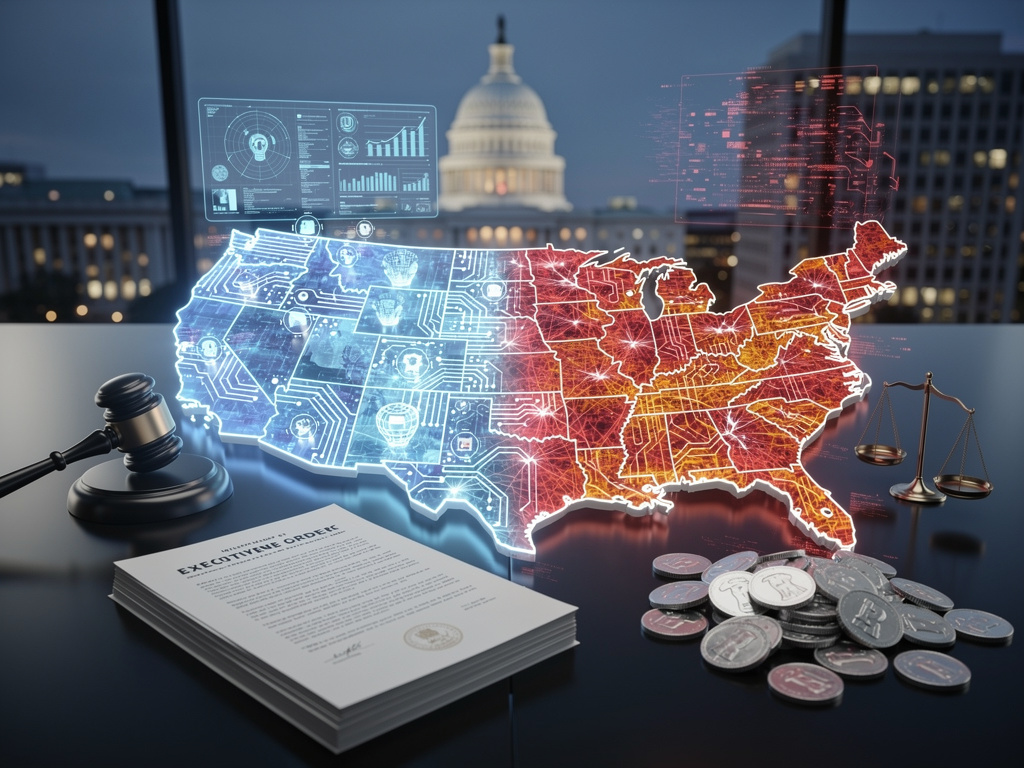
Fractures in the Fortress: Trump’s AI Gambit Splits Republican Ranks
In the corridors of power where technology meets governance, President Donald Trump’s recent executive order on artificial intelligence has ignited a firestorm within his own party. Signed on December 11, 2025, the directive aims to establish a unified federal framework for AI, effectively preempting state-level regulations that the administration deems obstructive to innovation and national dominance in the field. This move, championed by Trump’s newly appointed AI czar David Sacks, seeks to withhold federal funding from states imposing what the White House calls burdensome rules on AI development. But rather than unifying the Republican base, the policy has exposed deep fissures, with prominent GOP figures decrying it as an overreach that undermines states’ rights and local protections.
Critics within the party argue that the order represents a dangerous centralization of power, potentially leaving consumers and workers vulnerable to unchecked technological advances. Florida Governor Ron DeSantis, a longtime Trump ally turned occasional rival, has publicly lambasted the policy, warning that it could stifle state initiatives to safeguard against AI-driven job losses and privacy invasions. Similarly, Missouri Senator Josh Hawley, known for his populist stance against Big Tech, has voiced concerns that the preemption favors Silicon Valley elites at the expense of everyday Americans. These voices highlight a growing tension between the party’s traditional advocacy for limited government and its embrace of deregulatory zeal in emerging technologies.
The executive order’s roots trace back to intensifying debates over AI’s rapid evolution, where states like California and New York have begun enacting their own rules on data usage, algorithmic bias, and ethical deployment. Trump’s administration, influenced by tech moguls and venture capitalists, views this patchwork of regulations as a barrier to U.S. competitiveness against global rivals like China. By threatening to cut federal broadband funding—a critical lifeline for many states—the order attempts to force compliance, but legal experts question its constitutionality, suggesting it may overstep executive authority without congressional backing.
Voices of Dissent Amplify
Hawley’s critique, in particular, resonates with conservative principles of federalism. In a statement echoed across conservative media, he argued that allowing states to experiment with AI oversight aligns with the Founding Fathers’ vision of distributed power. This sentiment is shared by other Republicans, including some in Congress, who fear the policy could alienate voters already wary of Big Tech’s influence. Recent posts on X, formerly Twitter, reflect this unease, with users from various conservative circles expressing alarm over what they see as a federal power grab that prioritizes corporate interests over local accountability.
The appointment of David Sacks as AI czar has further fueled the controversy. Sacks, a PayPal co-founder and vocal Trump supporter, was tasked with advancing the tech industry’s agenda in Washington. However, as reported in a Politico article, industry lobbyists are increasingly anxious that his aggressive push for preemption might backfire, inviting more scrutiny rather than streamlining operations. Sacks has defended the order, emphasizing the need for a “national policy framework” to prevent regulatory fragmentation, but his Silicon Valley ties have made him a lightning rod for intraparty criticism.
Beyond the GOP’s internal strife, the policy intersects with broader national security concerns. The White House frames AI dominance as essential for economic and military superiority, citing the order’s purpose in an official release from The White House. Yet, detractors point out that preempting state laws could create a regulatory void, where issues like deepfakes, surveillance, and autonomous systems go unaddressed at the local level, potentially exacerbating societal harms.
Legal Hurdles and State Pushback
Legal challenges are already mounting. An analysis from NPR suggests the executive order may not hold up in court, as it relies on tenuous interpretations of federal authority over interstate commerce. States’ attorneys general, including those from Republican-led jurisdictions, are preparing lawsuits, arguing that the threat to withhold funding constitutes coercive federalism. This echoes past battles over issues like healthcare and environmental rules, where states successfully pushed back against Washington overreach.
Trump’s defiance of party critics was evident in the order’s signing ceremony, where he dismissed concerns as obstacles to American innovation. Coverage in The Washington Post details how the president pressed forward despite warnings from allies, including some MAGA stalwarts who view the policy as a betrayal of conservative values. One anonymous GOP strategist told reporters that the move risks fracturing the party’s coalition ahead of midterm elections, as voters in red states grapple with AI’s impact on jobs in sectors like manufacturing and agriculture.
The policy’s origins can be traced to lobbying efforts by tech giants, who have poured resources into influencing federal priorities. According to reports, figures like Elon Musk and Peter Thiel, both Trump confidants, have advocated for minimal regulation to accelerate AI deployment. This alignment has drawn ire from populist Republicans, who see it as cronyism. A post on X from a conservative commentator highlighted this divide, noting how the order “ties Republicans to an unpopular tech industry,” potentially alienating the party’s base.
Industry Reactions and Economic Stakes
The tech sector’s response has been mixed. While some executives applaud the uniformity, others worry about unintended consequences, such as heightened antitrust scrutiny. A Reuters piece quotes industry insiders expressing concern that the aggressive preemption could provoke a backlash, leading to stricter federal rules down the line. David Sacks, in his role, has been meeting with CEOs to assuage fears, but lobbyists remain skeptical, fearing the policy derails broader AI agendas.
Economically, the stakes are immense. AI is projected to contribute trillions to the global economy, and the U.S. aims to capture a lion’s share. Trump’s order, as described in The New York Times, creates a single regulatory structure to foster this growth, but critics like DeSantis argue it ignores localized economic disruptions. In Florida, for instance, state laws have focused on protecting tourism and real estate from AI-manipulated misinformation, areas now potentially overridden by federal decree.
GOP divisions extend to Congress, where some Republicans have blocked similar preemption language in budget bills. A The Hill report notes Trump’s frustration with these setbacks, leading to the executive action. This has sparked debates on Capitol Hill, with lawmakers like Hawley introducing bills to preserve state authority, underscoring the party’s ideological tug-of-war between free-market purists and those advocating for protective measures.
Broader Implications for Tech Governance
As the controversy unfolds, public sentiment on X reveals a polarized view. Supporters, including pro-Trump accounts, praise the order for preventing “left-wing states” from imposing “DEI filters” on AI, arguing it ensures national leadership. Critics, however, warn of a “vacuum of accountability,” with posts decrying the policy as a gift to oligarchs that bans local democracy.
The administration’s push aligns with Trump’s broader deregulatory agenda, but it clashes with growing bipartisan calls for AI safeguards. Democrats, such as Senator Adam Schiff, have seized on the issue, criticizing the order for replacing state protections with “nothing.” Even within the GOP, figures like Hawley emphasize the risks to children’s safety and economic security, as highlighted in a Time magazine analysis.
Looking ahead, the policy’s fate may hinge on judicial review and congressional action. States are vowing to fight, with governors forming coalitions to challenge the funding threats. This battle could redefine federal-state relations in the tech arena, influencing everything from data privacy to algorithmic fairness.
Shifting Alliances and Future Trajectories
Trump’s team remains steadfast, with Sacks actively engaging stakeholders to build support. Yet, the intraparty backlash, as detailed in the initial Business Insider report that spotlighted critics like DeSantis and Hawley, suggests a fracturing that could weaken Republican unity on tech issues.
The order also raises questions about international competitiveness. While the White House argues preemption is vital to outpace China, experts note that Europe’s stringent AI regulations haven’t hindered innovation there. This contrast fuels arguments from GOP skeptics that a balanced approach, incorporating state input, might better serve long-term interests.
Ultimately, the AI preemption saga encapsulates the Republican Party’s evolving identity in the digital age. As Trump navigates these waters, the divisions may force a reckoning, balancing innovation’s promise against the perils of unchecked power. With legal battles looming and public discourse intensifying on platforms like X, the outcome will shape not just AI policy, but the party’s cohesion in an era defined by technological upheaval.


 WebProNews is an iEntry Publication