
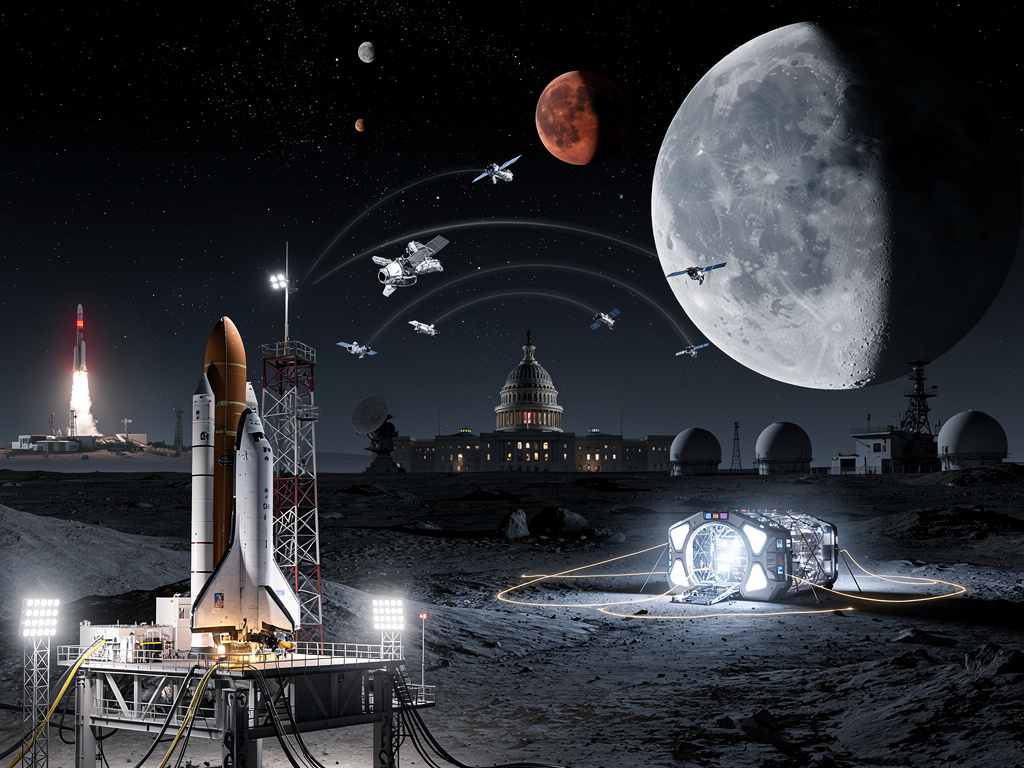
Trump’s Bold Lunar Leap: Charting a 2028 Moon Return and Beyond
President Donald Trump’s recent executive order on space policy has ignited fresh enthusiasm in the aerospace sector, signaling a renewed push for American dominance in space exploration. Issued on December 18, 2025, the directive commits the United States to landing astronauts on the moon by 2028, with plans for a lunar outpost to follow by 2030. This move comes as part of a broader strategy to counter emerging rivals, particularly China, which has set its sights on a crewed lunar mission around the same timeframe. Drawing from NASA’s ongoing Artemis program, the order emphasizes rapid advancement in human spaceflight, incorporating private sector innovations and novel technologies like nuclear power systems for sustained lunar presence.
The executive order, detailed in reports from various outlets, underscores a shift toward centralized oversight under the president’s office, dissolving the National Space Council in favor of more direct control. This policy not only reaffirms timelines but also calls for defending space assets against potential threats, reflecting geopolitical tensions. Industry experts view this as a catalyst for accelerating partnerships between government agencies and commercial entities, such as SpaceX and Blue Origin, which are pivotal in developing the necessary hardware for lunar missions.
Beyond the headline goals, the order highlights the integration of nuclear reactors on the lunar surface and in orbit, a step aimed at providing reliable energy for long-term habitation. This aspect has drawn attention for its potential to transform how humans operate in space, enabling extended stays and more complex operations far from Earth. As the U.S. races to establish a foothold on the moon, the policy also sets the stage for eventual Mars exploration, aligning with Trump’s vision of American leadership in the cosmos.
Accelerating the Artemis Timeline
The Artemis program, NASA’s flagship initiative for returning humans to the moon, receives a significant boost from Trump’s directive. Originally conceived during his first term, Artemis aims to land the first woman and the next man on the lunar south pole, rich in resources like water ice that could fuel future missions. The 2028 target for a crewed landing represents an ambitious acceleration, building on delays faced under previous administrations. According to Ars Technica, the plan includes deploying nuclear power reactors to support the outpost, addressing the energy challenges of lunar nights that last two weeks and plunge temperatures to extreme lows.
This nuclear emphasis is not merely supplementary; it’s foundational. Fission-based systems could provide kilowatts of power continuously, unlike solar arrays that falter in darkness. The order directs NASA and the Department of Energy to prioritize these technologies, potentially leveraging ongoing projects like the Kilopower reactor. Insiders note that such innovations could reduce reliance on Earth-supplied fuel, making a self-sustaining outpost feasible by 2030.
Competition with China adds urgency to these efforts. Beijing’s space agency has announced plans for a crewed moon landing by 2030, with robotic precursors already scouting sites. Trump’s policy explicitly positions the U.S. to outpace this rival, fostering a new space race reminiscent of the Apollo era. Reports from South China Morning Post highlight how this rivalry is driving investments in propulsion, habitats, and resource utilization, with American firms poised to benefit from increased funding.
Nuclear Power’s Role in Lunar Sustainability
Delving deeper into the nuclear component, the executive order mandates the development of reactors for both lunar surface and cislunar operations. This initiative builds on prior efforts, such as the Trump administration’s earlier push for space nuclear propulsion. By 2030, these systems could power habitats, scientific instruments, and even propellant production facilities using lunar regolith. The reliability of nuclear energy addresses a critical gap in current plans, where solar power’s intermittency limits mission scope.
Industry analysts point out that this focus could spur advancements in small modular reactors, adaptable for space environments. Partnerships with companies like BWX Technologies, already involved in NASA’s nuclear projects, are expected to intensify. The order’s emphasis on defending space from weapon threats also ties into this, as secure energy sources would be vital for resilient outposts amid potential conflicts.
Moreover, the policy cancels the National Space Council, streamlining decision-making but raising questions about interagency coordination. Critics argue this centralization might sideline expert input, yet proponents see it as a way to cut bureaucracy and speed progress. As per Reuters, this move is Trump’s first major space policy action in his second term, signaling a hands-on approach to achieving these milestones.
Geopolitical Implications and Private Sector Synergies
The lunar ambitions extend beyond technology, intertwining with global power dynamics. With China targeting the moon’s south pole for its resource potential, the U.S. aims to secure strategic locations first. This competition echoes Cold War rivalries but now involves economic stakes, such as mining helium-3 for fusion energy or establishing communication relays. Trump’s order calls for international partnerships under the Artemis Accords, which promote peaceful exploration norms, potentially isolating non-signatories like China.
Private sector involvement is another cornerstone. SpaceX’s Starship, selected for Artemis landings, could see expedited development under this policy. Elon Musk’s company, along with others, stands to gain from contracts for cargo deliveries and habitat modules. Posts on X reflect public excitement, with users speculating on Mars extensions, though these remain aspirational. For instance, discussions highlight how 2028 crewed missions align with Starship’s testing windows, amplifying optimism in the space community.
Funding remains a hurdle, however. NASA’s budget, currently around $25 billion annually, may need boosts to meet these timelines. The order directs the administration to prioritize resources, but congressional approval will be key. Historical precedents, like Apollo’s massive investments, suggest that national pride could drive allocations, especially amid bipartisan support for space leadership.
Technological Hurdles and Innovation Drivers
Achieving a 2028 landing demands overcoming significant challenges, including the Space Launch System (SLS) rocket’s reliability and the Orion capsule’s readiness. Delays in Artemis I and II have already pushed schedules, but Trump’s directive injects political will to resolve them. Innovations in in-situ resource utilization, like extracting oxygen from lunar soil, are prioritized to support the 2030 outpost.
Nuclear propulsion for faster transits to Mars is also mentioned, hinting at long-term visions. This could cut travel times from months to weeks, revolutionizing deep space exploration. The policy’s defense aspects include protecting assets from anti-satellite weapons, ensuring lunar infrastructure’s security.
Collaboration with allies, such as Europe and Japan contributing modules to the Gateway station, strengthens the program. These international ties, as noted in The Straits Times, contrast with China’s more independent approach, potentially giving the U.S. a diplomatic edge.
Economic Ripples and Workforce Impacts
The push for lunar goals is poised to create jobs and stimulate economies in states with aerospace hubs, like Florida, Texas, and California. Manufacturing for rockets, suits, and rovers will ramp up, benefiting suppliers across the supply chain. Estimates suggest thousands of high-tech positions, from engineers to technicians, mirroring the economic boom of the shuttle era.
Investors are eyeing opportunities in space-related stocks, with companies like Boeing and Lockheed Martin integral to Artemis. The order’s nuclear focus could revitalize the atomic energy sector, adapting terrestrial tech for extraterrestrial use. As reported by Washington Times, this commitment vows to return Americans to the moon, fostering innovation that spills over into civilian applications like advanced batteries and robotics.
Public sentiment, gauged from X posts, mixes enthusiasm with skepticism. Some users celebrate the ambition, envisioning Mars by 2036, while others question timelines amid budget constraints. Nonetheless, the policy galvanizes support, positioning space as a unifying national endeavor.
Strategic Defense in the Space Domain
A lesser-discussed but crucial element is the order’s emphasis on space defense. With directives to safeguard assets from threats, it acknowledges space as a contested domain. This includes countering hypersonic missiles or cyber intrusions that could disrupt missions. The lunar outpost, powered reliably, would serve as a strategic asset, perhaps hosting surveillance equipment.
Integration with the U.S. Space Force, established during Trump’s first term, is implicit. Policies for spectrum management and debris mitigation ensure sustainable operations. As U.S. News outlines, this sweeping order affirms the 2028 goal while restructuring governance.
Looking ahead, the 2030 outpost could evolve into a hub for science, mining, and tourism, laying groundwork for Mars. Challenges like radiation protection and life support must be addressed, but the directive’s momentum could accelerate solutions.
Pathways to Interplanetary Expansion
Trump’s policy doesn’t stop at the moon; it eyes Mars as the ultimate prize. By establishing lunar infrastructure, the U.S. gains a stepping stone for red planet missions, testing technologies in a proximate environment. Nuclear thermal rockets, mentioned in the order, promise efficient propulsion for such journeys.
International competition may spur collaborations or rivalries, but the U.S. lead in private innovation provides an advantage. Firms like SpaceX are already prototyping Mars architectures, aligning with the administration’s goals.
Ultimately, this executive action redefines American space priorities, blending ambition with pragmatism to secure a multi-planetary future. As timelines approach, the world watches whether these commitments translate into boots on lunar soil.


 WebProNews is an iEntry Publication