
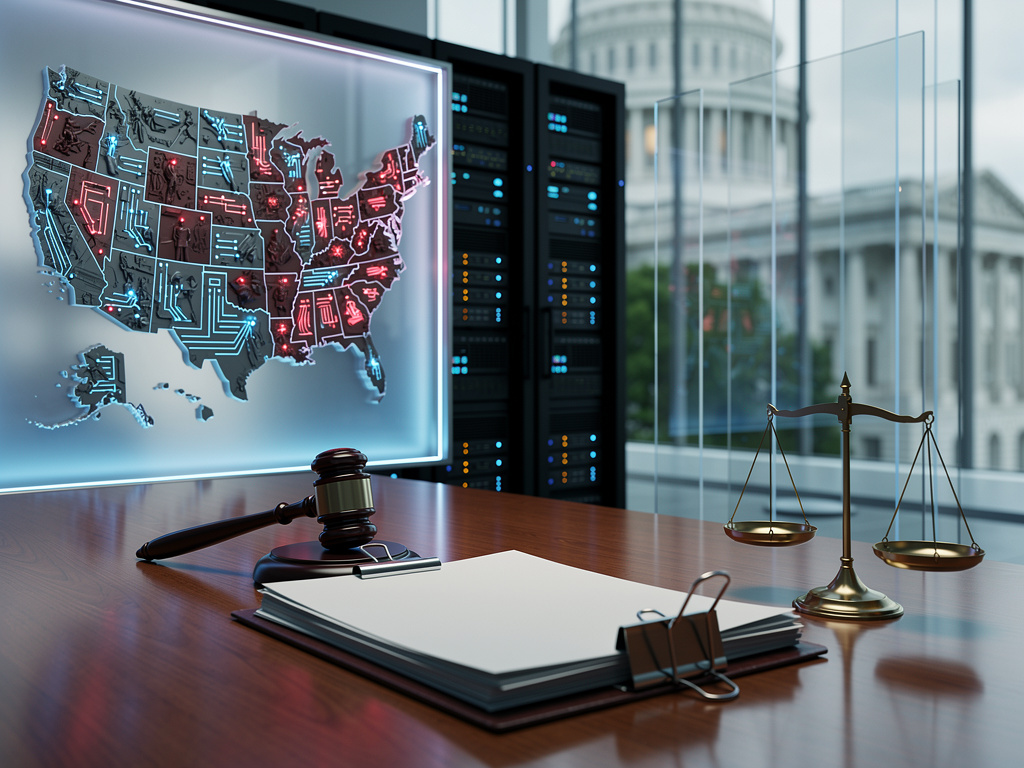
Trump’s AI Gambit: Forging a National Playbook Amid State Rebellion and Startup Turmoil
In a bold move that has sent ripples through the technology sector, President Donald Trump recently signed an executive order aimed at centralizing artificial intelligence regulation under a single federal framework. This directive, which seeks to override varying state-level rules, promises to streamline oversight and boost American innovation in AI. However, critics argue it could plunge startups into a prolonged period of uncertainty, as legal challenges mount and federal guidelines remain undefined. Drawing from recent reports, the order targets what the administration views as burdensome state laws that hinder technological progress.
The executive order, detailed in a TechCrunch analysis, establishes a Department of Justice task force dedicated to litigating against state AI regulations deemed obstructive. Within 30 days, this task force must be operational, while the Commerce Department has 90 days to identify “onerous” state laws. Trump’s administration frames this as a necessary step to prevent a patchwork of regulations that could stifle U.S. dominance in AI, echoing sentiments from industry leaders who have long called for uniformity.
Yet, the order stops short of nullifying existing state laws outright, leaving companies in a gray area. For instance, California’s robust AI protections, which emphasize public safety and ethical deployment, could face federal pushback. As The New York Times reported, Trump described the initiative as creating “one federal regulatory framework” during an Oval Office briefing, but legal experts question its enforceability without congressional backing.
Federal Overreach Sparks Interstate Tensions
The directive’s threat to withhold federal funding, such as broadband allocations, from non-compliant states adds another layer of coercion. According to Reuters, Trump explicitly stated that states impeding AI advancement would risk losing such support, a tactic that has drawn sharp rebukes from governors like California’s Gavin Newsom. Newsom’s office lambasted the order as promoting “corruption, not innovation,” highlighting California’s leading role in AI with over 15% of U.S. job postings and a lion’s share of venture capital funding, as per the 2025 Stanford AI Index cited in a statement from the Governor of California.
This funding leverage draws parallels to past federal-state clashes, such as those over environmental regulations. Industry insiders worry that startups, often operating on thin margins, will bear the brunt of any ensuing disputes. A small AI firm developing algorithmic hiring tools, for example, might comply with Colorado’s anti-discrimination law only to face federal scrutiny, creating compliance headaches and deterring investment.
Posts on X reflect a mix of optimism and skepticism among tech enthusiasts and entrepreneurs. Some users hail the order as a deregulation boon, potentially unleashing innovation by scrapping what they see as outdated state barriers. Others caution that the promised “one rulebook” might devolve into courtroom battles, leaving smaller players sidelined while Big Tech lobbies for favorable terms.
Legal Hurdles and the Path to the Supreme Court
Experts predict the executive order will face swift constitutional challenges, particularly on grounds of federal preemption and interstate commerce. NPR’s coverage notes that even some Republicans express discomfort with the approach, viewing it as an overreach that could undermine states’ rights. The order’s draft language, which surfaced earlier, proposed an AI Litigation Task Force to argue that state laws unconstitutionally regulate commerce across borders, a strategy that echoes historical precedents like the dormant Commerce Clause debates.
Colorado’s 2024 AI law, which mandates safeguards against bias in decision-making systems for hiring and banking, is explicitly cited in the order as a target. As detailed in Colorado Public Radio, this state measure aims to protect consumers from discriminatory AI, but the federal directive labels it “cumbersome.” Legal analysts from Law.com warn that without a clear federal standard in place, the order might foster more confusion than clarity, potentially leading to a Supreme Court showdown.
For startups, this limbo translates to real-world risks. Venture capitalists may hesitate to fund AI ventures amid regulatory flux, fearing that today’s compliant product could become tomorrow’s liability. One founder of a San Francisco-based AI analytics startup told reporters that the uncertainty has already delayed a funding round, as investors demand clarity on compliance costs.
Big Tech’s Influence and Collaborative Initiatives
The order isn’t solely about confrontation; it also promotes collaboration between government, academia, and industry. A separate but related White House initiative, as outlined in CNN Business, enables Department of Energy labs to partner with tech firms on AI-driven scientific research, potentially accelerating breakthroughs in fields like climate modeling and drug discovery. This aspect aligns with Trump’s broader agenda to prioritize “human flourishing” over what his administration calls engineered social agendas, a shift from Biden-era policies that emphasized ethical constraints.
Influential figures like David Sacks, a Trump ally and tech investor, have publicly supported the move, arguing it counters overregulation that hampers global competitiveness. However, critics point to potential corruption, with Newsom’s pushback in The Guardian accusing the order of favoring Big Tech donors over public interest. California’s dominance—home to giants like Google, Apple, and Nvidia—positions it as a key battleground, where state laws foster innovation while imposing guardrails.
On X, discussions often pivot to how this could benefit established players. Posts suggest that while startups grapple with legal ambiguities, companies with deep pockets might navigate the turmoil by influencing the emerging federal rules, potentially widening the gap between industry titans and emerging innovators.
Startup Survival Strategies in Uncertain Times
Amid the regulatory tug-of-war, startups are adapting by diversifying operations across states or even internationally to mitigate risks. Some are lobbying for federal legislation that would provide the uniformity Trump promises, rather than relying on executive fiat. Industry groups like the Chamber of Commerce have echoed calls for Congress to step in, warning that prolonged litigation could chill investment in AI, a sector projected to contribute trillions to the global economy by 2030.
The order’s emphasis on scrapping Biden’s restrictions, as noted in various X posts, aims to unleash innovation by reviewing all prior AI policies. This includes eliminating barriers to open-source AI development, which could empower smaller firms to compete. Yet, without concrete federal guidelines, experts fear a vacuum where unethical practices flourish, from biased algorithms to data privacy breaches.
For instance, a New York-based AI startup specializing in financial tech reported in industry forums that it’s now consulting lawyers to assess dual compliance paths, inflating operational costs by 20%. This scenario underscores a broader concern: while the order targets “American dominance,” it might inadvertently advantage foreign competitors in more stable regulatory environments like the European Union.
Broader Implications for Innovation and Policy
Looking ahead, the executive order could reshape how AI is governed, setting precedents for emerging technologies like quantum computing. If successful, it might inspire similar federal interventions in areas such as data privacy or autonomous vehicles. However, failure in the courts could embolden states to double down on their regulations, fragmenting the market further.
Tech leaders are divided. Some, inspired by Trump’s vision, see it as a catalyst for rapid advancement, potentially positioning the U.S. as the undisputed AI leader. Others, drawing from historical regulatory battles, predict a drawn-out process that drains resources from actual innovation.
Recent X sentiment leans toward cautious optimism among entrepreneurs, with many posting about the need for balanced federal rules that protect without paralyzing progress. As one user framed it, the order could either unify the field or strand innovators in a maze of lawsuits.
Navigating the Road Ahead for Tech Entrepreneurs
As the dust settles, startups must prioritize agility. Building flexible AI systems that can adapt to evolving rules will be key, alongside engaging in policy advocacy. Collaborations with academic institutions, bolstered by the order’s research initiatives, offer a pathway to legitimacy and funding.
Ultimately, the order’s legacy hinges on whether it delivers the promised “one rulebook” or merely prolongs discord. With court cases looming and states like California vowing resistance, the coming months will test the resilience of America’s AI ecosystem.
Industry observers suggest monitoring congressional responses, as bipartisan discomfort could lead to legislative overrides. For now, the directive stands as a high-stakes bet on federal supremacy, with startups caught in the crossfire, striving to innovate amid the uncertainty.


 WebProNews is an iEntry Publication