
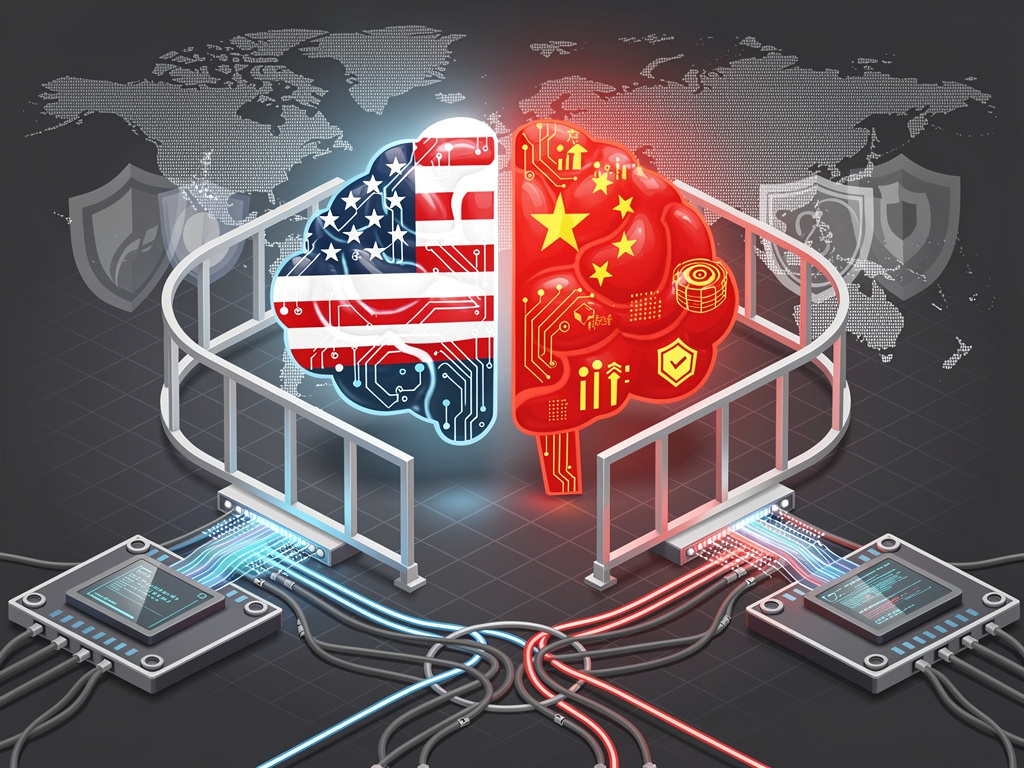
President Donald Trump stepped off Air Force One and declared progress. He and Chinese President Xi Jinping had spoken about artificial intelligence during their two-day summit in Beijing. They discussed “possibly working together for guardrails,” Trump told reporters. Pressed for details, he offered a simple phrase. “Standard guardrails that we talk about all the time.”
Except those standards don’t exist. Not in the United States. Not in China. And not between them. The claim landed amid a frenzied race where both nations pour resources into ever-more-powerful models. Washington leads for now. Beijing narrows the gap fast. Safety conversations remain vague, aspirational, and largely detached from enforceable rules.
Trump’s remarks, first reported by Bloomberg, came after the May summit. They echoed comments from Treasury Secretary Scott Bessent. In a pre-recorded interview from Beijing, Bessent said the two AI superpowers would begin formal talks. The focus included “a protocol” to stop nonstate actors from obtaining the most powerful models. “We’re going to set up a protocol in terms of, how do we go forward with best practices for AI to make sure nonstate actors don’t get ahold of these models,” Bessent told CNBC, as reported by The New York Times.
Bessent added that the U.S. would push its own values and practices. “I do not think we would be having the same discussions if they were this far ahead of us. So we’re going to put in U.S. best practices, U.S. values, on this, and then roll those out to the world.” The statements project confidence. Reality shows fragmentation.
Reality Check on Guardrails
In the U.S., federal oversight stays light. Trump’s AI Action Plan from last year offered dozens of recommendations. Most boiled down to accelerating development while demanding models remain “unbiased.” Administration officials interpret that term as avoiding outputs the president dislikes. Pre-release government reviews of frontier models have been floated. Yet broad regulation faces resistance. The National Institute of Standards and Technology produced a voluntary risk framework. States fill gaps with their own laws. California passed significant AI safety legislation. Enforcement questions linger. patchwork rules create confusion for developers who operate globally.
China has issued multiple AI governance documents. Recent ones address risks to labor markets, potential weaponization, and sector-specific guidelines. Officials describe risk mitigation steps. None bind companies with the force of law. Implementation remains optional. Both governments talk safety. Neither wants to slow the sprint for superiority.
Gizmodo captured the disconnect bluntly. “Great! Except… there are no standard guardrails,” the outlet wrote in its May 15 analysis. It described the U.S. scene as “a mess.” Trump’s plan amounted to “we should do AI,” the article argued. Bessent’s comments drew particular skepticism. “We want unlimited growth that is also safe,” he said, per the piece. “Yeah, great idea. Our best minds are on it, clearly.” The Gizmodo article noted that pre-summit talks involving Bessent stayed broad. Specific commitments stayed absent.
And the risks feel immediate. Advanced models could help design biological weapons. They could automate cyberattacks on critical infrastructure. They could generate disinformation at scale or slip from human oversight in unpredictable ways. U.S. experts fixate on existential threats from artificial general intelligence. Chinese counterparts worry more about social stability and information control. Chatbots that challenge official narratives pose domestic headaches for Beijing. Shared worries exist. Mutual trust does not.
Pre-summit reporting hinted at the tension. The Wall Street Journal reported in early May that Washington and Beijing weighed official AI discussions. The goal was preventing rivalry from spiraling into crisis. People familiar with the matter described AI as the digital-era arms race. Neither side appeared ready to manage the accidents or escalations powerful models might trigger. The summit put those deliberations to the test.
Trump also raised Nvidia’s H200 chips with Xi, according to Bloomberg. China passed on purchasing them. The detail underscored how commercial interests tangle with security talks. Export controls on advanced chips remain a flashpoint. U.S. policy seeks to preserve technological lead. Chinese firms race to close it through domestic innovation and circumvention. Safety dialogues happen against this backdrop of strategic competition. Cooperation feels conditional.
Carnegie Endowment analysts noted days before the meeting that Trump and Xi should tackle a conversation long considered impossible. Recent pieces from think tanks and outlets such as Carnegie highlight skepticism. Past U.S.-China AI talks under the prior administration produced little durable progress. Beijing has sought dialogue to narrow capability gaps. Washington worries such exchanges transfer sensitive knowledge without reciprocal restraint.
So what might concrete guardrails look like? Experts point to incident-reporting requirements for serious AI failures. Joint standards on testing for dangerous capabilities. A hotline for rapid de-escalation when one side detects anomalous model behavior. Protocols to restrict access to training compute or datasets that enable bioweapon design. Measures to prevent open-sourcing of models that exceed certain risk thresholds. These ideas circulate in policy papers. Few have translated into binding agreements.
But the summit did produce movement. Bessent’s announcement signals the start of structured talks. A protocol aimed at nonstate actors could limit proliferation risks. Terror groups or rogue labs acquiring frontier capabilities worries both capitals. Agreement there might prove easier than broader alignment on values or military applications.
Still, history cautions against optimism. Arms control treaties between nuclear powers took years of negotiation and verification mechanisms. AI evolves far faster. Models double in capability every few months. By the time rules are drafted, the technology may have shifted. Verification poses another nightmare. Unlike nuclear facilities, AI labs can hide progress behind code and data centers. Trust deficits make inspection proposals dead on arrival.
Industry players watch closely. Executives from Apple, Tesla and other firms accompanied Trump. Nvidia’s absence from the entourage fueled speculation about chip sales. The president’s team blends business promotion with national security posturing. That mix complicates pure safety discussions. Companies want clarity. Regulators want control. Governments want advantage.
Trump’s phrasing suggested familiarity. “Standard guardrails that we talk about all the time.” The repetition implied consensus. Observers saw something else. A leader projecting strength where foundations remain unbuilt. The U.S. pushes voluntary frameworks and light-touch rules. China issues guidance without teeth. International coordination stays aspirational. The gap between rhetoric and reality yawns wide.
Recent coverage reinforces the point. Axios reported Trump’s trip revived debate on global AI guardrails. Concerns about cybersecurity and arms-race dynamics surfaced repeatedly. No single breakthrough emerged from the Beijing meetings. Yet the door cracked open. Future working groups may define what “guardrails” actually mean. They may set red lines on certain capabilities. They may establish communication channels that prevent miscalculation.
Whether those efforts produce substance remains uncertain. Powerful incentives pull both sides toward dominance rather than restraint. National security hawks in Washington view AI as decisive for future conflict. Beijing sees technological self-reliance as core to sovereignty. Safety sits lower on the priority list for both. Innovation and values come first. The talk of standards feels preliminary. The hard bargaining lies ahead.
One thing is clear. Trump’s claim highlighted a vacuum. There are no standard AI safety guardrails. Creating them will test diplomacy, technical expertise, and political will. The alternative is two superpowers hurtling forward with ever-greater capabilities and no agreed rules of the road. That path carries dangers neither can fully predict. The summit may mark a first step. Or it may prove another round of performative dialogue. Industry insiders will parse every follow-up statement for clues.


 WebProNews is an iEntry Publication