
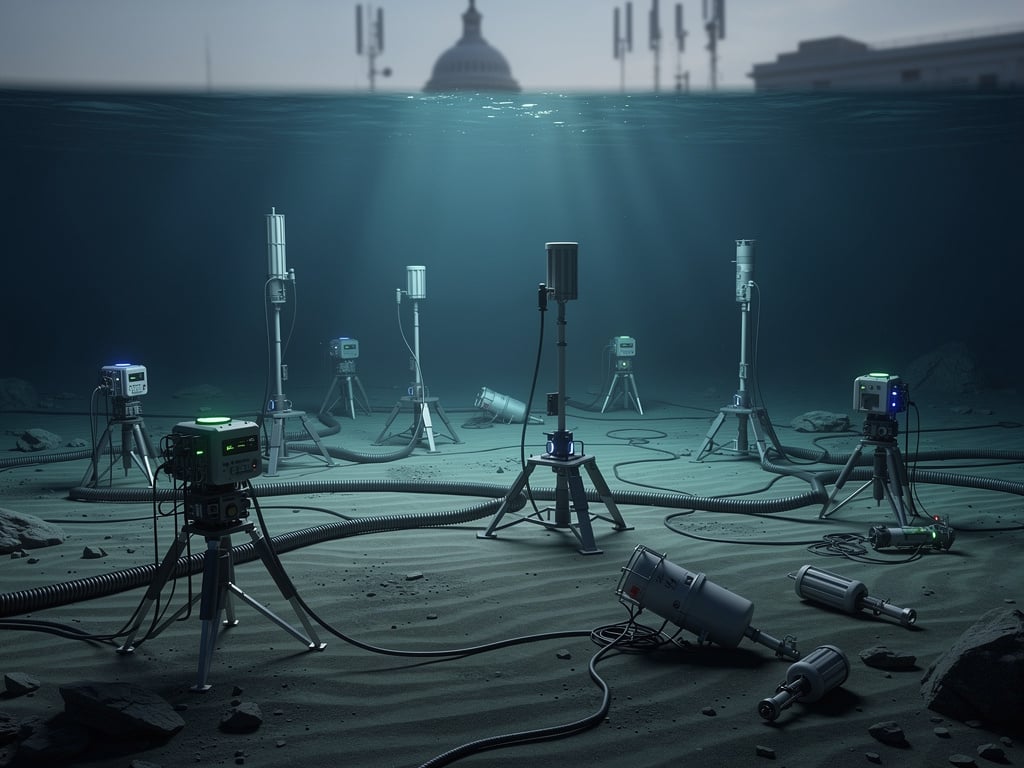
The Trump administration moved quietly in May to begin tearing apart a $368 million network of deep-sea instruments that had operated for more than a decade across the Atlantic and Pacific. No detailed justification accompanied the order. Scientists and coastal communities immediately suspected the decision targeted data that documented warming oceans, shifting currents and changing marine ecosystems.
But the system delivered far more. It fed real-time information into weather models, guided fishing fleets, tracked earthquake risks and supported offshore energy planning. That broader utility triggered swift and unusually broad opposition. On Wednesday the Senate voted unanimously to block any federal spending on the disassembly. Hours later the administration signaled it would stand down.
The reversal, expected to be formalized later on Thursday according to The New York Times, leaves open questions about equipment already pulled from the water and data streams interrupted for a month. Representative Zoe Lofgren, the top Democrat on the House Science Committee, issued a blunt assessment. “This should have never happened. This pathetic scheme was illegal,” she said in a statement relayed by Ars Technica.
The program in question is the Ocean Observatories Initiative, or OOI. It consists of more than 900 sensors anchored at multiple arrays off Oregon, Washington, Alaska, North Carolina and in the Irminger Sea between Greenland and Iceland. Some instruments sit on the seafloor. Others drift at various depths or float at the surface. They measure temperature, salinity, acidity, oxygen levels, currents, seismic activity and biological signals.
Over ten years the network produced information cited in more than 500 scientific papers. Its continuous record proved especially valuable for tracking how oceans absorb heat and carbon dioxide. That climate connection apparently drew the attention of officials aligned with efforts to downplay such evidence. Yet the same data also informed forecasts that protect lives and livelihoods on shore.
Senator Jeff Merkley, a Democrat from Oregon, called the original plan “supreme stupidity.” He co-led the Senate measure with Republican Senator Lisa Murkowski of Alaska. Their legislation barred the National Science Foundation from using funds to decommission the arrays until it completed a thorough review with scientists and coastal stakeholders. The vote passed by unanimous consent, a rarity in today’s divided Congress.
Similar concerns surfaced in the House. Lawmakers from both parties sent letters urging the foundation to reverse course. Some accused the agency of acting without legal authority. The foundation had framed the move as “descoping” to match “evolving scientific priorities.” Its proposed budget for fiscal 2026 had already called for a 55 percent cut to the agency overall.
News of the initial decision broke in early June. The Guardian reported widespread dismay among researchers who received no advance warning or scientific assessment. PBS NewsHour highlighted the sudden removal of instruments that had monitored marine heat waves and coastal flooding risks. CNN noted the furious bipartisan backlash that followed.
Industry voices joined the chorus. Fisheries managers rely on OOI data to set sustainable catch limits. Weather services incorporate ocean readings to sharpen storm predictions. National security agencies use seismic and current information for submarine operations and tsunami alerts. Even private firms developing offshore wind farms consult the records.
The administration’s reversal arrives with practical complications. Ships had already begun recovering some instruments. Whether those can be redeployed without significant cost or loss of calibration remains unclear. Lofgren’s office emphasized the uncertainty. “We also don’t yet know how much damage they have already done,” her statement read.
Supporters of the program point to its design for 25 years of service. The abrupt attempt to end it after roughly 15 months of operation erased irreplaceable baseline measurements. Once sensors leave the water, the continuous time series breaks. Rebuilding that record would take years and millions more dollars.
But the fight also exposed deeper tensions over federal science spending. The National Science Foundation operates as an independent agency created by Congress. Critics argued that political appointees had overstepped by directing such a drastic change without public input or peer review. The Senate’s action reinforced congressional oversight.
Recent coverage underscores the speed of events. An CNN article published Thursday morning detailed how Republican and Democratic lawmakers passed legislation to protect funding. OregonLive reported state lawmakers along the coast voicing “strong opposition” on the same day as the Senate vote. The reversal appears driven by that combined pressure.
Scientists who operate the arrays expressed relief mixed with caution. The Regional Cabled Array off Oregon, which uses fiber-optic lines for continuous power and data, will apparently continue. Other arrays that depend on battery-powered moorings and gliders face renewed uncertainty about long-term support.
The episode fits a pattern. Earlier Trump budgets targeted climate-related research. This time the administration encountered resistance from users who don’t focus on atmospheric trends but still need accurate ocean readings. Fisheries groups, shipping interests, coastal cities and emergency managers all weighed in.
Senator Murkowski, whose state depends heavily on ocean data for fisheries and storm preparedness, provided crucial Republican backing. Her involvement made the Senate measure truly bipartisan and harder to dismiss. Merkley later posted on social media that the partnership had protected sensors “essential for managing our fisheries, forecasting weather, and understanding climate change.”
OOI data flows freely to the public through an online portal. Researchers worldwide access it. The loss of even a month of readings creates gaps in models that project sea-level rise, hurricane intensity and ecosystem shifts. Those gaps matter for planning everything from coastal defenses to insurance rates.
Administration officials have not yet released a formal statement explaining the original decision or the reversal. The National Science Foundation described the initial move as aligned with budget constraints and shifting priorities. Yet the $350 million-plus already invested suggested sunk costs that dismantling would only increase.
Legal questions linger. House Democrats labeled the plan illegal. Whether courts would have agreed may never be tested. The swift Senate action and subsequent retreat avoided that confrontation. Still, the episode signals that broad coalitions can check executive moves on science infrastructure.
For oceanographers the outcome buys time. They now expect a review process that includes expert input. The hope is that the arrays will resume full operation and receive stable funding. Yet the experience leaves scars. Instruments recovered early may require expensive refurbishment. Calibration records could prove incomplete.
Coastal communities watch closely. Alaska fishermen, Pacific Northwest crabbers, Atlantic scallop harvesters and North Carolina tourism operators all draw indirect benefits from the sensors. Better forecasts reduce fuel costs, prevent overfishing and improve safety at sea. Those practical gains proved more persuasive in Congress than abstract climate arguments alone.
The reversal also highlights the value of long-term monitoring. Short political cycles clash with the decades required to detect slow ocean trends. A network built to last 25 years suddenly faced termination after ten. The bipartisan defense suggests some recognition that consistent data collection serves national interests beyond any single administration.
Questions remain about future budgets. The foundation’s proposed cuts for 2026 remain on the table. Lawmakers who saved the OOI this week may need to defend it again during appropriations fights. Sustained funding will determine whether the sensors return to full strength or limp along in reduced form.
For now the arrays stay in place. Data streams that paused may restart. And a month of political drama ends with the ocean sensors still listening to the water above them. The episode offers a reminder that even in polarized times, shared reliance on reliable science can produce unexpected alliances.


 WebProNews is an iEntry Publication