
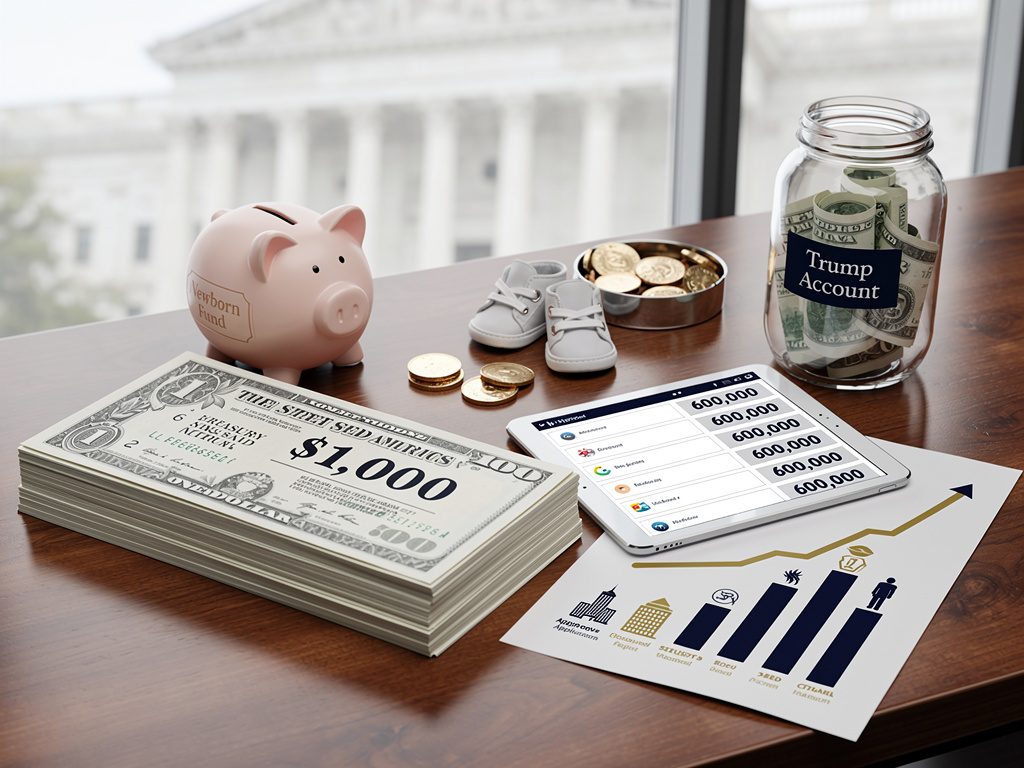
Trump Accounts Surge: 600,000 Families Rush to Claim $1,000 Baby Bonuses
Treasury Secretary Scott Bessent revealed that 600,000 families have signed up for Trump accounts since tax season began on January 26, 2026, signaling robust early interest in the program’s promise of government-seeded investment vehicles for children. “600,000 families out of an estimated 25 million” have filled out IRS Form 4547, Bessent told CNBC. The accounts, formally Section 530A under the One Big Beautiful Bill Act, offer tax-deferred growth on funds invested in broad market index funds, with withdrawals permitted penalty-free at age 18 for education, home purchases or business startups.
Eligibility centers on children born between January 1, 2025, and December 31, 2028, who receive a one-time $1,000 deposit from the Treasury Department, no income limits attached. Parents and guardians initiate enrollment via two checkboxes on Form 4547 during 2025 tax return filings, the IRS’s “fastest, safest, and easiest way,” with an online portal at Trumpaccounts.gov slated for mid-2026 and actual contributions starting July 2026. Annual private contributions cap at $5,000 per child until age 18, including up to $2,500 from employers.
Explosive Early Adoption Amid Tax Filings
Jason Ewas, associate director at the Aspen Institute Financial Security Program, attributes the swift uptake to low-income households filing early for anticipated larger refunds under Trump’s tax policies. “Low-income families, in particular, tend to file early in the tax season because they rely on tax refunds,” Ewas said, per CNBC. Bessent echoed the call to action during a CNBC interview: “We want all Americans to start signing up.”
The Treasury hosted a high-profile summit on January 28, 2026, at the Andrew W. Mellon Auditorium, featuring President Donald Trump, Bessent, White House Press Secretary Karoline Leavitt and unexpected guests like rapper Nicki Minaj. Minaj pledged $150,000 to $300,000 for fans’ ineligible children’s accounts, attending to amplify promotion, as reported by CNBC.
Bessent highlighted the program’s transformative potential, projecting the $1,000 seed at a 10.5% historical S&P growth rate could reach over $600,000 by retirement, or nearly $1.1 million with maxed $5,000 yearly inputs by age 28, according to Reuters and U.S. Department of the Treasury.
Corporate and Philanthropic Pledges Pile On
Employer matches supercharge the initiative, with JPMorgan Chase and Bank of America committing up to $1,000 per employee child, alongside Charles Schwab, Robinhood, SoFi, Uber, Charter Communications and BNY, per ABC News and CNBC. Altimeter Capital’s Brad Gerstner backed accounts for Indiana kids under age 5, about 406,000 eligible, targeting ZIP codes below $150,000 median income.
Billionaires are driving a “50-state challenge”: Michael and Susan Dell donated $6.25 billion for $250 seeds to 25 million children ages 10 and under in qualifying low-income ZIPs, while Ray Dalio and wife Barbara committed $75 million—$250 each—for 300,000 Connecticut kids, as detailed by CNBC and CBS News. “We’re going to have some big announcements today on some very important states from some great philanthropists who have adopted their states,” Bessent said to Yahoo Finance.
Additional firms like Uber, MasterCard, BlackRock, Visa and Charles Schwab participate, per the Trump Accounts website and PBS News. Funds grow tax-deferred in S&P-tracking index funds, with Ivory Johnson of Delancey Wealth Management calculating a $2,000 start (Treasury plus employer match) at 7% annual returns hitting $6,800 after 18 years.
Mechanics and Projections Fuel Optimism
Post-enrollment, Treasury authenticates via contact starting May 2026, investing in broad U.S. equity indexes. Families add pretax dollars up to $2,500 personally, with governments and charities exempt from caps. The Council of Economic Advisers estimates max contributions could yield over $300,000 by age 18 for a 2026-born child, per The Hill.
Bessent framed it as an ownership revolution: “Trump Accounts are not a government program. They are a radically new platform that returns us to a social contract anchored in individual ownership where everyone starts life on an investing journey,” from his Treasury remarks. With 38% of households lacking equity exposure, the initiative aims to democratize markets, he told CNBC.
Signups via Form 4547 accommodate up to two children per form, multiples allowed, with e-filing urged. While Treasury seeds launch July 4, 2026—America’s 250th anniversary—parents of older kids under 18 can open accounts sans $1,000 bonus, broadening reach to all with Social Security numbers.
Critics Highlight Equity Gaps
Detractors argue the structure favors wealthier families able to max contributions, potentially exacerbating divides. “Affluent families that can afford to make the maximum pretax contribution to the accounts will realize the greatest benefits. Poor families who can’t afford to set aside money for the accounts will benefit the least,” noted PBS News. At 7% returns, the lone $1,000 grows to about $3,570 over 18 years—modest immediate aid.
Others decry lack of early-childhood support, failing to counter cuts in food assistance and Medicaid. “The accounts do little to help children in their early years, when they’re most vulnerable and most likely to be in poverty,” per WSLS. Yet proponents, including Leavitt, position it against savings shortfalls: “They would address the lack of saving accounts for many American families,” via Reuters.
Supporters counter with universal access and compounding power, urging uptake of “free money.” Josh Youngblood of The Youngblood Group called it “money on the table,” in CNBC. As filings accelerate, the program’s scale—potentially 25 million accounts—could redefine intergenerational wealth transfer.
Summit Spotlights Momentum
The January 28 event drew Sen. Ted Cruz, Rep. Jason Smith and Cheryl Hines, underscoring bipartisan appeal amid midterm affordability debates. Trump touted it as core to his economic vision, with Bessent projecting enduring legacy through compounded growth for 2025-2028 births.


 WebProNews is an iEntry Publication