
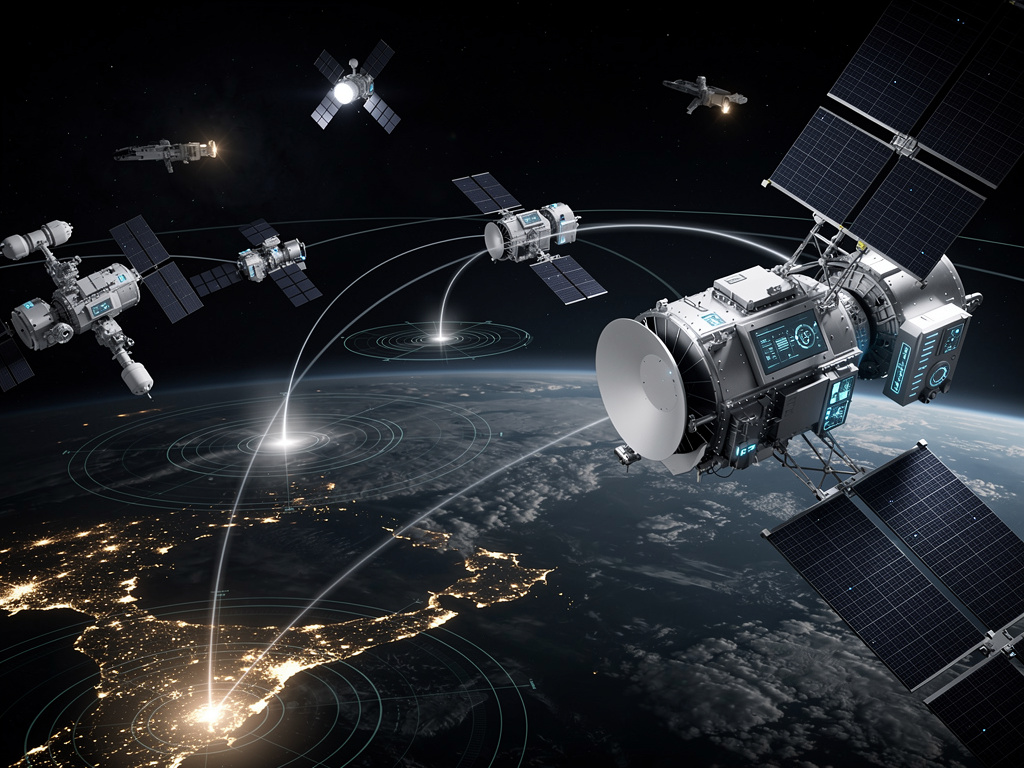
In a modest office in Colorado Springs, a company with fewer than 300 employees is racing to solve one of the most consequential national security problems of the decade: how to protect American satellites from destruction by Russian and Chinese weapons already orbiting overhead. True Anomaly, founded in 2022 by a former Air Force officer who once worked out of his garage, has emerged as one of the Pentagon’s most closely watched space defense contractors—a company that believes the United States has less than two years to field credible orbital defenses before adversaries gain an irreversible advantage.
The urgency is not theoretical. According to Business Insider, Russia and China have already placed weapons in orbit capable of targeting the satellites that underpin everything from GPS navigation to military communications to precision-guided munitions. True Anomaly’s CEO and co-founder, Even Rogers, a West Point graduate and former Air Force intelligence officer, has described the threat in blunt terms: America’s space infrastructure is vulnerable, and the window to address that vulnerability is closing fast.
A Founder Shaped by Wartime Intelligence
Rogers’ path to founding a space defense company was shaped by his years in military intelligence. After graduating from West Point, he served as an Air Force officer focused on space operations and intelligence, where he gained firsthand exposure to the growing counter-space capabilities of near-peer adversaries. That experience left him convinced that the traditional defense procurement model—with its years-long development cycles and cost-plus contracts—was fundamentally inadequate for the speed at which threats were evolving in orbit.
He founded True Anomaly in 2022, initially working from his garage before attracting venture capital funding that has since grown to more than $250 million. The company’s name itself is a term from orbital mechanics, referring to the angle that describes a satellite’s position along its orbit—a fitting label for a firm that sees itself as occupying an unconventional position in the defense industry. As reported by Business Insider, Rogers has framed the company’s mission around a specific deadline: the United States must have operational space defense capabilities by 2026, or risk ceding a strategic domain to its rivals.
The Threat Picture: Weapons Already in Orbit
The concern animating True Anomaly and its Pentagon backers is not speculative. Russia has conducted multiple tests of co-orbital anti-satellite systems, including a 2021 direct-ascent missile test that destroyed one of its own defunct satellites and generated thousands of pieces of debris. China, meanwhile, has been developing and testing a range of counter-space technologies, from ground-based lasers to inspector satellites capable of maneuvering close to adversary spacecraft. U.S. Space Command has publicly acknowledged that both nations have fielded or are fielding systems designed to deny, degrade, or destroy American space assets.
What makes the current moment particularly alarming to defense planners is the asymmetry of the threat. The United States military is more dependent on space-based systems than any other nation on Earth. GPS, satellite communications, missile warning, intelligence collection, and weather forecasting all rely on constellations of satellites that were designed during an era when space was considered a sanctuary. That assumption has been shattered. As Rogers told Business Insider, the U.S. has the most to lose in space and, paradoxically, has been among the slowest to field defenses there.
What True Anomaly Is Actually Building
True Anomaly’s product line centers on two main efforts: spacecraft designed for close-proximity operations and software platforms for space domain awareness. The company’s Jackal autonomous orbital vehicle is designed to rendezvous with and inspect other objects in space—a capability with obvious dual-use implications. While the company frames the Jackal as a defensive and situational awareness tool, the ability to maneuver close to another nation’s satellites is inherently a capability that could be used offensively, a fact that has not gone unnoticed by analysts.
On the software side, True Anomaly has developed Mosaic, a space domain awareness platform that uses sensor data and artificial intelligence to track objects in orbit and predict their behavior. The idea is to give military operators a real-time picture of what is happening in space, including the ability to detect when a foreign satellite is behaving anomalously—maneuvering toward a U.S. asset, for example, or releasing sub-satellites. This kind of space situational awareness has historically been the province of large government agencies like the 18th Space Defense Squadron, but True Anomaly argues that commercial technology can deliver faster updates and more granular analysis.
The Pentagon’s Appetite for Commercial Space Defense
True Anomaly’s rise coincides with a broader shift in how the Department of Defense procures space capabilities. The Space Force, established in 2019, has been increasingly willing to work with startups and commercial firms rather than relying exclusively on legacy prime contractors like Lockheed Martin, Northrop Grumman, and Boeing. The Space Development Agency, which is building a proliferated constellation of satellites in low Earth orbit, has awarded contracts to dozens of smaller companies. The rationale is straightforward: commercial firms can often deliver hardware faster and cheaper than traditional defense contractors, and the threat environment demands speed.
True Anomaly has secured contracts with the Air Force Research Laboratory and the Space Force, and it has participated in exercises and demonstrations designed to prove out its technology. The company launched its first Jackal vehicles into orbit in 2024, marking a significant milestone. According to Business Insider, the company plans to scale its operations significantly over the next 18 months, with the goal of having operational systems ready to contribute to national defense by 2026.
Skeptics and the Scale Problem
Not everyone is convinced that a startup can solve what is fundamentally a problem of national strategic posture. Critics point out that space defense requires not just hardware but doctrine, command-and-control infrastructure, international legal frameworks, and political will. Building a satellite that can maneuver near another satellite is one thing; integrating that capability into a coherent military strategy, with clear rules of engagement and escalation management protocols, is another matter entirely.
There are also questions about scale. True Anomaly may be able to build and launch a handful of Jackal vehicles, but defending the full constellation of American military and commercial satellites—numbering in the hundreds for military systems alone and thousands when commercial assets are included—would require a manufacturing and launch cadence that no startup has yet demonstrated. The company’s $250 million in funding, while impressive for a two-year-old firm, is a fraction of what legacy primes spend on a single major satellite program.
The Broader Commercial Space Defense Sector
True Anomaly is not operating in isolation. A growing cohort of companies is pursuing various aspects of space security. Slingshot Aerospace has built space domain awareness tools. Kayhan Space focuses on collision avoidance and space traffic management. Impulse Space and Atomos Space are developing orbital transfer vehicles that could have defense applications. The venture capital community has poured billions into space startups over the past five years, though much of that funding has gone to communications and Earth observation companies rather than defense-focused firms.
What distinguishes True Anomaly is its explicit and unapologetic focus on the military mission. While many space startups prefer to emphasize commercial applications and treat defense work as a secondary revenue stream, Rogers has built his company around the premise that space is a warfighting domain and that the private sector has a responsibility to help defend it. That positioning has attracted both funding and controversy, as some in the space community worry that the militarization of orbit will trigger an arms race that makes space less safe for everyone.
The 2026 Deadline and What Comes After
Rogers’ insistence on a 2026 deadline reflects a view shared by many in the national security establishment: that the next two years represent a critical window. China’s military modernization is accelerating, with the People’s Liberation Army Strategic Support Force expanding its space and cyber capabilities at a pace that has alarmed Pentagon planners. Russia, despite its economic constraints, continues to invest in asymmetric capabilities designed to offset American conventional superiority, and space weapons are among the most cost-effective tools in that portfolio.
If True Anomaly and companies like it can deliver on their promises, the result could be a more resilient and defensible American space architecture—one that does not rely solely on the assumption that adversaries will refrain from attacking satellites. If they cannot, the United States may find itself in a position where its most critical military systems are held at risk by adversaries who moved faster and invested more aggressively in the domain that increasingly determines the outcome of conflicts on Earth. The race, as Rogers has framed it, is not merely commercial. It is existential for American military superiority.


 WebProNews is an iEntry Publication