
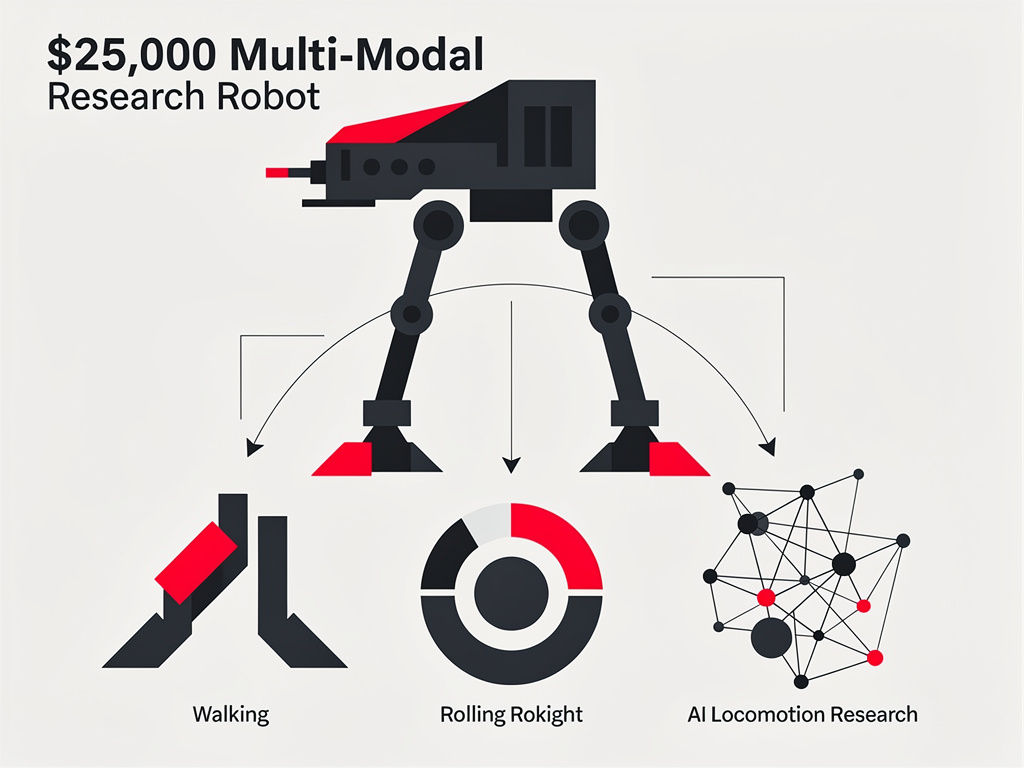
A two-legged robot struts across the show floor at CES, its narrow frame and pointed stance evoking Imperial walkers from the forests of Endor. CNET called it out first: LimX Dynamics’ Tron 1, priced at $25,000 for the educational edition, looks straight from Star Wars. But this isn’t Hollywood props. It’s a research platform pushing boundaries in bipedal locomotion.
LimX Dynamics, a Shenzhen-based firm founded in 2022 by professor Zhang Wei from the Southern University of Science and Technology, unveiled Tron 1 in October 2024. The robot measures just 845mm tall—about waist-high to an adult—and tips the scales at under 20kg. Aluminum alloy and industrial plastic form its lightweight body. A 12th-generation Intel Core i3 processor powers the onboard compute, with expansion ports for cameras, lidar, radar, or even robotic arms. Battery life hits over two hours per charge, swappable for longer runs.
What sets it apart? Modular foot-ends. Swap in point-feet for basic legged control. Flat soles mimic humanoid steps. Wheels unlock speeds up to 3m/s across terrain. One purchase gets three modes. Load capacity reaches 10kg, with peak joint torques of 60N·m and speeds of 15rad/s. Full Python SDK, ROS support, and Sim2Real deployment make it a dream for reinforcement learning experiments. LimX Dynamics official site lists the standard edition at $15,000 introductory, while the EDU version—packed with open-source tools—commands the $25,000 tag spotted at CES.
Videos show Tron 1’s grit. It bounds over obstacles in point-foot mode, climbs stairs on soles, rolls swiftly on wheels. Abuse tests from its P1 prototype predecessor had it shrugging off branches in woodlands, recovering balance mid-stride. Recent demos pair it with Yimoos Technology’s UWB for precise following, hauling 10kg payloads over rough ground without tipping. New Atlas noted its evolution from that rugged P1 into a commercial unit, ideal for AI-driven mobility research.
Industry insiders see bigger plays. Tron 1 bridges quadrupeds like Boston Dynamics’ Spot and full humanoids. LimX already fields the CL-1 humanoid for heavy lifting and the wheeled-legged W1 quadruped. At CES 2026, Tron 1 shared booth space with their Oli humanoid, which dances fluidly and navigates debris fields using dual depth cameras and lidar. RobotShop’s CES coverage captured the duo in action—Oli stretching yoga-style, Tron 1 switching gaits seamlessly.
China’s robotics surge fuels this. LimX raised $200 million in Series B last year, backed by Alibaba and JD.com. Production scales for humanoids like the 165cm, 31-DoF Oli and its feminized sibling Luna, which graced L’Oréal’s 2026 hair show with graceful poise. Tron 1 fits as a lower-cost entry: researchers tweak gait algorithms without million-dollar price tags. Unitree’s G1 humanoid starts cheaper at $16,000, but lacks the multi-modal twist.
Real-world tests prove resilience. One clip has Tron 1 riding a flatbed truck at 70km/h, balancing unassisted. Street deployments turn it into tour guides or delivery bots, as CNET’s hands-on revealed preprogrammed moves and remote control out of the box. Program it for street photography; it follows crowds autonomously.
And the Star Wars vibe? Inevitable. GeekTyrant mashed it with Cylons too. Engineers didn’t chase aesthetics—form follows function in narrow biped designs for stability. Yet it draws eyes, sparking talks on legged robots’ future.
Challenges remain. Battery swaps interrupt ops. Wheeled mode shines on flats, but true all-terrain autonomy demands better perception stacks. LimX pushes updates: TRON 2 rumors swirl with enhanced AI. For now, Tron 1 ships to labs worldwide, empowering coders to teach it new tricks.
Buyers include universities and firms testing RL policies. One German outfit skinned it as a robo-dinosaur for street patrols. LimX’s news page showcases guide robots built atop it. Pricey? Yes. But at $25,000, it’s accessible compared to custom rigs.
So. A mini AT-ST patrols labs. Not blasting Ewoks. Training tomorrow’s machines.


 WebProNews is an iEntry Publication